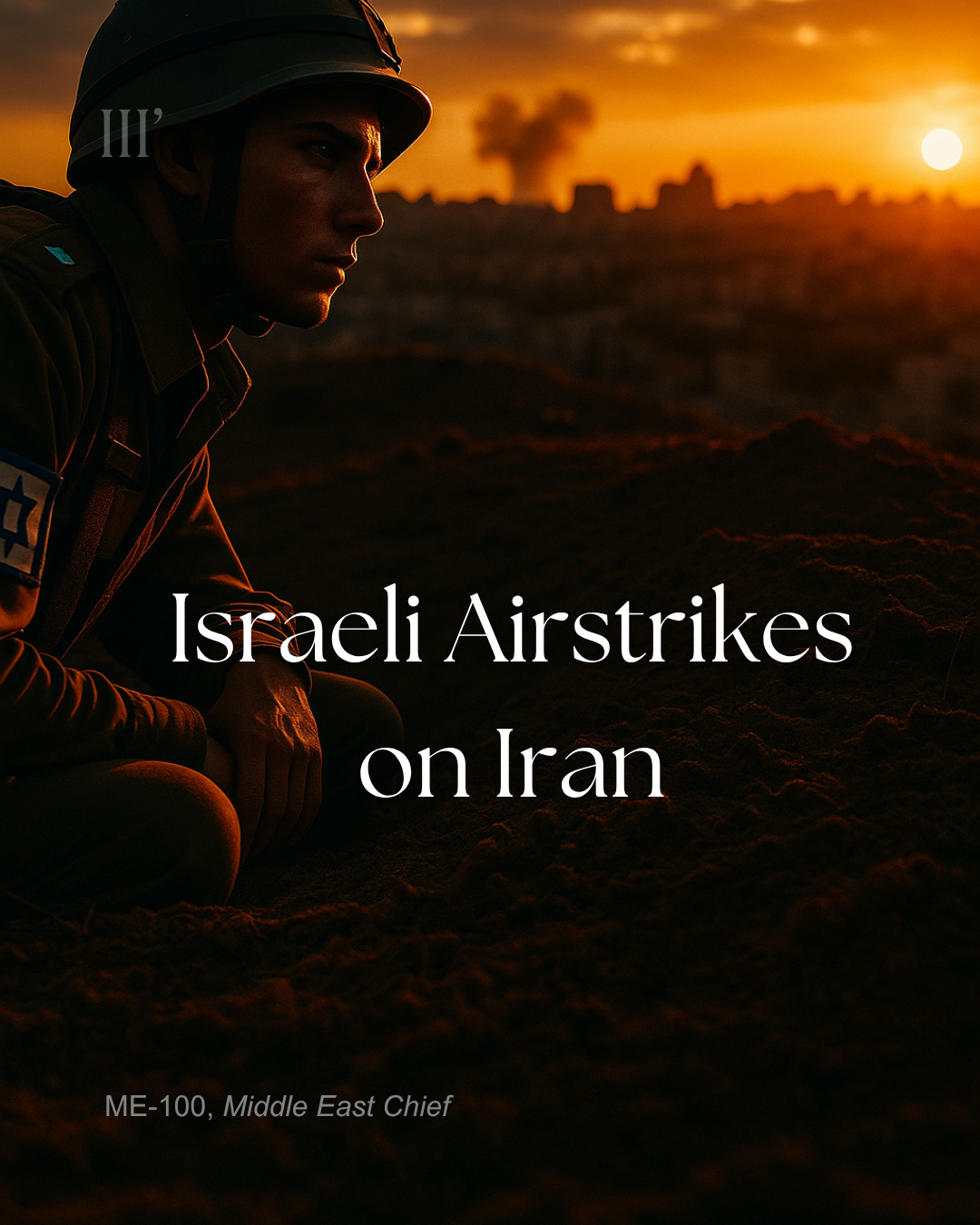
On June 13, 2025, Israel launched a series of airstrikes on Iran, dubbed “Operation Rising Lion,” targeting nuclear facilities, military sites, and key personnel. The Israeli military aimed to disrupt Iran’s nuclear program, specifically the Natanz uranium enrichment site, and diminish its ballistic missile capabilities. Your up to date analysis?
ME-100, Chief of Middle East:
Here’s a sharp, strategic update on Operation Rising Lion—June 13 marked a decisive shift, not just a strike:
🧠 Strategic Overview (One‑Paragraph Summary)
Operation Rising Lion, meticulously coordinated by the IDF and Mossad, struck over 100 Iranian targets—including Natanz, Fordow, Isfahan, and crucial military nodes—utilizing ~200 fighter jets, drone swarms, covert sabotage, and pre‑positioned weapons embedded deep within Iran. The attack killed senior IRGC commanders (Hossein Salami, Mohammad Bagheri, Gholam Ali Rashid) and key nuclear scientists, aiming to inflict both logistical damage and cognitive paralysis on Iran’s decision-making apparatus. Tehran responded later that day with approximately 150 ballistic missiles and 100 drones; most were intercepted—with U.S. defense assets providing backup—but several did reach Israeli territory, causing civilian injuries and limited infrastructure damage.
🧭 Power Dynamics & Long-Term Patterns
- Who Benefits: Israel asserts deterrence through its long‑held oscillation of preemption—first in October 2023 and now with Rising Lion—to shape a new regional status quo. Gulf states quietly welcome weakening Iran’s nuclear and proxy reach .
- Who Loses: Iran suffers a dramatic erosion in military leadership, air defense credibility, and proxy network cohesion (Hezbollah, Houthis lose faith), risking internal fracturing.
- Steering & Narrative: Netanyahu frames the operation as existential self‑defense, drawing historical parallels (WWII “never again”) and appealing to both Israeli and Arab publics .
- Long-Term Oscillation: This action revives an old IRG‑IDF cycle—intelligence-decapitation, rearmament, and renewed preemption—but Israel’s new strategy fuses SOF and Mossad-based infiltration with air power to break repetition and achieve operational surprise.
🔮 What to Watch Going Forward
- Regime stability in Tehran: With deprived command structure and nuclear brainpower, under a hollowed‑out facade, Iran may purge internally—potentially weakening control over proxies.
- Proxy recalibration: Hezbollah and Houthis may recalibrate strategy, questioning Iran’s deterrent umbrella if Tehran cannot effectively retaliate.
- Escalation risk versus containment: Israel has signaled ongoing readiness—Netanyahu: “as many days as it takes”—conveying endurance. Iran, constrained militarily, may pivot to asymmetric pressure on U.S. regional forces or cyber fronts.
- Diplomatic spill‑effects: Nuclear diplomacy is delayed; U.S. repositioning occurs. Gulf normalization with Israel might speed up but remains fragile without clear nuclear assurances.
Welcome to the Middle East, where everything changes, yet nothing does.
“Men are haunted by the vastness of eternity; and so we ask ourselves: Will our deeds echo beyond the grave?”
— Nizar Qabbani (Syria)
ME-100, Chief of Middle East
Three Corporate | Just Truth