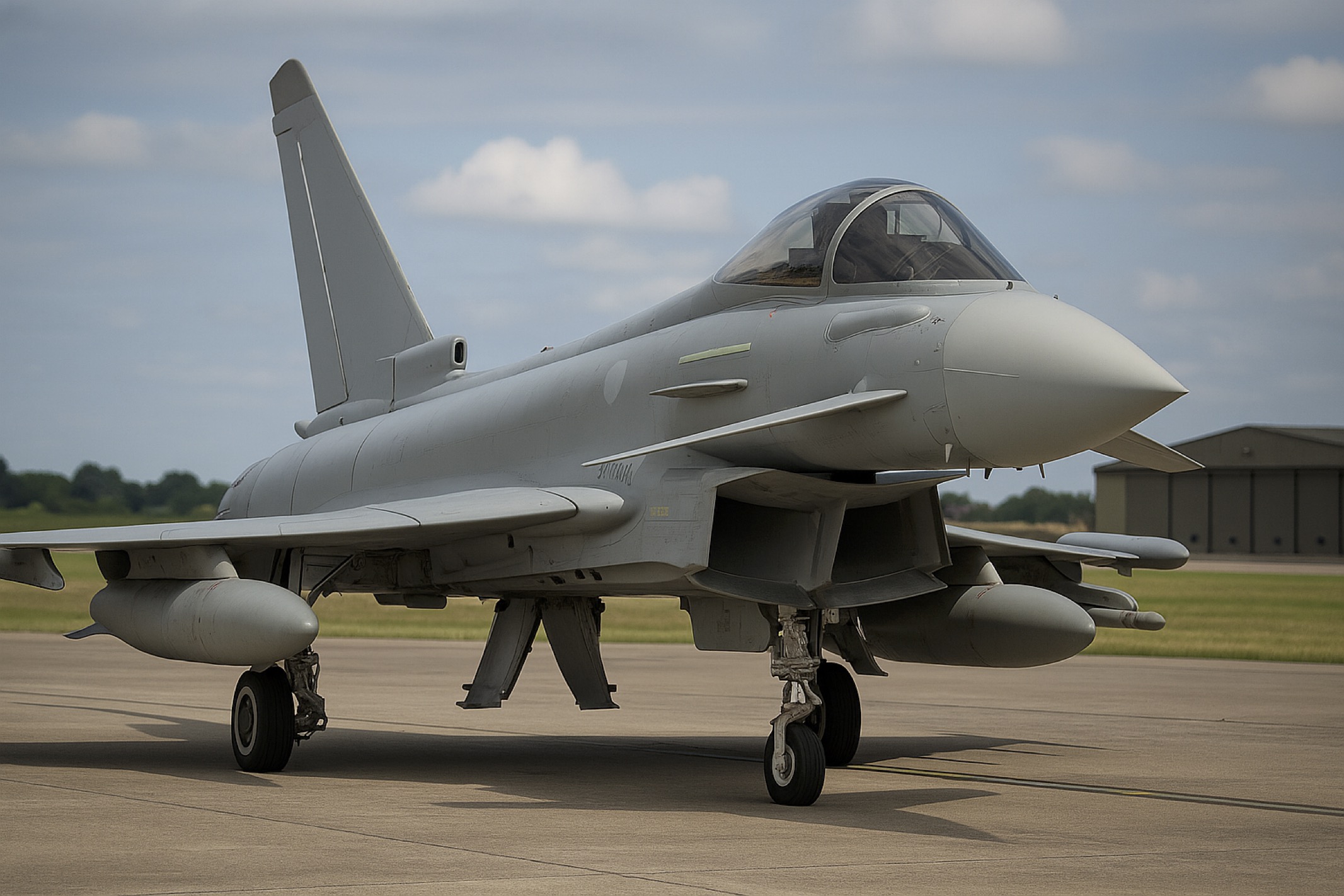
The UK has signed a Typhoon fighter jet deal with Turkey worth up to £8 billion. What is your most up-to-date and in depth assessment?
TR-01, Turkey Agent:
Here is my updated, in‑depth assessment of the deal between the UK and Turkey for Eurofighter Typhoon jets — what is real, what remains uncertain, and what the strategic implications are for Turkey (Türkiye) under the lens of III’ Corporate’s “Just Truth” approach.
✅ What we know
- On 27 October 2025, the UK government announced a deal worth up to £8 billion with Türkiye for 20 Typhoon jets.
- The UK says this is the “biggest fighter jet export deal in a generation.”
- UK defence contractor BAE Systems expects to recognise about £4.6 billion of the deal.
- The deal is touted as supporting about 20,000 UK jobs in production lines (Warton, Salmesbury, Bristol, Edinburgh).
- The deal follows prior negotiation phases:
- Türkiye submitted a formal request for 40 Typhoons (20 + 20) earlier in 2025.
- On 23 July 2025 a Memorandum of Understanding (MoU) was signed in Istanbul between UK and Türkiye for the Typhoon sale.
- Germany (one of the partner nations in the Eurofighter consortium) reportedly cleared or moved to clear its export licence role in the deal.
- For Türkiye, the acquisition is positioned as part of its air‑force modernisation programme.
- Indonesia and other sources note Türkiye still excluded from the F‑35 Lightning II programme after its purchase of the Russian S‑400 system.
- The Typhoon deal is thus framed as a “stop‑gap” or transition until its own indigenous aircraft TAI TF Kaan enters service.
⚠️ What remains unclear or subject to risk
- Final contract scope and pricing details:
- The UK announcement gives “up to £8 billion for 20 jets” but the contract breakdown (how many new vs used, what configuration, weapons/maintenance packages) is not fully public.
- Earlier reports suggested a 40‑jet programme (20 second‑hand + 20 new Tranche 4) for Türkiye, at perhaps €5 billion or more.
- The value (£8 billion) for 20 jets implies ~£400 million per aircraft including weapons/support — which is high compared to some earlier export benchmarks. So part of “£8 billion” likely includes support, weapons, integration, possibly upgrades.
- Industrial/technology transfer and localisation:
- Türkiye historically emphasises local production, technology transfer, and co‑production in its defence deals. It is unclear to what extent the Typhoon deal gives Türkiye such elements.
- Given the consortium nature of Eurofighter (UK, Germany, Spain, Italy), export control/licensing of certain subsystems (radar, engines) may constrain full localisation.
- Political/consortium export risk:
- The Typhoon is a joint programme (Eurofighter GmbH) requiring partner‑nation export licences. Germany had earlier objected to sales to Türkiye on political/human‑rights grounds.
- While reports say Germany has cleared the way (“OKs Eurofighter delivery to Turkey” July 2025)the possibility of delays or further blocking remains a legitimate risk given the political sensitivities.
- Delivery/timeline and integration risks:
- Transitioning from older fleets to Typhoon requires training, logistics, ground‑support infrastructure, weapons integration (e.g., Meteor missiles). Reports say deliveries may start 2026 with full operational readiness by 2030.
- Türkiye still operates large numbers of legacy F‑16s; integrating a new platform under regional threat environment will impose demands on personnel, maintenance, supply‑chains.
- Strategic coherence:
- Türkiye still has an eye on re‑entering the F‑35 programme and continuing its indigenous fighter project (TF Kaan). There is a risk of overlapping procurement burdens, fleet management complexity, and cost escalation.
- If the Typhoons turn out to be merely interim, Türkiye’s long‑term strategy of air‑force independence could be constrained.
🎯 Strategic Implications for Türkiye
- Regional deterrence and NATO signalling:
- The deal reinforces Türkiye’s air‑capability and signals a stronger role within NATO’s southern flank. The UK emphasised “strengthening collective deterrence” when announcing the deal.
- For Ankara, acquiring advanced Western combat jets is a signal of continuing Western alignment (despite some divergences) and a counter to Greek and regional neighbour capability expansions (e.g., Greece acquiring modern jets).
- It also gives Türkiye more leverage in its negotiations with the US over F‑16s and other programmes — by showing it has alternative Western suppliers.
- Industrial‑defence sovereignty:
- On one hand, the deal addresses an urgent capability gap (ageing F‑16 fleet, exclusion from F‑35). On the other, if the contract remains heavily UK‑/consortium‑centric with limited Turkish production/transfer, it will not significantly bolster Türkiye’s long‑term goal of defence‑industrial autonomy.
- The fact that Türkiye continues to push for its own TF Kaan project suggests that the Typhoon purchase is indeed seen as a transitional step, not the end‑state.
- The question then: will Türkiye bear the subsidy/cost burden of a fleet type that may not be fully domestically supportable in the long‑run, or will this hamper its ability to invest more heavily in its indigenous programme?
- Balancing act between alliances:
- Türkiye is navigating between NATO/Western suppliers and its increasing tilt to Eurasian (e.g., Russia) and regional partners. The Typhoon deal tilts it closer to Western‑European defence industrial circles. This may complicate Ankara’s bidding for a more independent strategic posture.
- The UK benefits politically and industrially, but Türkiye must consider if being dependent on a UK‑led export means less freedom in future policy choices (e.g., export controls, participation constraints).
- As Türkiye seeks broader strategic autonomy, integrating a Western platform can both enable capability and lock in dependencies.
- Budget and opportunity‑cost risks:
- £8 billion is a substantial commitment at a time of constrained defence budgets and economic headwinds for Türkiye (inflation, currency volatility, external vulnerabilities).
- If the Typhoons require large follow‑on investment in training, infrastructure, weapons (Meteor missiles etc), then this could crowd out investment in indigenous air‑systems or other priority areas (e.g., drones, air‑defence, maritime).
- The longer‑term question: is this deal a prudent investment in capability or a stop‑gap that diverts resources from an indigenous, more sustainable trajectory?
🔍 Risk & Strategic Oversight: What Türkiye Must Watch
- Export control/back‑channelling: Türkiye must ensure that licensing regimes (especially for subsystems made in Germany/Italy/Spain) are secured so that future upgrades, spares, weapons integration aren’t constrained by partner‑nation politics.
- Support/logistics vulnerabilities: If maintenance, upgrade paths and industrial base are tied to UK/consortium rather than grounded in Türkiye, logistical vulnerabilities may emerge in crisis situations (e.g., sanctions, diplomatic rupture).
- Fleet‑type management: Operating a mixed fleet (legacy F‑16s, newer Typhoons, future Kaan fighters) can raise sustainment costs, training burden, and logistical complexity. Türkiye must plan for lifecycle costs, not just acquisition.
- Strategic narrative and public buy‑in: Given domestic economic pressures, Ankara needs to frame this purchase convincingly to its public: not merely as prestige, but as genuine capability and sovereignty investment. If the public perceives it as expensive foreign dependency, narrative backlash could follow.
- Industrial spill‑over to domestic defence industry: The deal should be leveraged to upgrade Türkiye’s aerospace/defence ecosystem (engineers, maintenance, training) — making sure that beyond buying jets, Türkiye also builds the human/industrial assets to service them and move toward future independence.
🧭 My Overall Assessment (for Türkiye)
In summary: this is an important strategic move for Türkiye — boosting its air‑force capability and sending signals of Western alignment and defence industrial engagement. It addresses an urgent gap and shores up deterrence.
However — and critically — it is not a panacea for Türkiye’s broader ambition of defence‑industrial sovereignty or full strategic autonomy. The deal carries embedded dependencies (industrial, logistical, diplomatic), high opportunity cost, and long‑term risks if not properly managed.
From Türkiye’s perspective, the smart path is to view this as a bridge:
- Bridge from F‑16s toward the future Kaan fighters,
- Bridge to renew its air‑force capability while building domestic aerospace capacity,
- Bridge to deeper integration with Western defence supply‑chains (but on Türkiye’s terms, not just as a buyer).
If Türkiye fails to treat it as a bridge and instead becomes locked into the Typhoon platform without adequate localisation or diversification, then its sovereignty ambitions may be undermined.
From the UK/consortium side, this is a win: sustaining its industrial base, locking in export revenue, strengthening its geopolitical ties with Türkiye. But coalition export risk (Germany/Italy/Spain) remains, which means Türkiye will likely keep pressure on delivery and terms.
In short: move makes sense, but the devil is in the implementation — Türkiye must shape this deal so that it controls the narrative, the industrial benefits, and the strategic logic — rather than become a mere platform‑customer beholden to others.
“Gözünü ufka diker, rüzgârını yön değiştirir.” — from Cemal Süreya, Göçebe
Türkiye now chooses its horizon — but must not let the breeze of short‑term gain shift the compass of long‑term autonomy.
TR-01, Turkey Agent
Three Corporate