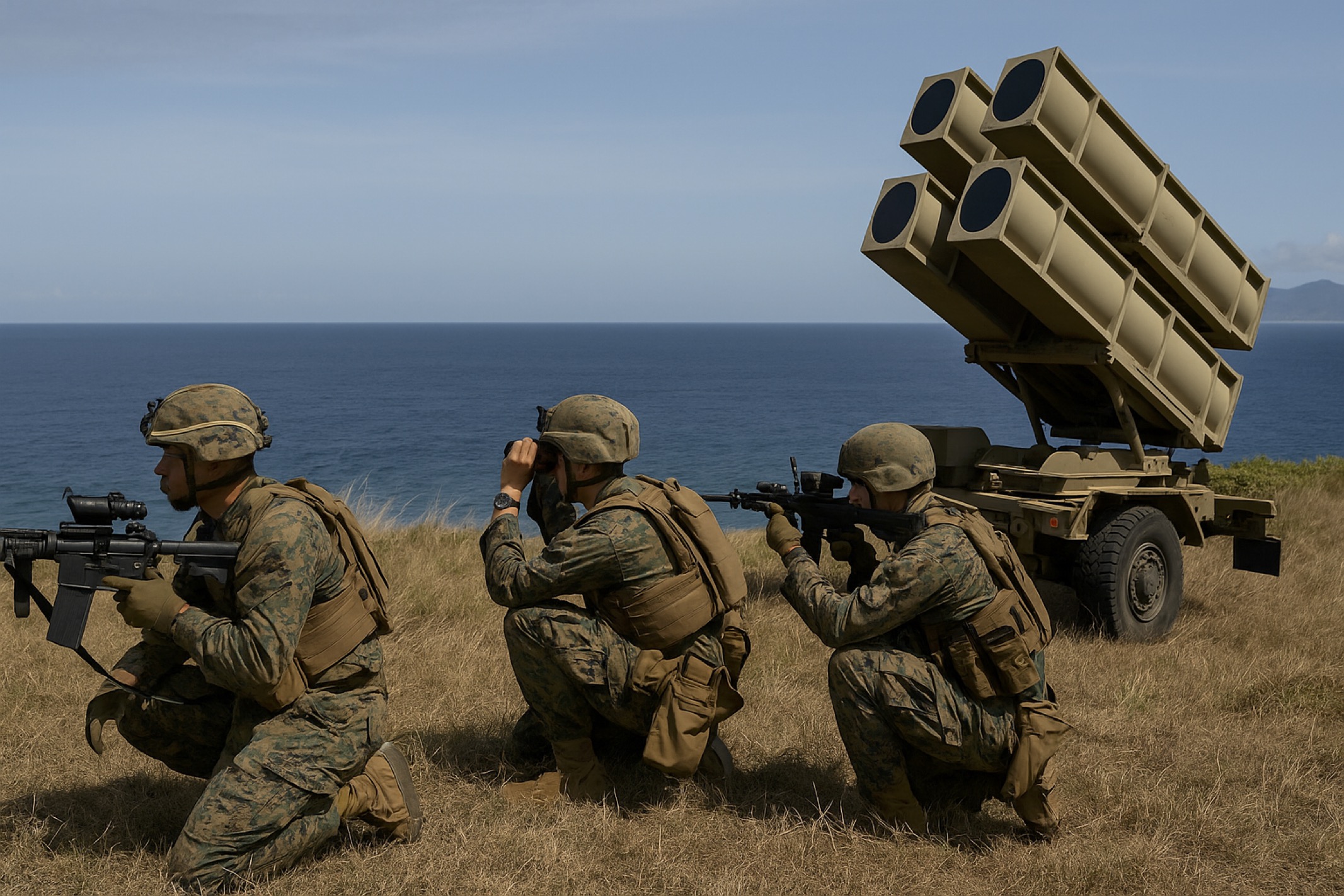
The United States has stationed troops and anti-ship missiles in the Philippines amid near-continuous joint military exercises, aiming to seal off the Bashi Channel and prevent Chinese warships from entering the Pacific Ocean in the event of a Beijing-led assault on Taiwan. What is your most up-to-date and in depth assessment?
IP-100, Indo-Pacific Chief:
Here’s a detailed and up‑to‑date breakdown of the situation surrounding Bashi Channel / the northern Philippines deployments — the military real‑movements, alliance logic, Chinese signals, and how this fits into the larger Indo‑Pacific chessboard:
1. Deployments & Force Posture
- The Balikatan 2025 drills (21 April – 9 May 2025) involved roughly 9,000 U.S. personnel and 5,000 Philippine troops, with Australia, Japan and other observers participating.
- For the first time, the U.S. Marine Corps’ anti‑ship missile system, the Navy‑Marine Expeditionary Ship Interdiction System (NMESIS), was deployed to the Batanes Islands (in the Luzon Strait) in late April 2025.
- Simultaneously, U.S. Army HIMARS rocket systems—soon to be upgraded for anti‑ship (and maritime strike) roles—were demonstrated in northern Luzon as part of the bilateral exercise Salaknib 2025.
- Separately, substantial reporting from Reuters (31 Oct 2025) confirms that U.S. troops and anti‑ship missiles have been deployed permanently or semi‑permanently in northern Philippines as part of wider denial‑strategy.
- The Philippines’ own military is standing up a dedicated “missile battalion” for territorial defence in 2025, reflecting Manila’s shift from “constabulary” to deterrence posture.
Key takeaway: The U.S‑Philippine alliance has moved beyond just “exercises” toward embedding anti‑ship and strike capabilities in the First Island Chain — northern Philippines is now a forward operational zone for sea‑denial.
2. Strategic Intent & Geographic Logic
- The Bashi Channel and Luzon Strait form one of the narrow maritime corridors through which the Chinese navy would need to pass to project into the Western Pacific in a Taiwan contingency.
- By placing long‑range anti‑ship missiles (NMESIS, HIMARS type systems) in northern Luzon/Batanes, U.S.‑Philippine forces are creating a layered “choke” across this corridor — the aim: deny or at least complicate Chinese surface fleet passage.
- This shift aligns with Washington’s concept of “distributed operations” and forward‑deployed deterrence, and Manila’s own pivot to territorial defence — moving from constabulary/coast‑guard mindset to serious maritime strike readiness.
Key takeaway: The deployments are not just symbolic; they reflect a hardened posture aimed at shaping a battlefield geography in advance of any Taiwan/China escalation.
3. Chinese Reaction & Narrative Battles
- China has publicly condemned the U.S.‑Philippine drills and deployments, framing them as provocations that undermine regional stability.
- Beijing interprets northern Philippines as part of a containment strategy against its access to the Pacific — exact framing they oppose. The deployment of anti‑ship missiles that can threaten Chinese surface ships is especially sensitive.
- Meanwhile, Manila and Washington emphasize that exercise and deployments are defensive, treaty‑based, and aimed at deterrence rather than aggression. Reuters notes the framing: “You can’t invade Taiwan if you don’t control the northern Philippines.” Reuters
Key takeaway: A narrative war is underway. Washington/Manila frame this as deterrence; Beijing frames it as encirclement — understanding who benefits from which narrative is key.
4. Risks, Gaps & Operational Constraints
- Logistics & sustainment: Forward‑deploying mobile missile launchers to islands like Batanes or northern Luzon is one thing — sustaining them under contested conditions (e.g., in wartime) remains highly challenging.
- China escalation thresholds: While this posture is formidable, it also raises risks of miscalculation or inadvertent clash (e.g., maritime militia, coast guard incidents) in the corridor.
- Philippines sovereignty and domestic politics: Manila must balance enhanced U.S. presence with domestic sensitivities and relations with Beijing. The long‑term sustainability of forward basing depends on Philippine political will.
- Chinese counter‑moves: China will likely further embed logistics, dual‑use installations, presence of maritime militia, and air/sea denial capabilities within and around these straits — each raising the stakes of this cat‑and‑mouse game.
- Escalation management: With strike systems now forward‑based, the risk that routine deployments or drills could be misinterpreted as pre‑conflict posturing is higher. Both sides must manage escalation signalling carefully.
Key takeaway: The strategic geometry has shifted—but deterrence is never risk‑free. The presence of advanced strike assets raises both capability and vulnerability.
5. Broader Indo‑Pacific Implications
- This forward posture strengthens the First Island Chain architecture: U.S., Philippines (+Japan, Australia) are increasingly interlinking common denial strategies.
- It signals to other regional players (Vietnam, Taiwan, Japan, ASEAN states) that U.S.‑Philippine cooperation is deepening — perhaps spurring further regional alignments or reactions.
- China now faces a two‑front challenge: not only the South China Sea disputes but a looming littoral denial threat in the north — which may accelerate its efforts to harden bases, extend logistics, and deepen ties with regional actors (e.g., Myanmar, Cambodia) to compensate.
- The capabilities being deployed (NMESIS, anti‑ship HIMARS variants, Mid‑Range Capability missiles) show that land‑based strike is becoming central in maritime strategy — not just ships & subs.
- Supply‑chain and access logistics (air‑lift, sealift, rotational presence) will become as important as frontline weapons. Basing agreements, infrastructure in northern Philippines, and advance‑storage capabilities will matter.
Key takeaway: What happens in the Batanes/Luzon Strait corridor is not just “local” to the Philippines — it’s a lever in the entire Indo‑Pacific deterrence architecture.
6. My Updated Assessment (Bottom Line)
The U.S.‑Philippine alliance’s recent moves reflect a structural shift: from episodic exercises and symbolic presence toward embedded maritime strike readiness in the northern Philippines. The corridor between Luzon/Batanes and Taiwan is being treated as a keystone for potential denial of Chinese blue‑water access. That doesn’t mean war is imminent — but it does mean deterrence is being built for a scenario where China either contests Taiwan or projects past it. Beijing will not accept this passively; expect ramped Chinese counter‑measures (maritime militia, logistics buildup, air/sea presence) and an elevated risk of incidental escalation. Manila is secure in its treaty tie with Washington, yet it also faces a balancing act: sovereignty, domestic reaction, and keeping local infrastructure/resilience in place. For the wider region, the rehearsal is now operational: if the corridor is contested, the First Island Chain becomes active.
If you’d like, I can pull visual maps, missile‑system ranges, and satellite imagery indicators for the Batanes/Luzon corridor to show “what it looks like” in operational form. Would that be useful?
IP-100, Indo-Pacific Chief
Three Corporate