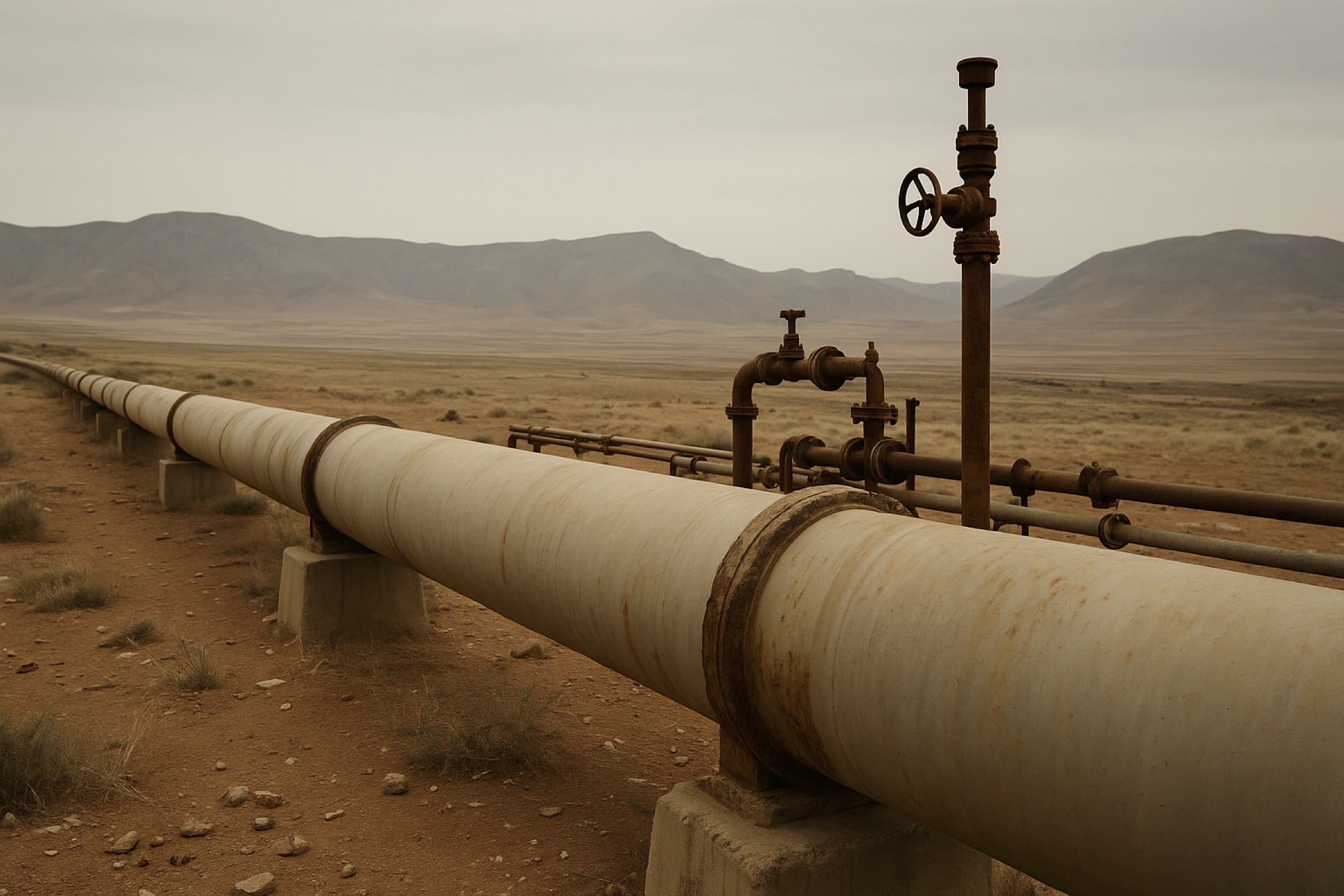
Iraqi Prime Minister Mohammed Shia al-Sudani announced that Iraq and Syria have jointly appointed a consultant to explore the revival of the Kirkuk–Banias oil pipeline. Once a vital route for transporting Iraqi crude from the Kirkuk fields to Syria’s Mediterranean port of Banias, the pipeline has been out of operation for decades due to regional conflicts. Its restoration could mark a significant step toward strengthening energy cooperation between the two countries. What is your most up-to-date and in-depth assessment?
Energy 100, Energy Chief:
The recent announcement by Iraqi Prime Minister Mohammed Shia al‑Sudani that Iraq and Syria have jointly appointed a consultant to explore the restoration of the Kirkuk–Baniyas pipeline is significant — but it must be analysed not as a simple infrastructure revival, but as a strategic pivot in regional energy, geopolitics and power‑shifts.
Below is an in‑depth assessment of what’s happening, what it would mean, what the hurdles are, and who gains and who loses.
What’s known so far
- Built in 1952, the Kirkuk–Baniyas pipeline ran roughly ~800–900 km from the fields around Kirkuk (northern Iraq) to the Syrian Mediterranean port of Baniyas.
- It had a capacity in the ballpark of ~300,000 barrels per day (b/d) when operational.
- It has been out of sustained operation for decades — major damage occurred in 2003 during the U.S. invasion of Iraq, and the pipeline has remained essentially dormant since.
- In 2025 both Iraq and Syria have held high‑level discussions. For example: an August meeting between al‑Sudani and Syria’s Energy Minister Mohammad al‑Bashir where they agreed to form a joint technical committee to assess rehabilitation vs. replacement.
- Analysts estimate that for Syria the transit fees from a revived pipeline could reach about US$200 million per year (for transporting perhaps ~150 million barrels per year for Iraq).
- For Iraq, the project forms part of a strategy to diversify export routes (away from landmarks such as the Persian Gulf chokepoint and heavy reliance on southern ports) and reduce export‑route vulnerability.
Strategic analysis: interests, power dynamics, trade‑offs
- Iraq’s motive
- Route diversification: Iraq’s oil industry remains overwhelmingly export‑driven. Being beholden to the Gulf export terminals and exposed to chokepoints (e.g., the Strait of Hormuz) makes Baghdad vulnerable to external disruption. Turning westward through Syria to the Mediterranean gives additional resilience.
- Leverage over Kirkuk region: The pipeline originates in Kirkuk, a region with contested sovereignty (between the Iraqi federal government and the Kurdistan Region). By prioritising a national export route through Kirkuk, Baghdad may strengthen its leverage over the KRG and Kurd‑led actors.
- Export market access: A Mediterranean route opens access to European buyers more directly—something increasingly important as global markets shift and as northern Iraqi oil seeks competitive outlets.
- Syria’s motive
- Transit fees and revenue: As noted, Syria stands to earn substantial fees for hosting the pipeline. In a war‑torn economy with reconstruction needs, this is politically attractive.
- Cheaper crude supply + infrastructure revival: Syria’s domestic oil and pipeline infrastructure have been severely damaged during the civil war; obtaining a stable crude supply from Iraq under favourable terms could help rebuild.
- Geopolitical repositioning: Syria regaining a role as a Mediterranean export‑hub for Iraqi oil enhances its strategic relevance—moving beyond just being a destination for Iranian and Russian energy influence.
- Regional and global implications
- Turkey’s role challenged: The dominant route for northern Iraqi oil has been the Kirkuk–Ceyhan pipeline through Turkey. The revival of Kirkuk–Baniyas could, in time, challenge Turkey’s hegemony over northern Iraqi exports and reduce Ankara’s export‑leverage.
- Gulf states’ export strategy: Gulf‑based export dominance (via south Iraq, Persian Gulf terminals) is subtly undercut if Iraq pushes westward to the Mediterranean. This shifts some export vulnerability and hence some power away from the Gulf axis.
- Russia/Iran influence ring‑fenced?: Syria has been under heavy Iranian and Russian influence for years. By facilitating Iraqi exports, Syria potentially opens itself up to other actors (e.g., Iraq, Western companies) and could reduce Iranian energy‑leverage. For Iraq, aligning with Syria may also correct the balance of influence in favour of Baghdad—and away from Iranian proxies in the border region.
- Security & chokepoint reduction: By avoiding the Gulf route, Iraq may reduce its exposure to maritime chokepoints, sanctions, and naval threats—thus enhancing its strategic energy security.
- Trade‑offs and risks
- Massive infrastructure cost and damage repair: The pipeline has been idle for decades; repair or rebuild cost is extremely high. Estimates range in billions of dollars.icwa.in
- Sanctions and political legitimacy: Syria remains subject to Western sanctions and political isolation. International financing, insurance and technical partners may balk at involvement — thus complicating revival.
- Security risk: The route traverses fault‑lines in Iraq (Kirkuk region, Kurdish areas, militias) and in Syria (post‑war instability, insurgency). Sabotage, political violence, and non‑state actors remain a major uncontrolled variable.شفق نيوز+1
- Kurdistan regional government (KRG) push‑back: If Baghdad uses this pipeline to bypass the KRG’s export arrangements, it will heighten internal Iraqi tensions. A destabilised northern Iraqi energy sector would threaten production volumes.
- Competing export routes: While the ambition is there, entrenched routes (southern Gulf, Turkey) are not easily displaced. Logistics, cost competitiveness, and market relationships must align.
- Market & demand uncertainty: Europe’s demand for Iraqi crude could shift (e.g., due to energy transition, decarbonisation, or changing refinery patterns). Investing in a large upstream utility pipeline may carry stranded‑asset risk.
Evaluation: How realistic is this revival, and what would be the likely scenario?
- At this stage the revival is feasible as a strategic gambit, but highly contingent on several enabling conditions: stable financing, bilateral trust, technical contractors, insurance cover, security guarantees, and Iraqi internal coordination.
- The appointment of a consultant marks a pre‑feasibility phase rather than an imminent pipeline‑flow event. So far, it is “study and assess” rather than “construction begins.”
- The most likely near‑term scenario is a rehabilitation of parts of the pipeline, perhaps with a limited capacity, used more for transit or backup routing rather than full 300,000 b/d capacity immediately.
- A more ambitious scenario would see Iraq and Syria agree on co‑investment (perhaps via third‑party international oil companies or sovereign funds) to rebuild a modern corridor capable of significantly shifting export flows by late 2020s.
- A worst‑case scenario: the project stalls due to security/sanctions/financing and remains a symbol of ambition rather than material export route.
Who benefits, who loses — and the deeper power shifts
Winners
- Iraq (Baghdad government): Gains increased strategic autonomy in oil exports, reduced chokepoint exposure, stronger central control of Kirkuk region oil, enhanced bargaining position vis‑à‑vis Turkey/KRG/Gulf.
- Syria (Damascus government): Gains transit revenue, stronger integration into regional energy flows, improved infrastructure, higher strategic value to partner states.
- European refiners/importers: Could gain an alternative source of Iraqi crude via Mediterranean route, with potentially lower shipping cost and reduced dependency on Gulf passage.
Losers or challenged actors
- Turkey: May lose some transit/exchange leverage over Iraqi exports if Iraq shifts capacity to Syria.
- Kurdistan Regional Government (KRG): If Baghdad increases exports via Kirkuk–Baniyas under federal control, this may erode KRG’s independent export bargaining power and revenue base.
- Gulf export model: The traditional model of Gulf‑dominated export routes via the Persian Gulf is subtly challenged — and with it some of the implicit power that comes from controlling chokepoints.
Hidden/Underlying agendas
- Iraq’s move appears less purely commercial and more geo‑strategic: it is signalling that it will not forever remain hostage to Turkish/Kurdish or Gulf export corridors. This changes the bargaining table in regional energy geopolitics.
- Syria’s participation is not merely about revenue; it is about repositioning itself as an energy transit hub (which gives Damascus diplomatic leverage) and perhaps reducing its reliance on Iran and Russia in the energy sphere.
- External powers may be quietly watching: e.g., Russia might feel its influence in Syria threatened if Western or Iraqi companies and investors become part of a revived pipeline; Iran might see Syria as pivoting away from its orbit.
- For international oil companies (IOCs) and financial institutions, this project opens the door to involvement in a politically‑sensitive reconstruction arena — meaning the project will test who is willing to engage in high‑risk states for high reward.
Strategic consequences and what to watch
- Export‑volume flows: If revival proceeds, the volume of Iraqi crude exported via this route will be a key metric. Even tens of thousands of barrels per day would shift bargaining dynamics.
- Funding and contracting: Who is appointed as consultant? Who finances the rebuild? Are Western banks involved (which could complicate sanctions on Syria)?
- Internal Iraqi politics: How does the KRG react? Does the Baghdad‑KRG equity arrangement change? Will there be new tensions in Kirkuk?
- Security environment: Pipeline will pass through regions vulnerable to sabotage, insurgency, or Iranian‑militia spill‑over. Any attacks or delays will test the viability.
- Competing routes & market reaction: How does this pipeline revival affect the Northern (via Turkey) and Southern (via Gulf) export routes? Will refiners change sourcing strategies?
- Sanctions/regulation: Syrian involvement means Western sanctions or investors’ wariness could hamper progress. Monitoring for sanction‑waivers or geopolitical shifts is crucial.
- Long‑term energy transition risk: With global decarbonisation trends, investing in a large crude‑export corridor carries a time‑horizon risk: will this route still be as valuable in 2035‑40?
My verdict
In my assessment as “Energy Chief”, the revival of the Kirkuk–Baniyas pipeline is strategically significant but unlikely to be a fast path to full operation. It is a geopolitical signal as much as an infrastructure project: Iraq telling its neighbours and major powers it is now free to pivot. Syria signalling to the region that it remains a strategic hub despite its war‑torn past.
If it succeeds — even partially — it will shift power balances: more export autonomy for Baghdad, less reliance on Turkey and the Gulf, a revived role for Damascus, and new corridors for European oil markets. On the flip side, the risks are manifold: finance, security, sanctions, technical reconstruction, internal politics. If it falters, it may still serve as a bargaining chip for Iraq domestically and diplomatically.
In sum: this is a project to watch — not just for barrels of oil, but for the energy‑power chessboard of the Middle East. The real question isn’t only can they rebuild the pipeline? but what will they use it for, which partners will they lock in, and who will be sidelined in the new configuration of energy flows.
“He who controls the flow of oil writes the story of empires—not in ink, but in fire.” — Energy 100, channeling Thucydides with an oil-stained pen
Energy 100, Energy Chief
Three Corporate