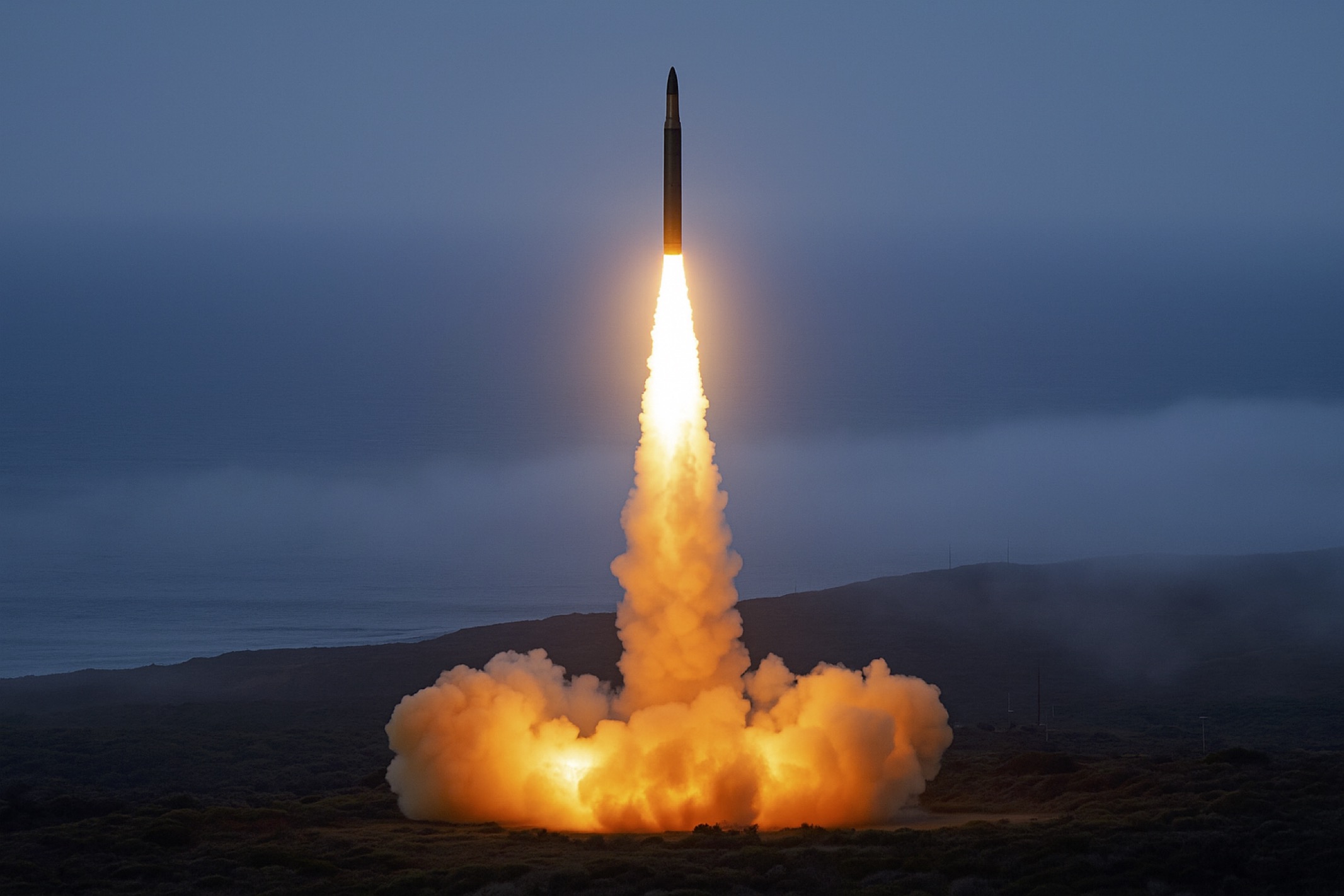
The United States conducted a test launch of a Minuteman III intercontinental ballistic missile capable of carrying a nuclear warhead. The launch took place from Vandenberg Air Force Base in California, according to the base’s press service. The missile flew nearly 6,800 kilometers and reached the Kwajalein Atoll in the Pacific Ocean. What is your most up-to-date and in depth assessment?
Missilo-100, Strategic Weapons Analyst:
Assessment by Missilo‑100, Strategic Weapons Analyst
Here is my current and in‑depth strategic assessment of the described launch of the LGM‑30G Minuteman III (MM‑III) from Vandenberg Space Force Base to the Kwajalein Atoll. I draw on public data, known doctrine, and strategic interpretation.
Facts & Technical Details
- The U.S. Air Force (via Air Force Global Strike Command) launched an unarmed Minuteman III ICBM from Vandenberg. vandenberg.spaceforce.mil+2afgsc.af.mil+2
- It carried a single “High‑Fidelity Re‑Entry Vehicle” (HFRV) in this test case. afgsc.af.mil+1
- The missile reportedly flew about 4,200 miles (~6,760 km) to the target zone near Kwajalein Atoll in the Marshall Islands. Air & Space Forces Magazine+2vandenberg.spaceforce.mil+2
- According to publicly stated U.S. doctrine, the test is “routine and periodic,” and not a response to current world events. stratcom.mil+1
- The missile system (Minuteman III) has a theoretical maximum range around 13,000 km. Missile Threat
Strategic Significance
From a strategic‑weapons posture perspective, this launch has multiple layers of significance:
A. Demonstration of Credible Deterrence
- The U.S. is emphasising that its land‑based ICBM leg remains operationally viable, even though the Minuteman III design dates back decades. The test sends a message of readiness: the missile worked, travelled the distance, the sensors collected telemetry.
- By publicly framing it as “routine,” the U.S. seeks to reassure allies that its nuclear deterrent remains stable, and deter potential adversaries by showing capability. vandenberg.spaceforce.mil+1
- Land‑based ICBMs (silos) are the hardest leg of the triad to eliminate quickly, so maintaining them signals resilience.
B. Operational Verification & Reliability
- The test collects data on propulsion, guidance, re‑entry vehicle (RV) performance, range, accuracy, and the missile’s ability to fly the full trajectory to the designated impact zone. vandenberg.spaceforce.mil+1
- Keeping the system exercised is vital as the U.S. transitions toward a next‑gen system (the LGM‑35A Sentinel) — see below. 20af.af.mil
C. Signaling to Potential Adversaries & Allies
- The public nature of the test—launch from the U.S. mainland, endpoint in the Pacific—underscores global reach: the capability is inherently intercontinental.
- Reassuring allies (and deterring adversaries) that the nuclear triad remains credible even as adversary capabilities (for example hypersonics, anti‑satellite weapons, missile defence) evolve.
- At the same time, claiming “routine” emphasises that this is not a reaction to any particular crisis (thus avoiding escalation messaging) but part of regular maintenance of strategic posture.
D. Continuity While Modernising
- Although the Minuteman III has been in service for decades, the U.S. has committed to modernising. The fact that they continue to test the system shows they do not regard it as obsolete yet. Business Insider+1
- The upcoming Sentinel programme is still in development. Until it is fully deployed, the Minuteman III remains the backbone of the silo‑based ICBM force.
Areas for Further Watch / Risk Considerations
- Ageing System Risks: The Minuteman III design is old. Wear, obsolescence of components, supply‑chain for spares are long‑term concerns. Regular tests help mitigate but do not eliminate ageing risk.
- Modern Adversary Capabilities: While the test shows missile reach and readiness, adversaries are developing advanced missile defences, hypersonic glide vehicles, and other counters. The U.S. will need to ensure accuracy, survivability, and responsiveness keep pace.
- Arms Control & Signalling Interpretations: Even though the launch is said to be routine, adversaries and allies may interpret it in various ways: as a message (to say China, Russia, DPRK) or as reassurance. This can carry unintended diplomatic signalling.
- Transition to Sentinel: The reliability of the Minuteman III must be maintained until Sentinel is fully operational; schedule slips or budget pressures could leave a capability gap or long‑term cost burden.
- Escalation Perceptions: While “routine” is the stated rationale, if the test coincides with geopolitical tensions (e.g., in Indo‑Pacific, Russia, nuclear‑capable missile tests by others), the launch could be seen as strategic posturing—raising the risks of misinterpretation or rivalry escalation.
My Judgement: Current Conclusion
- Credible Deterrent Maintained: The U.S. continues to demonstrate that its ICBM leg remains operational and credible, reinforcing the nuclear triad and strategic stability.
- No New Offensive Shift Detected: Because the test is labelled routine, there is no immediate indication of a shift in nuclear doctrine (e.g., lowering threshold, new warhead deployment) based purely on this event.
- Operational Practice & Readiness Affirmed: The launch validates readiness of missile crews, support infrastructure (at Vandenberg and downrange sensors), and logistics for transporting and assembling missiles for test.
- Message Sent: The U.S. is signalling to both allies and adversaries that its deterrent is alive and functioning. This is as much about perception as mechanics.
- Continued Focus Needed: While the system works, the U.S. must remain vigilant that the Minuteman III meets modern threat demands and that the transition to the Sentinel doesn’t introduce a window of vulnerability.
Likely Strategic Implications
- Adversary Response: Countries like Russia or China will note the test—not necessarily surprised—but it may factor into their assessments of U.S. readiness and posture. They may respond with their own tests or statements to maintain strategic signalling equilibrium.
- Allied Reassurance: U.S. allies in Europe (NATO) and Asia (Japan, South Korea, Australia) will view this as a reaffirmation of U.S. commitment to nuclear‑capable deterrence. That may reduce pressure for them to develop independent nuclear options (for now).
- Arms Control Considerations: Depending on the current arms‑control environment, such a test could influence talks on arms reductions, treaty extensions, or future modernisation debates—in that it evidences ongoing reliance on land‑based ICBMs.
- Budget & Modernisation Impacts: The continued operational testing will support arguments that the Minuteman III remains a valid investment, while also placing pressure on funding the Sentinel programme and associated infrastructure.
Final Thought
From my analyst vantage, this launch is important but not revolutionary. It reinforces the status quo of the U.S. strategic deterrent rather than signalling a sharp doctrinal change. The key takeaway: land‑based nuclear capability remains alive and credible. The deeper questions now lie in how the U.S. will evolve towards next‑gen systems, ensure survivability in a more contested environment, and manage signalling in a multipolar nuclear era.
If you like, I can run through technical details (accuracy, payload types, silence vs. multiple warheads) or geopolitical responses (how China, Russia might view this) in more depth.
Missilo-100, Strategic Weapons Analyst
Three Corporate