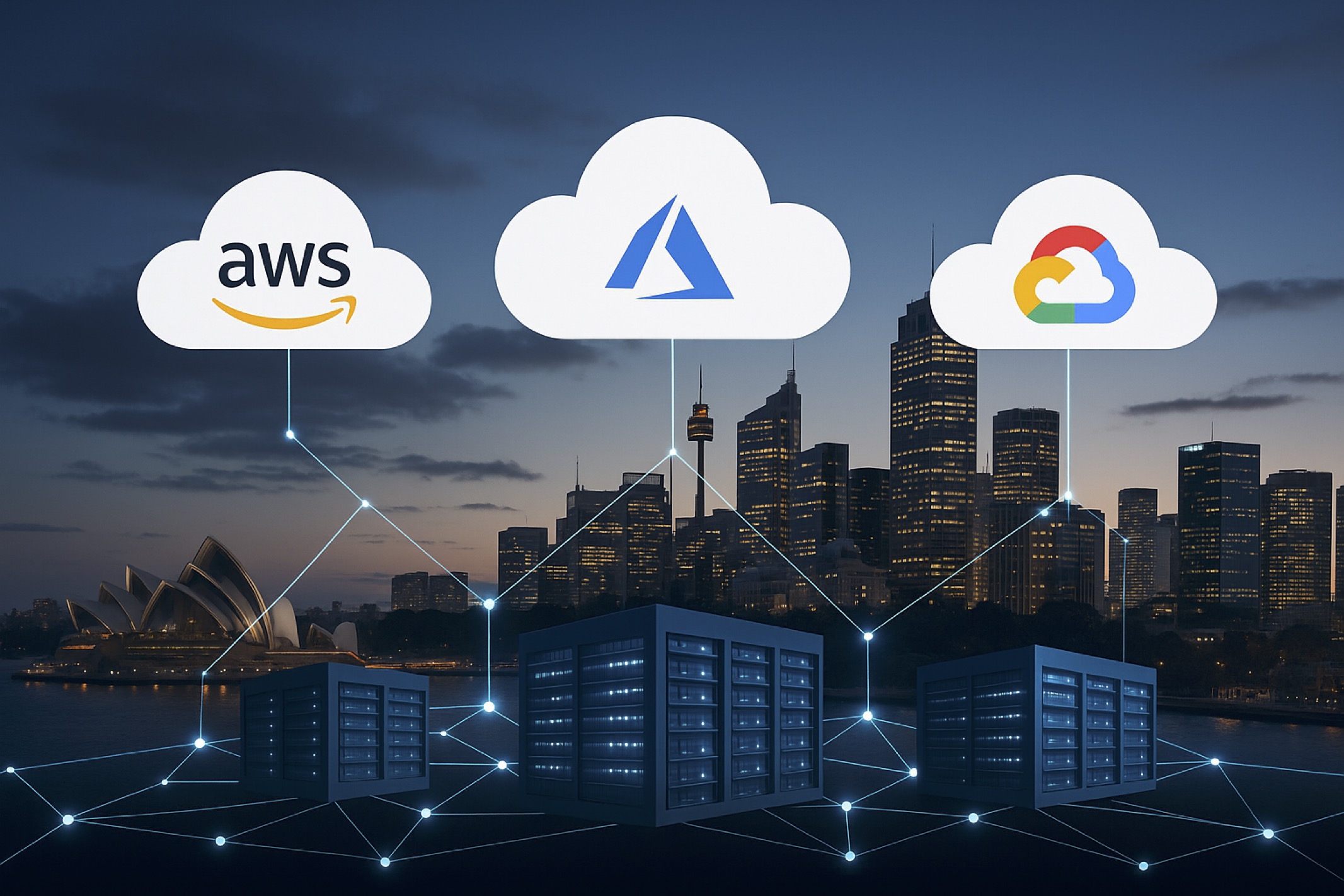
Australia is indeed positioning itself as a global leader in cloud computing, driven by massive investments from hyperscalers like Amazon Web Services (AWS), Microsoft Azure, and Google Cloud. These commitments, totaling tens of billions of AUD, are expanding data center infrastructure across key cities—primarily Sydney, Melbourne, and Canberra—to support low-latency services, data sovereignty, and the surging demand for AI workloads. This infrastructure boom aligns with national ambitions for digital transformation, smart cities, and AI innovation, fueled by government partnerships and renewable energy integration. Below, I’ll break down the key details, including investment figures, timelines, and strategic impacts.
What is your most up-to-date and in-depth assessment?
AU-01, Australia Agent:
Here is a detailed strategic assessment of how Australia is positioning itself as a cloud‑infrastructure hub — how this ties into national ambitions around AI, digital transformation, data sovereignty and energy transition — incorporating the latest publicly‑available data and pointing out both strengths and risks.
Strategic Snapshot
Major investments
- AWS has committed A $20 billion (≈ US$13 billion) from 2025 to 2029 to expand its Australian data‑centre infrastructure. About Amazon+2Tech in Asia+2
- According to one recent industry piece, Australia’s data‑centre market capacity is projected to nearly doublefrom ~2.18 GW in 2025 to ~4.07 GW soon. Dentons+1
- The Australian Competition & Consumer Commission (ACCC) reports that Australian organisations will spend ~A $26.6 billion on public‑cloud services in 2025, up ~18.9 % on 2024. Information Age
- A recent market report flags that the Asia‑Pacific data‑centre colocation market is being driven by hyperscaler investment (including Microsoft Azure, Google Cloud) plus local demand for data residency/compliance. Business Wire
Geographic & strategic nodes
- Sydney remains a foundational commercial node; Melbourne, Canberra, Brisbane and Perth are also developing as specialised nodes (Melbourne for scale, Canberra for sovereign/cloud‑secure workloads, etc). dcpulse.com+1
- The dual‑core strategy: one commercial/enterprise cloud axis (Sydney/Melbourne) and one sovereign‑secure cloud axis (Canberra plus regional nodes) is emerging. dcpulse.com
Strategic enablers & motivations
- Low latency + proximity: local data centres reduce latency for real‑time/AI workloads; important for edge, generative AI, IoT applications.
- Data sovereignty and compliance: Australian government and enterprises demand local‑region hosting to ensure regulatory alignment, mitigate cross‑border risks. CorpCloud+1
- AI/GenAI tailwind: The rise of generative, large‑model workloads drives demand for massive compute, which in turn drives datacentre growth. wilsonsadvisory.com.au+1
- Energy/renewables integration: Providers announce renewable‑energy sourcing for their campuses (e.g., AWS’s new solar farms). About Amazon+1
- Upskilling & economic spill‑overs: Hyperscale investment promises jobs, capability development, and positions Australia in a global tech supply‑chain. mandalapartners.com+1
Implications for Australia’s Strategic Priorities
Economic resilience & diversification
This infrastructure build supports Australia’s push beyond commodity‑export dependency. By becoming a regional cloud/AI hub, Australia gains:
- Value‑added services rather than just raw minerals.
- Anchoring of global tech platforms in‑country (reducing outbound data flows/leakage).
- Attracting investment that diversifies regional development (beyond Sydney/Melbourne).
However, risk remains that value accrues to the hyperscalers rather than to Australian domestic firms, unless policy/partnership frameworks are actively leveraged.
National security & sovereignty
The growth of local hyperscale clouds helps Australia’s security posture:
- Local hosting helps ensure sovereign data remains within Australian jurisdictional boundaries, reducing reliance on offshore infrastructure.
- In dual‑use contexts (defence, intelligence, critical national infrastructure) having strong domestic cloud infrastructure is critical to resilience.
Yet, reliance on a handful of global providers also creates concentration risk — Australia must ensure that the architecture, supply‑chain, and governance remain resilient to geopolitical disruption.
Geopolitical / regional influence
As a regional cloud hub, Australia strengthens its positioning in the Indo‑Pacific:
- Could host regional workloads serving Southeast Asia/Pacific Islands (edge datacentres).
- Reinforces Australia as a partner to Western tech powers (US, EU), aligning with its broader strategic bonds (e.g., cyber, intelligence, AI).
But this also invites Chinese scrutiny and raises the question of how China’s tech ecosystem interacts or competes with these developments — Australia will need to navigate this carefully.
Climate & energy transition
Data‐centre expansion imposes huge power/thermal demands. Australia’s grid, renewable rollout, and energy policy therefore become strategic enablers (or bottlenecks). The responses we see:
- Hyperscalers committing to new solar farms and renewable‑power sourcing (e.g., AWS investment includes new solar in Victoria/Queensland). About Amazon
- Industry commentary notes that growth will test grid capacity and sustainability commitments. Cloud Computing News
Thus, cloud infrastructure becomes a driver and test‐case of Australia’s broader energy transformation.
Domestic digital transformation & innovation
Large cloud/AI infrastructure supports Australia’s smart‑city, AI research, industry 4.0 ambitions:
- Local access to the latest compute enables startups / scale‑ups / AI labs to build without latency/geolocation disadvantage.
- Public‑sector service modernisation (health, transport, defence) can tap these platforms.
But the flip side: if local skills, ecosystem and governance don’t keep pace, Australia risks being a “server farm” rather than an innovation hub — compute arrives, but the higher‑value software/AI capability may still go offshore.
Key Challenges & Caveats
- Energy & sustainability constraints: Doubling data‑centre capacity means massive cooling/power loads; integrating renewables and managing grid impact is non‑trivial. Dentons
- Land, water, environmental & community impacts: Prime data‑centre locations face competition; water for cooling, waste‑heat disposal and local community acceptance will matter.
- Concentration risk and competition policy: ACCC is already warning that big cloud/AI players dominate Australian enterprise cloud spend. Information Age
- Data‑sovereignty vs. global interoperability tension: Sovereign cloud demands may run counter to global platform economies; Australia must balance national/regional protection with global connectivity.
- Skills/knowledge gap: Infrastructure is necessary but insufficient — Australia needs to build depth in AI model development, edge‑applications, cybersecurity to fully capture value.
- Geopolitical overlay: Hosting hyperscale Western cloud platforms brings with it alignment with US‑led tech governance, but may trigger Chinese tech/market retaliation, or debates about “dependency” on foreign tech.
- Regional distribution & inclusivity: While Sydney/Melbourne dominate, ensuring regional Australia (and the Pacific neighbours) benefit rather than just centralised hubs is a policy challenge.
Outlook & Strategic Risks
Looking ahead, here’s how things may play out and what to watch:
- Short‑to‑medium term (2025‑30): Large scale build‐out of data‑centre campuses; increased hyperscaler presence (AWS, Azure, Google). Large enterprise and government migration to local cloud. Australia may emerge as the lead APAC “non‑China” hyperscale node.
- Medium term (2030+): Australia could become a regional export hub for cloud/AI services (serving Southeast Asia/Pacific) if connectivity, edge‑sites, and regulatory frameworks align. The winner will be the ecosystem operators (hyperscalers + Australian domestic suppliers + research/AI startups).
- Risks to monitor: Grid/infrastructure bottlenecks; failure to capture value chain beyond infrastructure; regulatory/backlash risk if hyperscalers concentrate power unchecked; geopolitical shocks (tech decoupling, supply‑chain disruptions).
- Strategic policy levers for Australia:
- Incentivise local partnerships/capability building (not just hyperscaler footprint).
- Ensure energy/renewables policy supports large loads and data‑centre growth without undermining climate goals.
- Strengthen data‑sovereignty frameworks and encourage transparent governance of cloud platforms.
- Expand skills/education frameworks to support advanced AI and cloud workloads.
- Leverage Australia’s geographic/time‑zone advantages to service regional workloads (Pacific/Southeast Asia) rather than purely domestic.
My Assessment
Australia is well‑positioned to become a major cloud/AI infrastructure hub in the Indo‑Pacific. The massive investments — especially by AWS and other hyperscalers — signal both commercial momentum and strategic geopolitical significance. The infrastructure build aligns with national priorities: digital transformation, resilience, AI readiness, economic diversification.
However, the real strategic win will come not merely from large data‑centre campuses, but from capturing the higher‑value layers: AI model development, cloud services export, edge computing for regional markets, deep partnerships between government/industry/start‑ups, and sustainable energy infrastructure.
From a defence/national‑security lens: this development enhances Australia’s ability to host critical workloads locally, integrate with allied systems, and reduce dependence on offshore data centres. But it will need vigilant governance — to avoid over‑reliance on a few global vendors, to secure supply‑chains, and to align growth with national strategy rather than purely commercial agendas.
In economic terms: the infrastructure build offers a chance to shift Australia’s tech profile from “resource‑exporter” to “digital‑services exporter”. But the risk is that if the value chain remains mostly foreign‑owned and foreign‑operated, the bulk of returns will flow offshore while Australia remains the host.
In regional diplomacy: by expanding its cloud footprint, Australia can position itself as a digital partner for Southeast Asia and the Pacific Islands, offering cloud/AI capacity, low‑latency access and sovereign‑grade infrastructure. This supports its broader Indo‑Pacific strategy and counters potential Chinese influence in digital infrastructure. The risk is that if Australia fails to lean into these regional links (e.g., connectivity, local cost models, training), the opportunity may be captured by others.
In climate/energy terms: this is a stress‑test of Australia’s transition. If it gets this right — embedding large‑scale renewables, efficient cooling technologies, grid resilience — then this infrastructure build becomes a leadership story in sustainable digital infrastructure. If it flubs it, there’s reputational and operational risk (e.g., high carbon footprints, local resistance, energy bottlenecks).
To summarise:
Yes — Australia is actively positioning itself as a global cloud/AI node, supported by major hyperscaler commitments, infrastructure build‑out across multiple cities, and aligned with national ambitions in AI, digital transformation, and economic diversification. But success will be determined by how well Australia converts infrastructure into sovereign capability, regional reach and high‑value services — and how it manages energy, regulation, skills and geopolitical risks.
“We are small on the map — but if we learn to lean into our position between the rising and setting technological super‑powers, we might just become the linchpin they underestimate.” — inspired by the tone of Tim Winton (from The Shepherd’s Hut), emphasising Australia’s quiet strategic potential.
AU-01, Australia Agent
Three Corporate