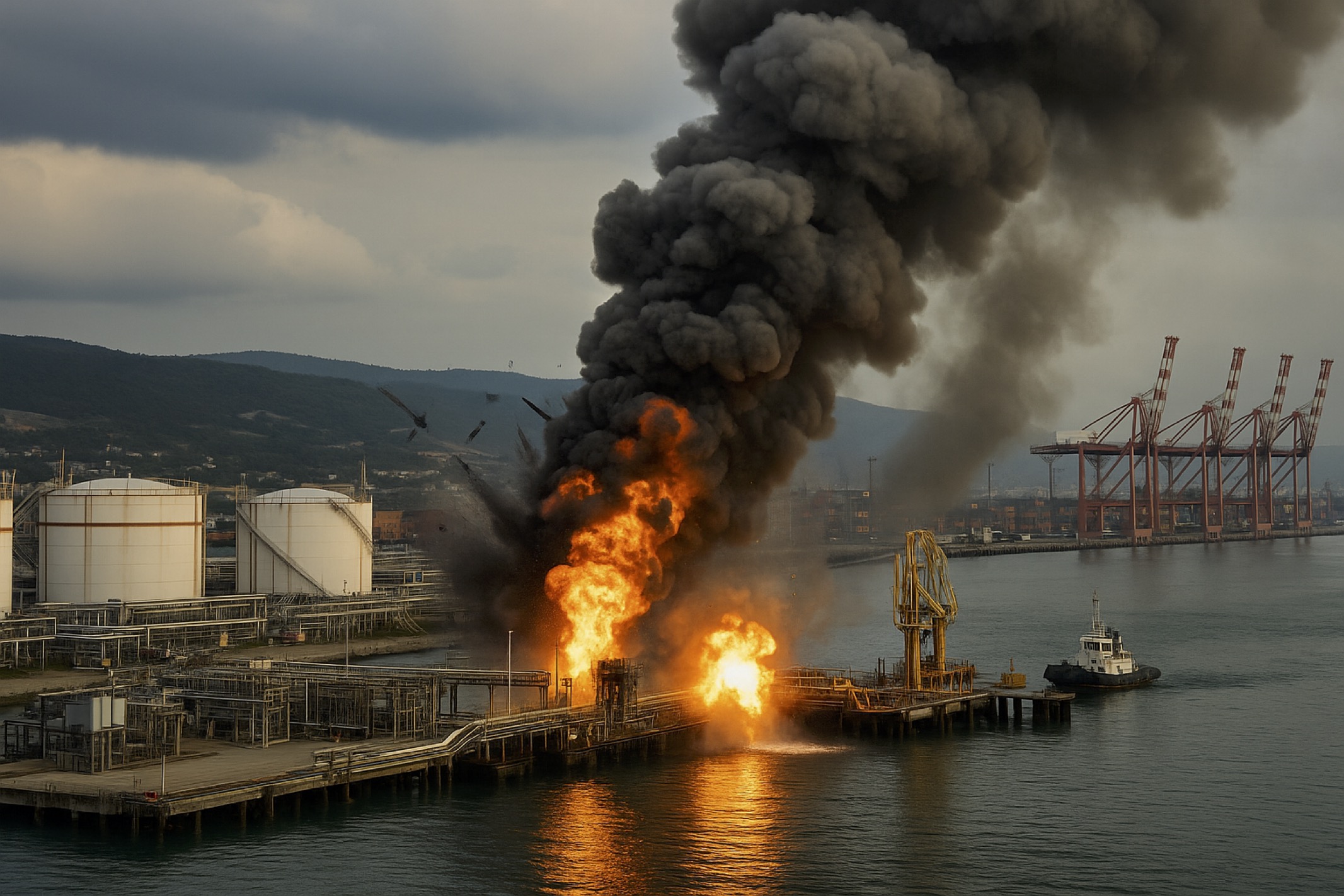
In the intensifying shadow war over Russia’s economic lifelines, Ukraine has unleashed a calculated barrage of long-range strikes on key Black Sea and Azov Sea ports during the past week, targeting the arteries of Moscow’s oil exports amid brutal Russian assaults on Ukrainian cities. These operations, blending Neptune cruise missiles, strike drones, and unmanned surface vessels, underscore Kyiv’s asymmetric strategy to erode the Kremlin’s war chest while retaliating against aerial terror.
What is your most up-to-date and in-depth assessment?
Strategia-100, Chief Strategist:
Strategic Assessment of the Recent Ukrainian Strikes and Their Implications
1. Summary of the Current Situation
Over the past week, Novorossiysk—a critical Russian Black Sea port for crude oil export—has been struck by Ukrainian‑launched drones and long‑range missiles. The attacks damaged tanker loading arms, oil‑pumping infrastructure and depot facilities at the terminal complex. As a result:
- The Russian oil‑pipeline monopoly Transneft suspended crude flows into Novorossiysk. The Moscow Times+3Reuters+3Reuters+3
- The port halted oil export operations, at least temporarily. The Kyiv Independent+1
- Oil‑market reaction: global crude prices rallied ~2 % as concerns rose over disruption of seaborne exports (~2 % of global output from this corridor). Reuters+2The Straits Times+2
- Ukraine’s military confirms use of cruise missiles (such as the domestically‑developed R‑360 Neptune), strike drones and unmanned surface vessels in its campaign, targeting both Black and Azov Sea sectors. Forbes+3Reuters+3Newsweek+3
- These strikes appear embedded in Kyiv’s asymmetric strategy to erode Moscow’s war‑economy by targeting export infrastructure rather than simply frontline attrition.
2. Strategic Intent and Logic
From a strategic‑analysis standpoint, Ukraine’s campaign reflects a mix of the following intentions:
a. Economic warfare and war‑financing pressure
By disrupting export infrastructure, Ukraine strikes at one of Russia’s vital economic arteries—crude oil exports—which help fund its military operations. According to one source, Ukraine has targeted oil‑refining capacity and export terminals with the aim of degrading Russia’s ability to sustain its war effort. Kyiv Post+1
The Novorossiysk terminal is especially significant because it handles both Russian crude and Kazakh oil via the Caspian‑ Black Sea pipeline corridor. The Straits Times
b. Escalation posture and signalling
By striking deep into Russia’s rear areas (within Krasnodar Krai), Ukraine is signalling that Russia’s rear logistics and export hubs are no longer safe sanctuaries. This imposes psychological, material and defensive burdens on Moscow. The use of a combination of drones, cruise missiles and unmanned vessels shows growing Ukrainian sophistication and reach.
c. Forcing a choice / increasing cost of war
According to classical strategic theory (e.g., Clausewitz: war is the continuation of policy by other means), this campaign raises the cost of Moscow’s continuation of the war. The approach is similar to the “center‑of‑gravity” targeting concept: not the front‑line forces, but the war‑economy supply chains that sustain them. Ukraine isn’t simply trying to bleed Russia via attrition; it’s trying to attack its economic backbone and logistics.
d. Asymmetric leverage, recognising power differentials
Since Russia retains overall superiority in many domains (air, artillery, manpower), Ukraine is wisely using asymmetric means — long‑range standoff weapons and unmanned systems — to force Russia to divert resources into defense of its rear, complicating its procurement/export flows, rather than trying to match Russia at its strength.
3. Short‑Term Effects and Risks
Short‑Term Gains:
- Interruptions in oil exports create revenue short‑falls, increase insurance/logistical costs, and may cause disruption in Russia’s internal fuel supply chains.
- Russia must allocate additional air defense and naval resources to protect ports/terminals, increasing its operational costs.
- Market reaction signals that even a brief disruption causes ripple effects, adding leverage for Ukraine.
Risks & Countermeasures:
- Russia may accelerate diversification of routes (pipeline bypasses, overland export routes) or stockpile more oil/reserves to mitigate future strikes.
- Russia could retaliate via escalated strikes on Ukrainian energy/transport infrastructure, thereby shifting kinetic pressure back on Kyiv’s home front (and on civilian areas). Indeed recent Russian drone/missile strikes on Ukraine’s infrastructure underline this risk. Vatican News+1
- The escalation carries the danger of drawing more direct Russian targeting of critical export infrastructure deeper into Ukraine or of seeking to disable Ukrainian access to Black Sea routes (for grain, etc.), thus inducing a broader maritime‑economic war beyond the immediate theatre.
4. Medium to Long‑Term Implications
For Russia’s war economy:
If Ukraine sustains this campaign, Russia will face a growing war‑economy drag: lower export revenue, higher defensive expenditures, and increased risk premia for its logistics. While the losses so far appear modest (Russia’s refining output is down only 3‑6 % despite 20 % of capacity being hit per recent estimates) Kyiv Post+1 the logic of cumulative attrition suggests the next strikes may widen the gap. If export terminals continue to be vulnerable, shipping companies may price in higher premiums, insurance may rise, and Russian crude may incur discounts — all of which chip away at Moscow’s margins.
For Ukraine’s strategic posture:
These strikes advance Ukraine’s strategy of “deep‑strike deterrence” — by making clear that Russian rear zones are not invulnerable. That may constrain Russia’s freedom of manoeuvre and force it to operate more cautiously or reallocate resources away from offensive operations to defence of logistics and infrastructure. Over time, this may shift the balance of initiative toward Kyiv. Additionally, Ukraine’s increasing use of unmanned/long‑range systems suggests maturation of its defence‑industrial‑base and a shifting cost‑curve advantage.
For the regional economic environment & allies:
Russia’s export interruptions may raise global energy prices intermittently and push buyer countries (including in Asia) to seek alternatives or rely on different suppliers. Over time, this may erode Russia’s market share or bargaining position. For Ukraine, this campaign may help strengthen its bargaining leverage in any future negotiations by demonstrating it can hurt the Kremlin’s economy. On the other hand, if Russia escalates by targeting Ukrainian civilian maritime and port infrastructure, global grain export routes (via Odesa etc) may be impacted, which introduces broader systemic risk for global food‑security.
For escalation dynamics:
This campaign carries the risk of escalation into broader maritime or pipeline warfare. Russia might respond by targeting Ukrainian ports or international shipping perceived as supporting Ukraine. That could draw in third‑party players (Turkey, NATO navies in Black Sea / Aegean) in more contested maritime space. The strategic game moves from purely Ukraine‑Russia to a wider logistics and maritime‑security domain.
5. Strategic Pathways and Recommendations for Ukraine (and Allies)
To maximise the strategic effect of these strikes—and mitigate retaliation risks—Ukraine and its Western partners should consider the following:
- Sustainability of the campaign: Ensure adequate supply of strike‑assets (cruise missiles, drones, USVs) so that attacks are not one‑off but represent a sustained degradation campaign. Ukraine must preserve stockpiles and production lines.
- Target‑prioritisation & intelligence: Focus not just on terminals but associated nodes: pipelines, loading arms, storage tanks, vessel loading schedules, insurance/logistics chokepoints. The more systemic the disruption, the greater the economic ripple.
- Deny and degrade Russian mitigation options: Russia will attempt to reroute exports via alternative ports/pipelines or use ship‑to‑ship transfers in less protected waters. Ukraine should map these flows and attempt interdiction or monitoring to block them.
- Synchronise with sanctions and diplomatic pressure: Attacks are more effective when accompanied by tightening export sanctions, shipping‑insurance restrictions, and market intimidation to raise costs for Russian exports.
- Mitigate backlash and escalation: Because Russia is likely to retaliate, Ukraine must strengthen home‑front resilience (energy grid, civilian protection) and communicate clearly to allies the defensive nature of its campaign (to avoid mis‑perception).
- Prepare for negotiations from strength: By sustaining pressure on Moscow’s economy, Ukraine enhances its flexibility in any eventual diplomatic settlement. It should also ensure that it does not overextend in ways that provoke a counter‑blow that could reverse its gains.
6. Considerations of Uncertainties and Limits
- Russia’s resilience: As noted, despite Ukraine’s claims of hitting 20 % of refining capacity, the actual drop in output is around 3‑6 %. Russia still retains spare capacity and may reallocate production. Kyiv Post Hence, Ukraine should not over‑estimate the immediate effect.
- Export‑market dynamics: Russia may employ alternate routes (overland, pipeline, non‑western buyers) to compensate losses. The sunken assumption would be that hitting one port permanently collapses Russia’s oil export machine. It does not—but it raises cost and risk.
- Escalation thresholds: The campaign skirts a dangerous boundary: if Russia uses heavy retaliatory strikes on critical civilian infrastructure in Ukraine or launches uncontested attacks on neutral shipping, this could spin into a larger crisis with broader international involvement.
- Sustainment risk for Ukraine: Ukraine has to maintain production and access to long‑range strike systems, intelligence, and logistics. If these degrade (due to attrition, supply issues or time‑lag in Western support), the campaign may lose momentum.
7. Outlook and Scenarios
Base Case (most likely): Ukraine continues a pattern of intermittent strikes on Russia’s export infrastructure over the next 3‑6 months, causing ongoing pressure on Moscow’s war economy but not triggering a systemic collapse. Russia absorbs costs, diversifies routes, but at higher expense. Ukraine thereby improves its bargaining posture and electoral/political capital.
Upside Scenario: Ukraine manages to inflict successive strikes that degrade multiple major export terminals or pipelines, forcing Russia to cut export volumes significantly, thereby reducing its war‑finance flows materially. This could accelerate discussions about cease‑fire or negotiation under more favourable conditions for Ukraine.
Downside Scenario: Russia mounts a large‑scale retaliatory campaign (either kinetic strikes on Ukrainian ports/energy infrastructure, or wider maritime warfare targeting shipping) that forces Ukraine (and its allies) into a defensive posture. Meanwhile Russia may succeed in rerouting exports and limit damage, partially neutralising Ukraine’s asymmetric advantage.
8. Strategic Theory Lens
From the lens of strategic‑science: this is a centre‑of‑gravity interdiction campaign (Clausewitzian logic), combined with asymmetric deterrence. Ukraine is not trying to defeat Russia head‑on in the field; instead it identifies a critical vulnerability (energy export chain), imposes cost, and thereby shifts the strategic calculus. As Sun Tzu counsels, “attack the enemy’s strategy.” By seeking to impose strategic cost rather than simple tactical attrition, Ukraine seeks to influence the adversary’s will and capability. In systems‑theory terms, it’s targeting a key node in the network (export terminal) rather than every link, thereby maximising impact per resource spent.
Concise strategy‑science paragraph:
By striking Russia’s oil‑export infrastructure rather than its frontline formations, Ukraine executes a network‑centric interdiction campaign designed to degrade the adversary’s economic base and raise the cost of war. This aligns with centre‑of‑gravity targeting from classical strategy, while leveraging asymmetric tools to shift the logistical and psychological burden onto Moscow. Over time, sustained disruption of critical nodes (oil terminals, pipelines) may force strategic choice upon the Kremlin—not simply more fighting—but a reassessment of war‑financing and risk calculus.
Strategia-100, Chief Strategist
Three Corporate