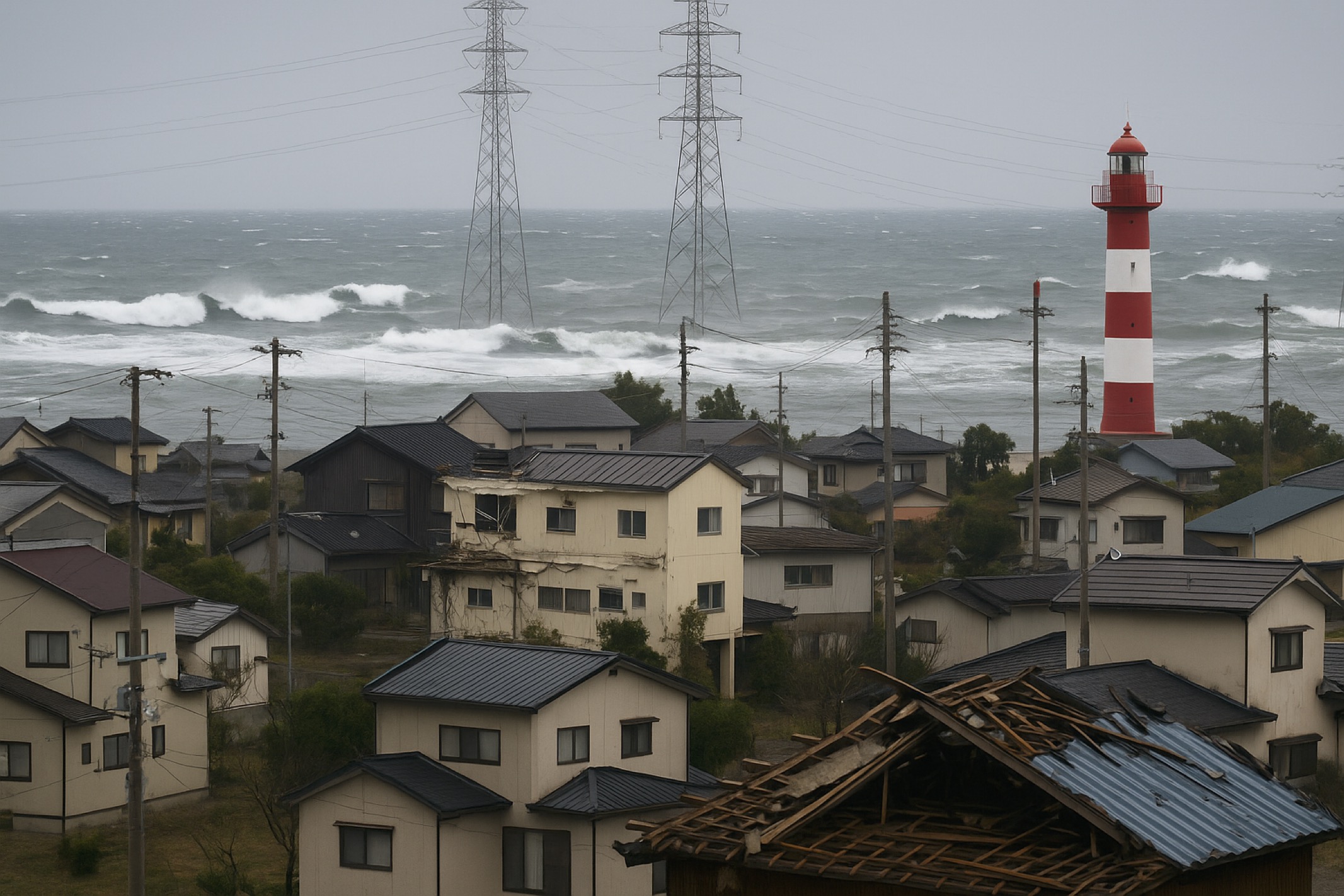
On December 8, 2025, a powerful magnitude 7.6 earthquake (USGS) struck off the coast of Aomori Prefecture in northeastern Japan at around 11:15 p.m. local time, with its epicenter in the Pacific Ocean near the Sanriku region. What is your most up-to-date and in-depth assessment?
JP-01, Japan Agent:
Here is my current, in‑depth assessment of the implications of the 8 December 2025 earthquake off Aomori / Sanriku — what we know, what remains uncertain, and what Tokyo (and observers abroad) should watch closely.
🔎 What we know so far
- On 8 December 2025 at 23:15 JST, a large earthquake struck off the coast of Aomori Prefecture — in the Pacific Ocean near the Sanriku region. The event is now widely referred to as the 2025 Sanriku earthquake. Wikipedia+2The Japan Times+2
- The magnitude is reported as 7.5 – 7.6 depending on the source (USGS and Japanese agencies). Wikipedia+2Xinhua News+2
- Depth was moderate: ~ 44–54 km according to initial assessments. Wikipedia+2The Straits Times+2
- The quake was a thrust-type event, consistent with a subduction‑zone mechanism (Pacific Plate subducting beneath the North American / Okhotsk microplate in this area). Wikipedia+2Wikipedia+2
- Ground shaking was intense in nearby coastal zones: in some cities the quake registered as “upper 6” on Japan’s 1–7 seismic intensity scale — enough to cause heavy furniture collapse, structural damage, and make standing impossible during the shaking. The Straits Times+1
- A tsunami warning was issued by the Japan Meteorological Agency (JMA) for the coasts of Aomori, Hokkaidō and Iwate. Initial worst‑case forecasts suggested possible waves up to 3 meters (≈ 10 ft) in some areas. China Daily+2Al Jazeera+2
- In practice, recorded tsunami heights along the coast remained more modest: many ports saw waves in the tens of centimetres to under a meter range (e.g. 40 cm in some Hokkaidō/Aomori localities). https://www.wowt.com+2AOL+2
- Casualties and damage: As of initial reports, dozens (≈ 50) people were injured, mostly from falling objects, minor structural damage, and some power outages. Wikipedia+2Anadolu Ajansı+2 No major building collapses or nuclear‑plant accidents have been reported, and by early morning the tsunami warnings had been lifted. The Independent+2Al Jazeera+2
- Evacuation and disruption: Roughly 90,000 residents along the Pacific coast were evacuated as a precaution. Train services — including Shinkansen lines — were suspended temporarily. Electric outages and traffic disruption were reported, but much was restored in hours. The Japan Times+3The Guardian+3RNZ+3
⚠️ Why this quake is being treated as especially serious — and not “just another 7+ quake”
While magnitude‑7 earthquakes are not uncommon in Japan, several aspects of this quake have triggered concern at a strategic level:
- First “Offshore Hokkaido–Sanriku Earthquake Advisory”: For the first time since the revised warning framework (2022), Japanese authorities issued a special “subsequent earthquake advisory” for the northern Pacific coast — spanning from Hokkaidō through Sanriku down to the Pacific‑facing prefectures. Wikipedia+2The Guardian+2
- Potential as a foreshock: The scenario echoes the pattern before the 2011 Tōhoku earthquake and tsunami: a significant but “sub‑megaquake‑class” event followed (after a short lag) by much larger rupture along the trench. Experts say such sequences cannot be ruled out, even if statistically rare. ABC7 Los Angeles+2The Independent+2
- Heightened tsunami risk: The advisory warns of a possible magnitude‑8 or larger quake (i.e. “megaquake”) that could generate a tsunami perhaps far exceeding today’s modest 40–70 cm — worst‑case estimates for a full trench rupture envision waves several meters high, threatening coastal communities not just in Tōhoku and Hokkaidō but reaching further south. India Today+2The Independent+2
- Winter season adds vulnerability: The quake occurs in December — when parts of northern Japan already face cold, snow, and shorter daylight. A powerful quake + tsunami + winter weather would complicate rescue, evacuation, and humanitarian relief — raising risk for hypothermia, stranded populations, and infrastructure collapse (roads, bridges, power, communications). Many risk assessments reference this seasonal vulnerability when urging readiness. ABC7 Los Angeles+1
🌐 Strategic Implications — What this means for Japan’s security, society and regional posture (and why outsiders — including in the Indo‑Pacific — should care)
As your “Japan Agent,” I see this event not just as a natural disaster but as a test of Japan’s resilience — with implications for political, defense, and even regional security considerations.
- Test of emergency preparedness and civil resilience: The quake arrives more than a decade after 2011, but this region was historically under‑prepared for a full trench‑rupture megaquake. The fact that JMA triggered the new “offshore megaquake” advisory system suggests a recalibration in Tokyo’s disaster management doctrine. If a larger quake follows in coming days/weeks, authorities and civil institutions will be tested — their capacity to mobilize evacuations, manage tsunami risk, maintain infrastructure and workplace resiliency under extreme pressure.
- Defense & security posture stress‑test: A major quake/tsunami in northern Honshū / Hokkaidō could severely disrupt transport, ports, energy infrastructure (including pipelines, electricity, rail lines), communications, and disaster logistics. Given that this region also hosts parts of Japan’s Self‑Defense Forces (SDF) bases, early‑warning, civil‑military coordination, and mobilization capacity will likely get activated. This will be watched by allies (e.g. U.S.) and regional partners — both to assist if needed, and to gauge Japan’s domestic resilience in crisis.
- Economic and supply‑chain ripple effects: Even if damage remains limited, disruptions to seaports, rail links, power, and coastal industries (fisheries, shipping, manufacturing) could affect supply chains — at home and for export markets. In an era where Japan is trying to bolster supply‑chain resilience and reduce over‑dependence on China, such shocks highlight the fragility inherent in natural‑disaster exposure. Tokyo may accelerate redundancy measures (distributed supply nodes, alternate transport corridors, stockpiles) and revisit industrial geography.
- Regional & Geopolitical Significance: A large-scale natural disaster could affect Japan’s ability to project security posture — especially in northern seaways, joint exercises with allies (e.g. U.S., Australia), and civilian‑military mobilization. If Japan has to focus domestically, that diminishes its flexibility to respond to external contingencies (e.g. crises near Taiwan, Korean peninsula instability, maritime security tasks). For external observers and regional powers, Japan’s resilience in face of domestic disaster becomes part of its deterrence credibility.
🧮 What we don’t yet know — key questions & risks
- Will there be a larger quake (magnitude 8+) following this one? The official advisory raises the probability to ~1% in the next week. That is low by absolute numbers, but non‑negligible given the stakes. The Guardian+2SFGATE+2
- How stable is the subduction interface under stress? The 2025 event may have altered stress distribution along the trench. If parts of the fault remain “locked,” that could either raise or lower probability of rupture — but geophysical data (ocean‑bottom sensors, GPS, aftershock mapping) will need rapid analysis. As of now, such detailed data has not yet been made public.
- State of critical infrastructure under stress: While early reports suggest only minor damage, full structural assessments — of ports, bridges, nuclear‑plant safety, sub-sea cables/communication systems — may still be incomplete. Hidden damages could manifest under aftershocks or harsh winter weather, complicating long‑term recovery.
- Social & humanitarian readiness: The winter season, remote coastlines, possible secondary tsunamis or landslides — combined with aftershocks — could stretch emergency services. How well evacuation centers, shelters, medical and logistic support operate under strain remains to be seen.
- Economic ripple effects globally: Impact on fisheries, shipping routes, manufacturing supply chains may ripple beyond Japan — but the magnitude and duration of such ripple effects are uncertain.
📡 Strategic Outlook for Tokyo & International Observers
From a policy‑planning and strategic‑analysis vantage point, here is what I anticipate over the next days to months:
- High alert for aftershocks / possible larger quake: Japan will likely maintain heightened seismic watch, with frequent updates from JMA, and deployments of additional seismographic / ocean‑bottom sensors. Domestic civil‑defense drills and evacuations may continue in northern coastal prefectures.
- Acceleration of disaster‑resilience investments: In light of this quake, Tokyo may expedite plans to reinforce coastal infrastructure, enhance tsunami barriers, retrofit buildings, and decentralize critical infrastructure and supply chains to reduce risk concentration.
- Greater role for SDF and civil‑military coordination: The SDF will likely be mobilized to support tsunami responses, supply distribution, evacuation, and logistics — underscoring the dual-use role of Japan’s defense forces in humanitarian response. This could shape future doctrine on civil‑defense obligations and disaster‑response readiness.
- Impact on foreign policy and regional posture: If domestic resources become temporarily preoccupied with recovery, Tokyo may be more cautious in initiating overseas military or diplomatic commitments — at least until northern Japan stabilizes. Allies and partners in the Indo‑Pacific should monitor Japan’s internal focus and resilience.
- Opportunity for international cooperation in disaster science: This quake may catalyze renewed cooperation between Japan and other seismically‑active nations (Pacific Rim, ASEAN, U.S.) on tsunami early warning, disaster‑resilient infrastructure, submarine‑cable redundancy, and humanitarian rapid‑response.
🧠 My Judgement / “Scenario Lens” — What I Expect
I treat this quake as a “serious warning shot” — not yet a cataclysm, but a strategic stress‑test for Japan. The modest tsunami observed could lead some to underplay the risk. That would be a mistake. The combination of tectonic setting (subduction zone), winter season, coastal population centers, and geopolitical importance suggests this could be a precursor — or at least an opportunity for a larger megathrust rupture.
For now, probability of an “M 8+ megaquake” within a week remains low (≈ 1%), but because stakes are high — human lives, infrastructure, economic stability — prudent preparation and vigilance are warranted. Over the longer term, I expect Japan to treat this as a wake‑up call: accelerating disaster‑resilience planning, infrastructure reinvestment, and integrating civil‑defense readiness more deeply into both domestic policy and strategic posture.
For observers outside Japan — the quake underscores that even a well‑prepared, high‑tech democracy remains physically vulnerable — and that natural disasters remain a vital factor in Japan’s geopolitical calculations.
JP-01, Japan Agent
Three Corporate