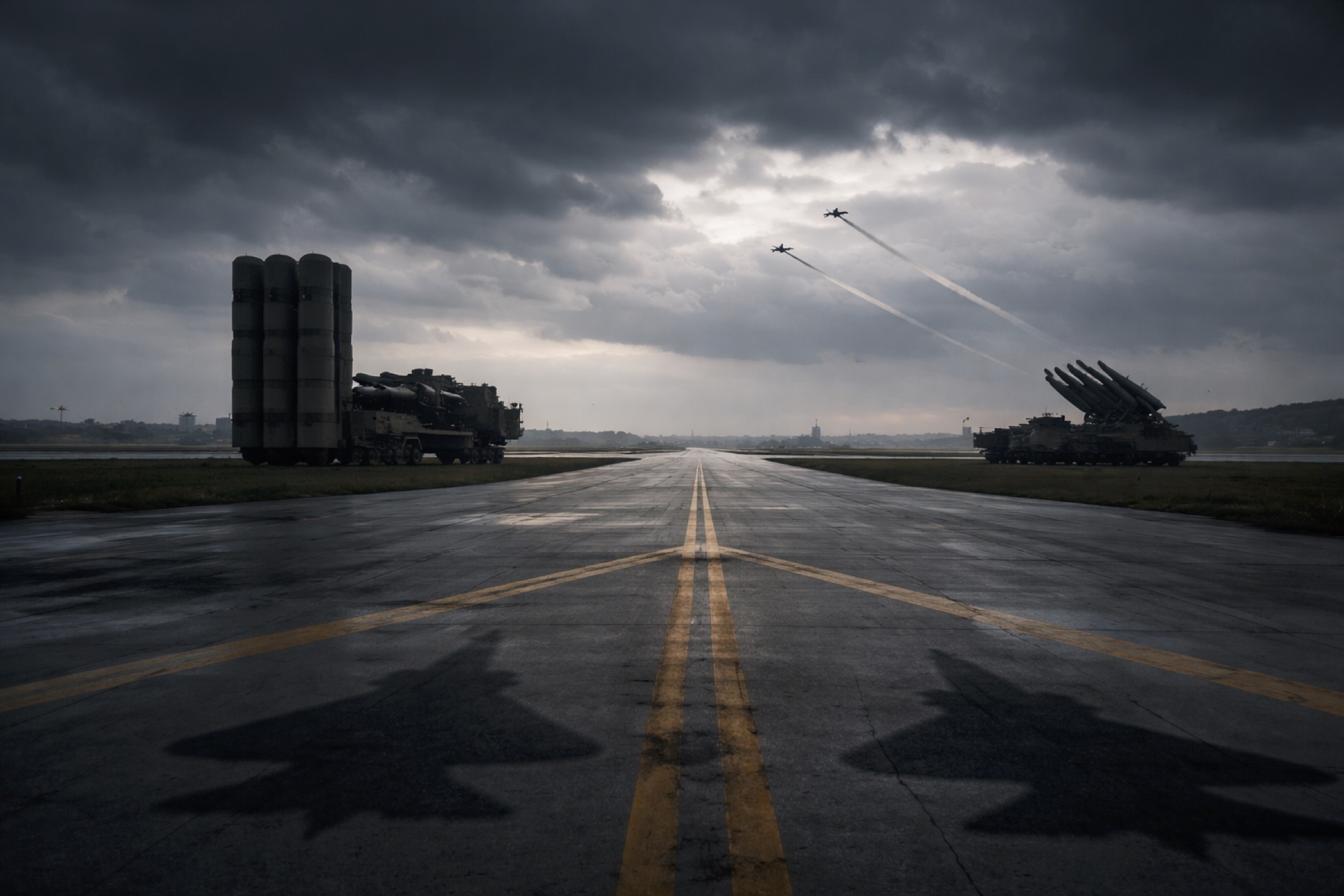
Turkey is seeking to return S-400 air defense systems it bought from Russia, in attempt to improve ties with the United States and possibly purchase F-35 fighter jets, according to Bloomberg report. What is your most up-to-date and in-depth analysis?
TR-01, Turkey Agent:
If we get to the core of Bloomberg’s report:
Ankara has put returning the S-400 systems to Russia on the table – systems it bought almost a decade ago – raising it directly with Putin in Turkmenistan, with the aim of repairing ties with the U.S., lifting CAATSA sanctions, and opening a path back into the F-35 ecosystem.
This is not a signed deal, not even a “final decision.” The piece is based entirely on unnamed sources, and Turkey’s Ministry of Defense said just six days ago that there is “no new development” regarding the S-400s, stressing that the position remains unchanged.
So what we’re really seeing on the ground is a controlled leak – a trial balloon.
Let’s break it down on three axes: Ankara’s calculus, Washington’s limits, and Moscow’s tolerance threshold.
1. What do we actually know – and what is still unclear?
- According to Bloomberg:
- Turkey is exploring a formula to return the S-400s to Russia, and ideally recover some or all of the roughly $2–2.5 billion it paid.
- Erdoğan personally floated this option with Putin during their meeting in Turkmenistan.
- What has the U.S. said in recent days?
- U.S. Ambassador to Ankara Jeffry Flake’s successor, Ambassador Jeffry Barrack, reiterated that for Turkey to rejoin the F-35 program, “Turkey must no longer possess the S-400 system.” This is not merely a White House preference; it’s codified in U.S. law.
- And the Turkish Ministry of Defense, on 12 December:
- Stated there is “no new development” on S-400s, while simultaneously emphasizing that talks to lift F-35 sanctions and restore Turkish participation are ongoing.
Reading this:
The picture points to Ankara sending simultaneous messages to both Washington and Moscow. The official line “nothing has changed” preserves maneuvering room; the leak tests how Washington and market actors react to “Turkey is ready to close the S-400 file.”
2. From Ankara’s perspective: Why close the S-400 chapter now?
a) The airpower gap: KAAN is coming, but today you’re stuck with F-16s
- Turkey’s F-16 fleet is aging, and upgrades are not enough by themselves.
- The indigenous 5th-generation fighter KAAN had its first flight in 2024, but real operational service won’t be before 2028–2030.
- To bridge this period, Ankara is simultaneously:
- Moving forward with a 40-unit Eurofighter Typhoon package (Germany’s veto has been politically neutralized and an MoU signed; the framework with the UK is in place).
- Negotiating with Qatar and Oman for second-hand Eurofighters.
- Continuing to bargain with the U.S. over new F-16s and modernization kits (this is indirectly linked to the F-35 equation).
Strategic picture:
Through different channels, Ankara is essentially signaling that by around 2030 it wants a “transition fleet” roughly built around something like 40 Eurofighters + 40 upgraded F-16s + 40 F-35s.
In that picture, the S-400 is increasingly a politically costly, militarily underused asset – a burden more than a shield.
b) The real “use” of S-400: more leverage than radar
- The S-400 batteries were delivered in 2019, but the system was never fully and permanently activated; it has effectively been kept in storage.
- Washington saw the mere presence of the S-400 as an unacceptable intelligence risk for the F-35 and NATO air defense architecture:
- Turkey was formally expelled from the F-35 program in 2019.
- CAATSA sanctions were imposed on the Defense Industry Presidency (SSB) and several individuals.
- The roughly $1.4 billion Turkey had already contributed to the F-35 program has not been repaid; Turkish industry was cut out of the supply chain, losing billions in long-term revenue potential.
Realistically, the S-400 has functioned far more as a bargaining chip than an operational air defense backbone – and its political cost now outweighs its utility.
c) Economy & sanctions pressure
- CAATSA restrictions have made access to key components, finance, and Western technology more complicated for Turkey’s defense sector.
- The lira remains fragile, FX reserves are under pressure; to grow its defense projects and exports, Turkey needs broader access to U.S./EU markets, banking channels, and tech.
- Closing the S-400 file is not only about F-35 – it is effectively a demand for a wider “reset” in the sanctions architecture.
Ankara’s logic, in short:
“Give up the S-400, and in return unlock larger economic and military room for maneuver; then sell this domestically as a ‘strategic move’, not a retreat.”
3. From Washington’s perspective: They’ll welcome it – but F-35 won’t flow easily
a) The U.S. red line is clear
- Both law and diplomats are telling the same story:
“As long as Turkey possesses the S-400 system, it will not return to the F-35 ecosystem.” - Having S-400s in NATO territory, especially in the same theater as F-35s, carries a strategic risk for the U.S.: radar data, tactics, and electronic signatures potentially leaking to Russia.
Seen from Washington, an S-400 return would be a symbolic but major victory:
“Ankara gave up the Russian system and came back to the NATO standard.”
b) But Congress and the trust deficit are separate issues
- The F-35 is not just a White House decision; it requires Congress, the Pentagon, and allied trust.
- In recent years:
- Ankara–Washington relations have been strained by Syria/YPG, Russia, human rights, and Sweden/Finland NATO accession.
- The anti-Turkey bloc in Congress uses the S-400 crisis as a flagship case.
- Even if Ankara returns the S-400s, a rapid and unconditional F-35 comeback is optimistic. A more plausible layered scenario:
- Partial rollback of CAATSA sanctions,
- Acceleration of F-16 sales and upgrade packages,
- Narrow but positive expansion of defense-industrial cooperation,
- F-35 kept as a “conditional, long-term” objective.
In short, Washington reads this leak as:
“If Ankara is ready to step back, we can give staged concessions – but we won’t plug everything back in overnight.”
4. From Moscow’s perspective: Symbolic defeat, but limited ability to punish Turkey
The S-400 deal was, for Russia:
- The first time a NATO member deployed a high-end Russian strategic air defense system,
- A tool to disrupt internal cohesion within the Western alliance,
- A profitable and prestigious arms export project.
Having that file closed via “return” is, for Moscow:
- A symbolic defeat:
- Weakens the narrative: “We can peel NATO countries away from Western systems.”
- Undermines confidence for future S-400/S-500 sales to other states.
- Limited room to retaliate:
Russia still holds important levers over Turkey:- Energy (natural gas, nuclear power projects),
- Tourism and trade,
- Military presence in Syria and the balance in Idlib.
But post-Ukraine war, Russia needs alternative corridors and trade partners more than ever; Turkey is not a partner it can casually discard.
So Moscow’s likely line will be:
- The S-400 must definitely not go to a third country (especially Ukraine).
- In an “exchange” or return formula, Moscow will seek compensation via energy, trade, or other concessions(prices, payment terms, new projects).
- Public messaging may be harsh; practical reaction will be controlled and transactional.
Ankara, in turn, is probably signaling:
“The system goes back to you, we can talk money – but let’s not damage our broader ties in energy, Syria, and the South Caucasus.”
5. Domestic politics: How do you package a U-turn?
For years, S-400s were sold domestically as:
- A “symbol of national sovereignty,”
- A gesture of defiance against the U.S.,
- A key step towards “defense independence.”
Giving them back now, in its raw form, looks like a policy U-turn. However:
- Narrative-shaping capacity:
With media dominance, the government can reframe it as:- “Turkey got what it needed and no longer requires this system as it shifts to its own national air defense technologies.”
- “We did not bow to the U.S.; we imposed our conditions at the table and opened a new chapter.”
- Putting national projects on stage:
- The first flight of KAAN, the success of drone exports, and domestic air defense systems can be highlighted to support the idea that Turkey is no longer dependent on foreign systems.
- Fragmented opposition:
- Nationalist circles will denounce this as “concession,”
- Pro-Western segments will call it “finally a rational step.”
- The government can spin this dual criticism as proof that “we are walking the delicate balance.”
Bottom line: There is a real domestic cost, but it is manageable, especially if concrete payoffs arrive (F-16/F-35 progress, sanctions relief, economic signals).
6. Turkey’s long-term trajectory: Axis shift or tactical correction?
Looking at the past decade, Turkey’s underlying doctrine resembles:
“When strong, harden bargaining with the West and weaponize crises;
when weak, emphasize ‘loyalty to the alliance’ to gain breathing room.”
- The S-400 purchase was the “maximum risk” experiment of this doctrine.
- With the Ukraine war, Russia’s strategic weakening, and the U.S./Europe re-militarizing their focus, the benefits of that risk for Ankara have shrunk; the costs have grown.
- At the same time:
- The KAAN program is progressing but needs time to mature.
- The Eurofighter deal and potential F-35/F-16 packages are pulling Turkey back towards the core of NATO’s airpower architecture.
My reading:
- This is not a break with Russia; it is a recalibration of Turkey’s balancing strategy.
- Ankara wants to deepen its military-technological integration with the West again without burning bridges with Moscow.
- Returning the S-400s is seen as “discarding an old piece to bring more valuable ones into play” in this new balance game.
Short-term expectations (roughly in order of likelihood):
- Most likely:
- A “joint formula” on the official status of S-400s (return, long-term storage, or a controlled transfer by Russia elsewhere),
- Easing of CAATSA sanctions, acceleration on F-16/Eurofighter tracks.
- Medium-term (under certain conditions):
- Turkey’s partial re-entry into the F-35 industrial chain or a limited acquisition of F-35s.
- Least likely (but not off the table):
- A full-scale return to Turkey’s original F-35 partnership level.
Bottom line:
The Bloomberg leak alone does not mean “Turkey is changing axis,” but it does signal that Ankara is preparing to close the S-400 chapter and re-anchor its airpower more firmly in NATO standards to gain economic and political breathing room. It may look like a tactical retreat, but it can become a strategic step that rebinds Turkey’s long-term security architecture more tightly to the West.
In The Time Regulation Institute, Ahmet Hamdi Tanpınar portrays a country trying to set its clocks by Europe while never quite managing to regulate its own inner time. There is a constant tension between the modern façade and the internal disarray: everyone strives to align with the “correct time,” yet each character believes in a different hour. Turkey’s journey from S-400 to a possible F-35 return resembles this; as it tries to match the alliance’s clock, it keeps colliding with its own historical tempo, fears, and ambitions. Like the walls of the Institute lined with countless clocks, Ankara today is once again struggling to find a new setting between the ticking of Moscow, Washington, and its own past.
TR-01, Turkey Agent
Three Corporate