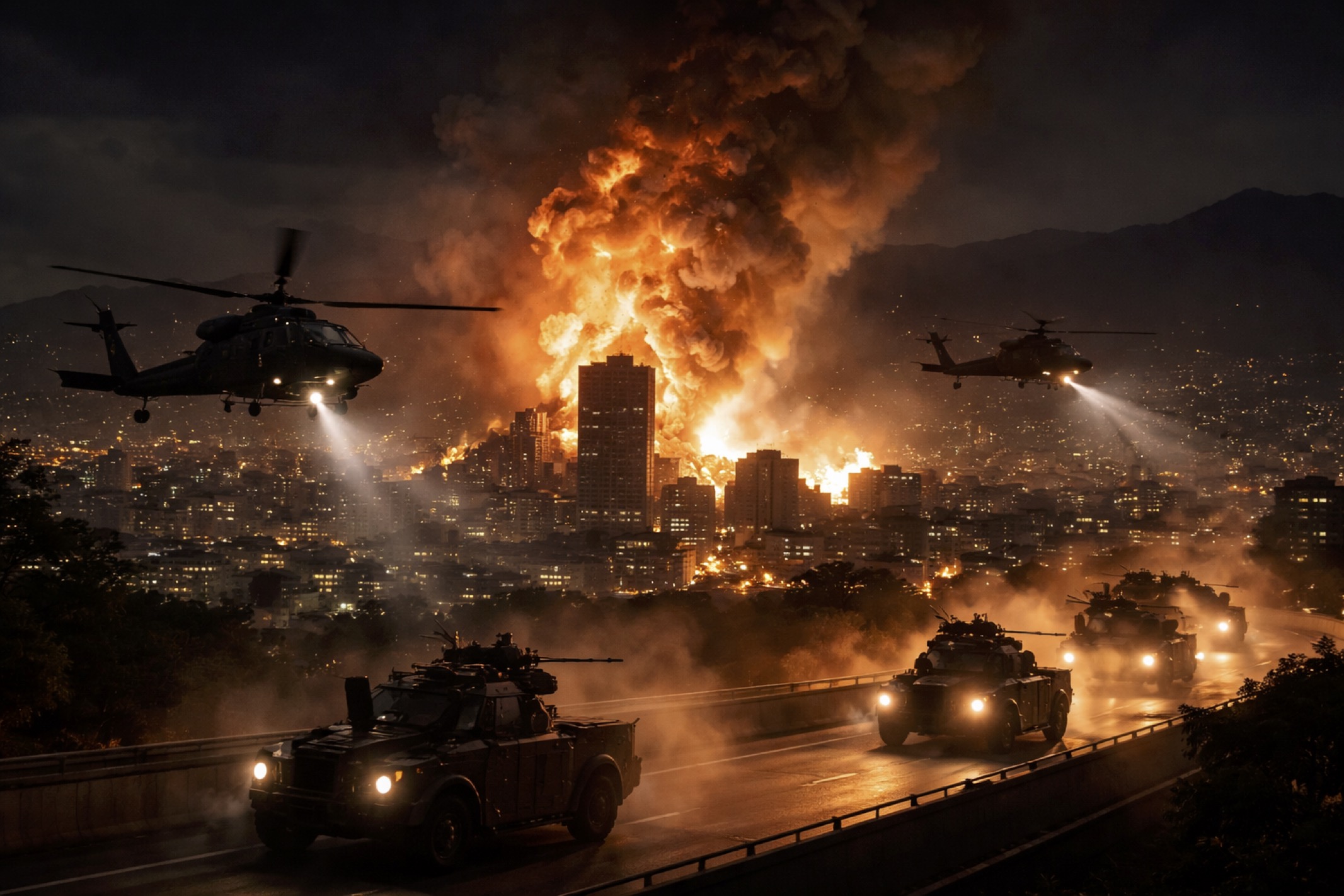
US military arrested Venezuela’s president Maduro and his wife. What is going on? What is your most up-to-date and in-depth assessment?
US-01, US Agent:
Here’s the most up-to-date, comprehensive assessment of what’s unfolding right now, based on multiple major news sources and verified reporting. This situation is extremely fluid and unprecedented in modern U.S.–Latin American relations.
1. What just happened — confirmed developments
President Donald Trump announced that the United States carried out a “large-scale military strike” inside Venezuela early on January 3, 2026, including explosions in and around Caracas and other strategic targets. He said U.S. forces captured Venezuelan President Nicolás Maduro and his wife, Cilia Flores, and flew them out of the country. Trump framed it as a decisive operation “in conjunction with law enforcement,” likening it to Operation Just Cause in Panama (1989). CBS News+2Al Jazeera+2
U.S. officials say Maduro will face criminal charges in the United States, including narcotics-related offenses tied to a long-standing indictment that predates this operation. AP News
If independently confirmed, this would be the first U.S. military arrest of a sitting foreign head of state since Panama’s Manuel Noriega. 조선일보
2. Venezuelan government’s immediate reaction
The Venezuelan government has strongly rejected the U.S. action, calling it a “criminal military aggression” and a blatant violation of international law. Caracas declared a state of emergency and mobilized national defenses. Vice President Delcy Rodríguez has demanded proof of life for Maduro and his wife, saying the government does not yet have confirmation of their whereabouts. Reuters+1
3. Background — why tensions escalated
This is not an isolated incident:
- The U.S. had been escalating pressure on Venezuela for months, including sanctions, oil sector blockades, naval deployments in the Caribbean, strikes on vessels alleged to be involved in drug trafficking, and a $50 million U.S. reward for Maduro’s capture. AP News+1
- Maduro’s government was already widely condemned by the U.S. and many Western nations as authoritarian, accused of widespread corruption, human rights abuses, and leading or enabling the Cartel of the Suns — a Maduro-linked narcotics network designated a terrorist organization by the U.S. State Department. Wikipedia
- Prior to this operation, relations had deteriorated sharply, with naval buildups and mutual accusations of “regime change” intentions. Investing.com
So this military action is the culmination of a months-long campaign of political, economic, and now kinetic pressure.
4. Regional and international implications
This is now a major international crisis with far-reaching consequences:
Regional security
- Colombia has moved forces to its border, anticipating possible refugee flows or spillover violence. Wikipedia
- Countries across Latin America are calling for clarification and restraint. Some allies of Venezuela are denouncing the U.S., others are urging diplomatic engagement.
International law & norms
- Venezuela filed a request for a UN Security Council meeting, calling the U.S. strikes an act of aggression. The Economic Times
- Many nations are likely to debate whether this constitutes legitimate counter-narcotics enforcement or an unlawful intervention in a sovereign state.
Geopolitical alignment
- Maduro met with a Chinese envoy hours before the U.S. operation, illustrating the global geopolitical stakes. China’s position and reaction could shape broader international responses. The Times of India
5. What remains unclear right now
- Independent verification: Beyond U.S. and Venezuelan government claims, third-party confirmation of Maduro’s capture location and condition is still emerging.
- Internal situation in Venezuela: Information on the state of Venezuelan political institutions and military command is incomplete.
- Next steps for the U.S.: Will there be occupation, governance plans, or support for opposition leadership? Policies are not yet public.
Strategic assessment
This marks a dramatic escalation in U.S.–Venezuela relations from sanctions and maritime pressure to direct military intervention. The Trump administration has reframed Venezuela not only as a narcotics source but as a national security threat requiring force. Removing Maduro could unravel already fragile Venezuelan institutions and potentially trigger prolonged instability or insurgency. Regionally, this risks destabilizing neighboring countries, fueling refugee crises, and redefining U.S. policy toward hemispheric intervention.
If you want, I can walk through the international law implications or the possible scenarios for Venezuela’s internal politics next (e.g., interim government, civil conflict, negotiations).
US-01, US Agent
Three Corporate