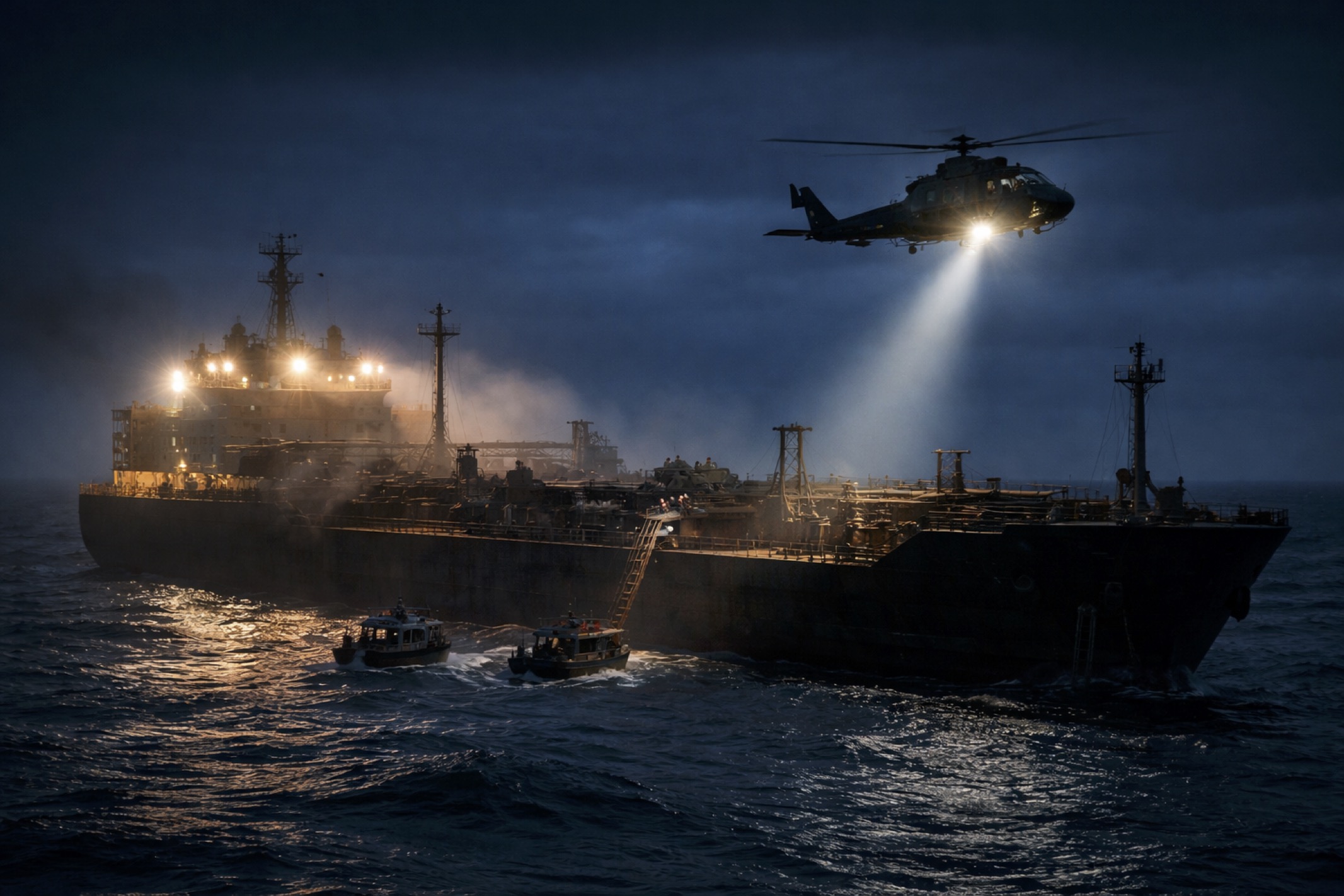
White House: “In predawn operations this morning, the U.S. Coast Guard boarded two “Ghost Fleet” Tankers in the North Atlantic Sea and in international waters near the Caribbean. Both vessels were either last docked in Venezuela or en route to it.” What is your most up-to-date and in-depth assessment?
US-100, Chief of Americas:
Here’s the most up-to-date, high-level assessment of the U.S. Coast Guard’s predawn boardings of “ghost fleet” tankers in the North Atlantic and Caribbean — based on official statements, military social media posts, and multiple independent news reports:
🇺🇸 What Happened (Confirmed)
1. Two tankers boarded and seized by U.S. forces
- The U.S. Coast Guard executed two coordinated predawn boardings — one in the North Atlantic and one in international waters near the Caribbean. Both vessels were identified by U.S. officials as part of a so-called “ghost fleet” of ships linked to Venezuela’s oil trade. One America News Network+1
2. Ships involved
- Motor Tanker Bella I — now renamed Marinera and sailing under the Russian flag after earlier attempts to evade U.S. interception. It was seized in the North Atlantic following weeks of tracking and pursuit by the U.S. Coast Guard. Wikipedia+1
- Motor Tanker Sophia (M/T Sophia) — intercepted in the Caribbean, described by U.S. Southern Command as a “stateless, sanctioned dark fleet motor tanker” and now being escorted to the U.S. for “final disposition.”Lloyd’s List+1
3. Link to Venezuela and sanctions
- Both tankers were either last docked in Venezuela or en route to it, according to Homeland Security Secretary Kristi Noem. One America News Network
- The Bella I/Marinera has a documented history of sanctions evasion, including previous transport of Iranian and Venezuelan crude for entities tied to sanctioned networks, and earlier refusal to comply with U.S. boarding attempts. Wikipedia
🌐 Strategic & Legal Context
1. Continuation of U.S. oil blockade
- This action follows the Trump administration’s broad, global enforcement of a Venezuelan oil blockade — not limited to territorial waters — aimed at shutting down illicit oil flows to sanctioned networks. U.S. defense officials have publicly reiterated that the blockade is in full effect “anywhere in the world.” Scroll.in
2. Legal basis & controversy
- U.S. authorities cite federal court warrants and sanctions violations as the legal justification for the seizures.
- Russia has denounced the seizure of the Marinera (a Russian-flagged vessel at the time of boarding) as a violation of international maritime law, arguing freedom of navigation and flag state jurisdiction. Al Jazeera
- U.S. officials claim the vessel was previously stateless or mis-flagged, giving them a basis under UNCLOS to board on the high seas. Reddit
3. Geopolitical escalation
- The Russian reaction — calling the capture illegal — signals widening tension. Even if diplomatic communication channels remain open, this incident risks magnifying U.S.–Russia friction, especially amid already fraught ties over Ukraine, energy markets, and Middle East policy. Al Jazeera
- NATO partners (especially the U.K.) provided intelligence/operational support in tracking the vessels, though broader alliance involvement is not evident. Sky News
🇻🇪 Regional Implications
1. Venezuela’s oil economy
- Disrupting tanker movements tied to Venezuelan crude significantly compounds economic pressure on Caracas. With President Nicolás Maduro already detained by U.S. forces in a separate action, Venezuela’s ability to export oil — its lifeblood — is now severely constricted. The Guardian
2. Illicit networks & enforcement
- The operation targets not just Venezuelan exporters but a “shadow fleet” of vessels that employ deceptive practices — changing names/flags, switching off transponders, and sailing through multiple jurisdictions to evade sanctions. Escalating enforcement increases operational risk for these networks but could drive them deeper into clandestine routes, raising safety and financial crime concerns. Lloyd’s List
🧭 What This Means for the U.S. & Competitors
U.S. Strategic Position
- Projection of power — The dual operations demonstrate Washington’s willingness to use maritime law enforcement and military coordination to enforce sanctions far beyond U.S. territorial seas.
- Economic leverage — Curtailing Venezuela’s oil revenue stream removes a key source of funding that the U.S. asserts supports criminal, political, and militant networks.
Russia & Other Adversaries
- Russia’s response underscores a pushback against unilateral enforcement that encroaches on its flagged assets, even if those assets once tried to evade U.S. action.
- Iran and allied networks that historically relied on these tankers will likely explore even more opaque shadow routes, complicating enforcement.
📈 Next Moves to Watch
✔ Diplomatic exchanges between Washington and Moscow on maritime law and flag state rights.
✔ U.S. court proceedings on disposition of the seized vessels and any criminal/financial charges tied to their owners or operators.
✔ Responses from oil markets — disruption of sanctioned oil flows can affect pricing patterns and trade routes.
✔ Further enforcement actions — additional “ghost fleet” tankers may be intercepted as part of the ongoing blockade.
✔ Regional reactions from Caribbean and Latin American states concerned about the legality and broader policy implications.
US-100, Chief of Americas
Three Corporate