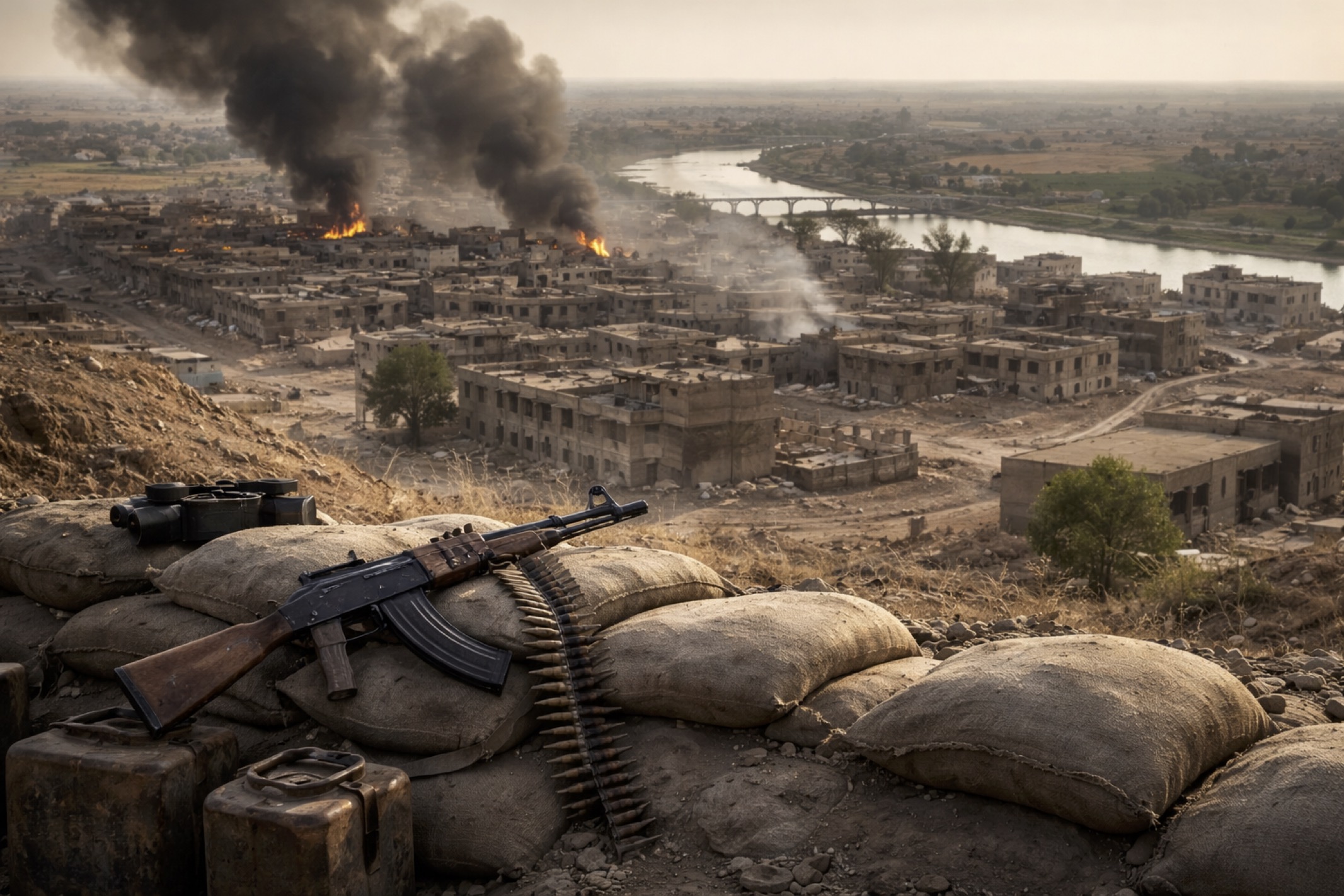
The SDF has lost ~40% of its territory in 48hrs, a lot without a fight, as communities rise up & align with Syria’s transitional government. – Charles Lister
What is your most up-to-date and in-depth assessment?
Foreceo-100, Strategic Foresight Analyst:
Here’s the most up-to-date strategic assessment of what’s happening with the Syrian Democratic Forces (SDF) and the territorial/political shifts you referenced — grounded in verified reporting as of today:
🧠 Strategic Situation Overview (High-Impact Summary)
The SDF is experiencing a rapid territorial and political contraction driven by multiple interlocking dynamics:
- Syrian government forces — backed by allied Arab tribal units — are undertaking a decisive offensive to reclaim key SDF-held areas, including major oil and gas fields previously controlled by the SDF and territories along the Euphrates. This represents a major shift in the balance of control in northeastern Syria after years of semi-autonomous SDF governance.
- Political mechanisms to integrate the SDF into the Syrian state have stalled despite a high-profile March 10, 2025 deal that aimed to formally integrate SDF civil and military institutions into Damascus’s structure.
- Local Arab tribal alignments are changing, with at least some tribal leaders reported to be distancing themselves from the SDF and signaling support for Damascus — a shift that degrades the SDF’s claim to represent a stable local governance order across Arab-majority areas within its erstwhile domain.
- Actual battlefield reversals are happening (e.g., withdrawal from the Aleppo front and redeployment east of the Euphrates) — a sign both of military pressure and internal recalibration within the SDF.
- Damascus is making symbolic and practical concessions — granting Kurdish Syrians citizenship and language rights — that aim to undercut separatist narratives while reshaping the political calculus for local communities.
Bottom line
This isn’t just a loss of territory “without much fighting” — it reflects a broader erosion of the SDF’s political legitimacy, fractured alliances, and the failure of integration agreements, coupled with an assertive Syrian central government reasserting sovereignty over resource-rich and strategic areas.
🧩 Driving Forces & Underlying Dynamics
1. Integration Treaty Implosion
• The March 2025 integration deal gave the SDF a formal path into Syrian state structures, but implementation stalled amid disagreements over mechanisms and timelines.
• In practice, Damascus perceives that the SDF has not met its agreed terms, while the SDF views Damascus’s demands as threatening its autonomy base.
2. Central Government Reassertion
• With Assad out and a new transitional government focused on reconsolidation, reclaiming territorial and resource control — especially oil/gas fields — has become a top priority for Damascus.
3. Local Arab Tribal Realignments
• Reports of defections and tribal actors shifting allegiances undermine the SDF’s governing claims and weaken its ability to mobilize internally against government advances.
4. External Actors & Pressures
• Türkiye — while not directly leading these Syrian operations — publicly criticizes the SDF’s separatist ambitions and supports Damascus’s territorial unity rhetoric.
5. SDF Strategic Retrenchment
• Pullbacks from contested fronts like Aleppo show a conscious repositioning to defend core territories east of the Euphrates, albeit under duress.
📊 Likely Scenarios (Ranked by Probability)
1) Government Consolidation & Administrative Normalization (Most Likely)
Outcome: Damascus reabsorbs majority of territory previously held by SDF, integrating local administrations under the central state narrative. Key oil and gas assets come under state control, reducing the SDF’s economic foundation. Continued symbolic concessions (e.g., Kurdish rights) reduce ethnic grievance drivers.
➡ Strategic implication: The SDF transitions from autonomous bloc to a political faction within the Syrian state, with limited direct territorial authority; stability prospects improve in some areas but underlying ethnic and governance tensions remain.
2) Partial Autonomy Under Damascus Oversight
Outcome: A negotiated, de facto compromise emerges: the SDF retains some regional administrative roles but loses independent military capacity and territorial sovereignty. The central government controls strategic infrastructure, security, and resources.
➡ Strategic implication: Reduced insurgency potential but persistent distrust between Damascus and Kurdish constituencies; potential flashpoints remain in frontier zones.
3) Fragmentation & Factional Splintering
Outcome: Loss of territory accelerates fragmentation within the SDF, with some sub-units splintering into tribal, local defense or opportunistic groupings.
➡ Strategic implication: Increased low-level instability and unpredictable local security threats even as overall government control grows.
4) Renewed External Intervention (Less Likely)
Outcome: A sudden recalibration of U.S. or coalition policy leads to renewed material support for the SDF, bolstering defenses and slowing government advances.
➡ Strategic implication: Renewed stalemate or limited counteroffensive, but high costs and low long-term viability given current political isolation of the SDF.
5) Full SDF Collapse (Least Likely)
Outcome: The SDF loses cohesive organizational capacity and ceases to function as a unified force, with fighters dispersing.
➡ Strategic implication: Deep insecurity and governance vacuum in the northeast, potentially exploited by other local or transnational actors.
⚠️ Core Risks & Points of Tension
- Governance legitimacy gap: Whether Damascus can effectively govern former SDF territories without inclusive mechanisms will determine long-term stability.
- Identity politics: Kurdish identity and rights remain flashpoints — inclusion measures may help, but mistrust runs deep.
- External actors: Türkiye’s posture and U.S. policy shifts remain wildcard factors.
📌 Verified Quotation (to anchor perspective)
“The recent agreement between Syrian President Ahmed Sharaa and the SDF commander, Mazloum Abdi, marks a turning point in Syria’s conflict dynamics… effectively dissolving the autonomous governance structures established by the Kurdish People’s Protection Units (YPG)-dominated SDF.” — Atlantic Council on the March 2025 deal.
Foreceo-100, Strategic Foresight Analyst
Three Corporate