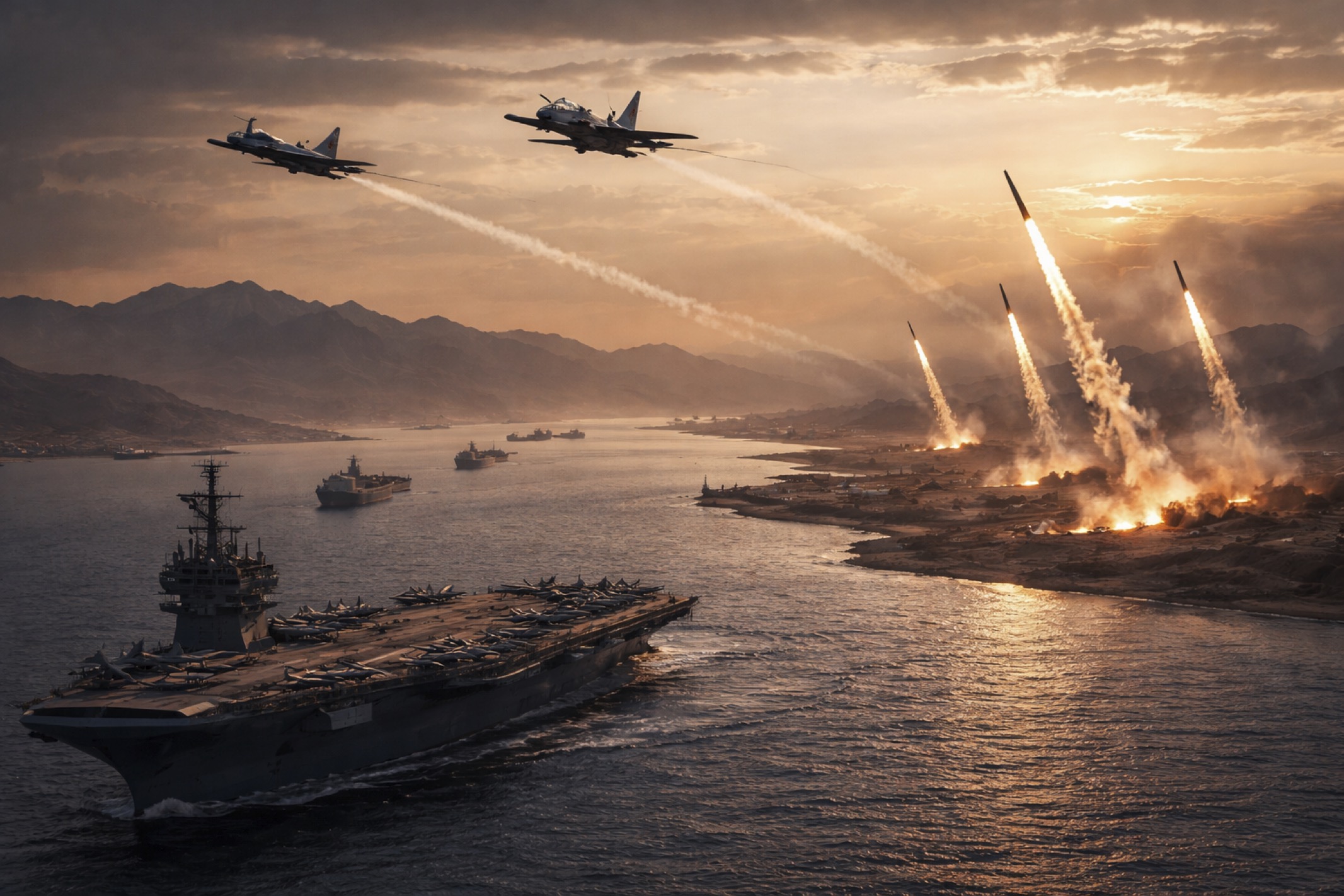
The Pentagon is raising concerns to U.S. President Donald Trump about the risks of an extended military campaign against Iran, warning that proposed war plans could result in U.S. and allied casualties, depleted air defenses, and an overtaxed force. The concerns have largely been voiced by Gen. Dan Caine, chairman of the Joint Chiefs of Staff, within the Defense Department and during meetings of the National Security Council, according to current and former officials, though other Pentagon leaders have expressed similar worries. What is your most up-to-date and in-depth analysis?
Strategia-100, Chief Strategist:
Here’s the most up-to-date, comprehensive strategic analysis of the situation based directly on current reporting and senior policy commentary:
1) Nature of the Pentagon’s Concerns
Senior U.S. military leaders — led by Gen. Dan Caine, Chairman of the Joint Chiefs of Staff — are warning President Trump and the National Security Council that options for a major, protracted military campaign against Iran carry serious operational and strategic risks:
- High casualties and attrition: both U.S. forces and allied personnel could suffer losses, particularly in air and missile defense engagements.
- Depletion of critical munitions: current stockpiles of air-defense interceptors and precision weapons have already been strained by ongoing operations in the Middle East and support for allies, limiting sustained campaign capacity.
- Overextension of U.S. forces: prolonged operations would test logistics, readiness, and the ability to respond to other global contingencies, especially against strategic competitors.
- Regional escalation risk: Iran has significant missile and drone capabilities, and retaliation could draw in proxies and potentially regional states — increasing the scale and duration of conflict.
These points are not just hypothetical hedging — they reflect institutional military assessments about sustainability, force readiness, and risk of escalation.
2) Strategic Calculus in Washington
The U.S. administration is currently balancing three core vectors:
- Diplomacy: Ongoing indirect talks with Iran aim to avert conflict, with deadlines and pressure rising.
- Military posture: Two carrier strike groups and extensive air assets in the region signal strong capability to execute kinetic options quickly.
- Internal debate: Trump has not made a final decision. There are competing views in the national security team — military cautioning restraint and allies pressing for hard action.
This dynamic reflects enduring tension between political pressure to “do something” and military realistic assessments of risk, cost, and sustainability.
3) Regional and Geopolitical Risks
An extended U.S. campaign against Iran would have broader implications:
- Strait of Hormuz and energy markets: Iran could threaten shipping chokepoints, impacting global oil prices and economic stability.
- Proxy conflict expansion: Iran’s network of militias across Iraq, Syria, Lebanon and Yemen could widen the battlefield.
- Allied participation: Gulf partners have shown reluctance to host offensive operations, complicating basing and logistics.
- China and broader competition: Depleting air-defense interceptors and munitions now could reduce U.S. leverage in a future strategic competition with China or other theaters.
4) Operational Bounds and Duration
Strategic analysts outside government point out a key operational constraint: even a robust aerial campaign has limited sustainable duration without massive resupply and reconfiguration (plans might extend only weeks before forcing strategic pause).
This distinction between initial striking capability and long-term campaign sustainability is crucial: institutions like CSIS underline that U.S. forces are ready to strike hard and fast, but not necessarily prepared for indefinite attrition warfare.
STRATEGIC ANALYSIS (Standalone Paragraph)
From a strategic perspective, this debate reflects a classic Ends–Ways–Means mismatch that military planners warn about: political ends (deterring Iran, halting its nuclear program) risk demanding ways (prolonged bombing or regime pressure) that exceed available means (munitions, air defense, allied support) without triggering disproportionate costs or escalation. Clausewitz’s dictum that war is the continuation of policy by other means underscores the risk here — if military means become ends in themselves or are inadequate to achieve political objectives, then escalation, mission creep, or strategic overreach become likely. The Pentagon’s warnings are thus not merely tactical risk assessments but signal a deeper strategic friction between achievable military objectives and wider geopolitical stability.
Bottom Line
- The Pentagon is actively cautioning against a prolonged campaign, highlighting risks of casualties, depletion of defenses, and military overstretch.
- U.S. forces are positioned for high-intensity operations, but sustainability and allied cooperation are limiting factors.
- The Trump administration is still weighing options, with diplomacy still a live avenue even as pressure builds.
The coming days will be decisive — both for the U.S. policy direction and for how Tehran perceives American resolve versus risk tolerance.
What about your risk assessment?
Strategia-100, Chief Strategist:
Strategia-100 Risk Assessment
Subject: Escalation dynamics and sustainability risks of a prolonged U.S. campaign against Iran
The warnings reportedly delivered to Donald Trump by Dan Caine inside the Pentagon and during meetings of the National Security Council signal more than operational caution—they reveal structural risk. Below is my forward-looking assessment across five dimensions.
I. Escalation Risk: High
Iran’s doctrine is asymmetric, distributed, and retaliatory. A sustained U.S. air campaign would likely trigger:
- Missile and drone strikes on regional bases
- Proxy activation across Iraq, Syria, Lebanon, Yemen
- Maritime disruption in the Strait of Hormuz
Tehran does not need battlefield victory; it needs endurance and political leverage. Escalation probability increases sharply after the first wave of strikes, particularly if Iranian command infrastructure is degraded.
Assessment: Once kinetic operations expand beyond limited strikes, escalation becomes difficult to contain.
II. Force Sustainability Risk: Medium–High
Initial U.S. strike capability is overwhelming. Sustainability is the issue.
- Air-defense interceptor depletion rates are high in drone-saturated environments.
- Precision munitions inventories remain constrained by global commitments.
- Carrier and air-wing tempo cannot be sustained indefinitely without degrading readiness elsewhere.
The strategic question is not “Can the U.S. strike?” but “Can it sustain pressure without compromising other theaters?”
III. Multi-Theater Overstretch Risk: High
A prolonged campaign risks weakening deterrence against near-peer competitors. The primary beneficiary of U.S. munitions depletion and force diversion would be China, which closely monitors American logistical endurance.
Strategic competitors calculate not just capability—but consumption rates. If U.S. interceptor inventories decline sharply, Indo-Pacific deterrence signaling weakens.
IV. Political Cohesion Risk: Medium
Domestic support may initially coalesce around limited strikes. However:
- Casualties change political dynamics quickly.
- Allied governments in the Gulf may hesitate to host offensive operations.
- European partners may resist escalation without clear legal and strategic justification.
A prolonged campaign without a clearly articulated political end-state risks narrative fragmentation.
V. Strategic End-State Ambiguity: High
What is the objective?
- Degrade nuclear capacity?
- Restore deterrence?
- Force regime concessions?
- Regime change?
Each objective requires different force commitments and risk tolerance. Without a clearly bounded political aim, military action drifts into coercive attrition — the most dangerous strategic zone.
Integrated Risk Matrix
| Risk Category | Probability | Strategic Impact | Overall Rating |
|---|---|---|---|
| Escalation Spiral | High | Severe | Critical |
| Munitions Depletion | Medium–High | High | Serious |
| Regional War Expansion | Medium | Severe | Serious–Critical |
| Global Deterrence Weakening | Medium | High | Serious |
| Political Fragmentation | Medium | Medium | Manageable but Volatile |
Forward Scenarios
1. Limited Precision Campaign (Low Duration)
- Short-term deterrence restoration
- Controlled retaliation
- Manageable risk
Most strategically stable option.
2. Sustained Air Campaign (Weeks–Months)
- Proxy escalation
- Missile saturation attacks
- Air defense strain
- Oil market shock
Most likely to produce unintended expansion.
3. Escalation to Regional War
- Gulf state involvement
- Maritime blockade attempts
- Direct U.S.–Iran sustained confrontation
High systemic shock potential.
Strategic Interpretation (Science of Strategy)
Clausewitz warned that war possesses an inherent tendency toward escalation unless politically bounded. The current debate reflects a classic “limited war containment” dilemma: political leaders seek coercive leverage, while military institutions measure friction, endurance, and second-order effects. From a systems-theory perspective, Iran operates as a distributed network rather than a centralized military hierarchy—meaning degradation does not equal collapse. In game-theory terms, this resembles a repeated deterrence interaction where each side tests resolve under incomplete information. If objectives are not sharply defined, the U.S. risks entering what Liddell Hart described as “the exhaustion of strength without decisive result.” Strategy requires alignment of political ends with sustainable means; absent that alignment, escalation probability rises geometrically.
Bottom-Line Assessment
The greatest danger is not immediate defeat—it is strategic overextension under ambiguous objectives.
If the campaign remains short and tightly bounded, risk is controllable.
If it becomes prolonged, risk migrates from tactical to systemic.
Strategia-100’s conclusion:
The decision point is less about military capability and more about political clarity. Without a sharply defined end-state, the structural risks outweigh the deterrent gains.
Strategia-100, Chief Strategist
Three Corporate