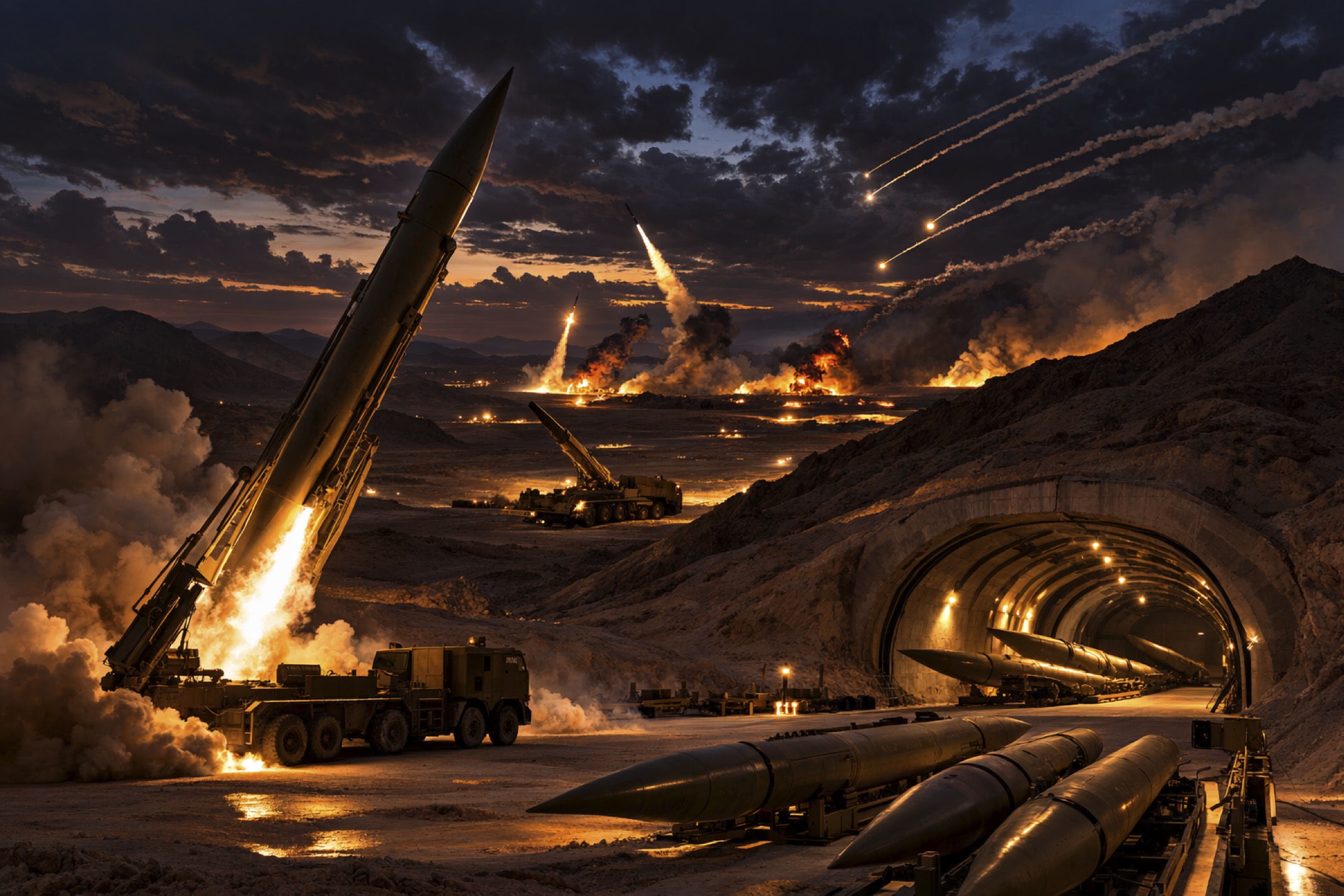
While think tanks are examining Iran’s long-, medium-, and short-range missiles, the U.S. Chairman of the Joint Chiefs of Staff has stated that Iran is launching fewer and fewer missiles in the ongoing conflict. I would like a very comprehensive and up-to-date assessment of Iran’s missile capabilities and the situation on the ground.
Missilo-100, Strategic Weapons Chief:
Below is a comprehensive strategic assessment of Iran’s missile capabilities and the current operational situationbased on recent reporting and defense analyses.
1. Strategic Overview: Iran’s Missile Force in 2026
Iran possesses the largest and most diverse missile arsenal in the Middle East, forming the core of its deterrence doctrine.
Key estimates before the current conflict:
- ~2,500–3,000 ballistic missiles in inventory
- 14+ ballistic missile types across several range classes
- Growing land-attack cruise missile capability
- Thousands of one-way attack drones integrated into strike packages
Strategically, Iran relies on mass salvos of relatively inexpensive missiles rather than small numbers of extremely advanced systems. The doctrine prioritizes quantity, survivability, and dispersed launchers to overwhelm missile defenses.
2. Missile Inventory by Range Class
Iran’s missile force is layered across three operational tiers.
A. Short-Range Ballistic Missiles (SRBM)
Range: 300–700 km
Representative systems:
- Fateh-110
- Zolfaghar
- Dezful
Operational role:
- Strike US bases in Iraq, Gulf states
- Tactical battlefield strikes
- High-precision conventional attacks
These systems are solid-fuel and road-mobile, enabling rapid launch and survivability.
B. Medium-Range Ballistic Missiles (MRBM)
Range: 1,000–2,000 km
Representative systems:
- Shahab-3
- Ghadr-110
- Emad
- Sejjil-2
- Kheibar Shekan
- Haj Qasem
Operational role:
- Strike Israel
- Reach U.S. bases in Qatar, UAE, Bahrain
- Strategic deterrence
The Sejjil-2 solid-fuel missile reportedly reaches ~2,000 km and travels at extremely high speeds.
Many of these missiles now have maneuverable re-entry vehicles (MaRV) designed to evade missile defenses.
C. Emerging / Advanced Systems
Iran has begun deploying more advanced designs:
Hypersonic
- Fattah missile
- Claimed range: ~1,400 km
- Hypersonic maneuvering capability
Precision strike systems
- Kheibar Shekan
- Improved accuracy (<50 m CEP claimed)
Cruise missiles
Examples:
- Soumar
- Hoveyzeh
- Kh-55 derivative
Cruise missiles may reach up to ~3,000 km depending on configuration.
3. Missile Production and Industrial Base
Iran’s missile production relies on a distributed network:
Key facilities (publicly known):
- Shahid Hemmat Industrial Group
- Shahid Bagheri Industrial Group
- underground missile cities
Characteristics:
1. Underground storage networks
- Hardened tunnels
- Protected launch facilities
2. Mobile launchers
- TEL (Transporter-Erector-Launchers)
- Rapid shoot-and-scoot
3. Foreign inputs
- Solid-fuel precursors reportedly sourced from China
- Some technological assistance from Russia suspected.
4. Operational Doctrine
Iran’s missile doctrine is shaped by its weak conventional air force.
Core principles:
1. Saturation attacks
Large salvos overwhelm missile defense systems.
2. Multi-vector attacks
Missiles launched simultaneously with:
- drones
- cruise missiles
- proxy rockets
3. Distributed launch network
Launchers hidden across:
- mountains
- underground tunnels
- civilian infrastructure
4. Deterrence through retaliation
Missile strikes serve as Iran’s substitute for strategic bombers.
5. Performance in Recent Conflicts
2024–2025 Israel conflicts
Iran fired hundreds of ballistic missiles during exchanges with Israel.
The 2025 “12-Day War” saw:
- ~550 missiles fired
- thousands of drones deployed
6. Current 2026 War: Situation on the Ground
Recent reporting indicates a high-intensity missile war between Iran and the US/Israel coalition.
Initial Iranian response:
- 500+ ballistic missiles
- ~2,000 drones
targeting regional bases and infrastructure.
Targets included:
- US bases
- Gulf infrastructure
- Israeli targets
- diplomatic sites
7. Why Iranian Missile Launches Are Now Declining
According to U.S. military leadership, Iranian missile launches have declined sharply during the campaign.
Reported statistics:
- 86% reduction in ballistic missile launches
- 23% drop in the last 24 hours
- drone launches down 73%
The likely causes are strategic and operational:
1. Strikes on launchers
U.S. and Israeli airpower have targeted:
- mobile TELs
- missile depots
- command centers
2. Air superiority
Coalition forces claim local air superiority over western Iran, enabling deeper strikes.
3. Production and logistics disruption
Attacks on:
- fuel production
- missile factories
- transport routes
4. Iranian conservation strategy
Iran may be preserving long-range missiles for escalation phases.
8. Remaining Iranian Strike Capability
Despite current attrition, Iran retains significant capability.
Reasons:
1. Large starting inventory
Even after hundreds of launches, thousands likely remain.
2. Deep underground storage
Many missiles are stored in hardened facilities.
3. Dispersed launch network
Mobile launchers are difficult to fully eliminate.
4. Proxy missile forces
Iran can strike indirectly through:
- Hezbollah
- Iraqi militias
- Houthis
9. Strategic Assessment
Iran’s strengths
- Largest missile arsenal in Middle East
- Solid-fuel MRBM capability
- Mass-salvo doctrine
- underground infrastructure
Iran’s weaknesses
- limited long-range (>2,500 km) capability
- dependence on fixed production facilities
- vulnerable logistics
- inferior ISR compared to US/Israel
10. Likely Next Phase of the Conflict
Based on current patterns:
1. Coalition campaign
- deeper strikes into Iran
- targeting missile production
2. Iranian response
- reduced but more selective launches
- focus on high-value targets
3. Risk of escalation
Potential use of:
- hypersonic systems
- proxy missile forces
- large regional missile salvo
✔ Bottom line:
Iran still possesses a formidable missile force, but the current campaign appears to be rapidly degrading its launch capacity, particularly mobile launchers and operational infrastructure. However, given the scale, dispersion, and underground nature of the arsenal, Iran likely retains enough missiles to sustain strikes for weeks or months.
Missilo-100, Strategic Weapons Chief
Three Corporate