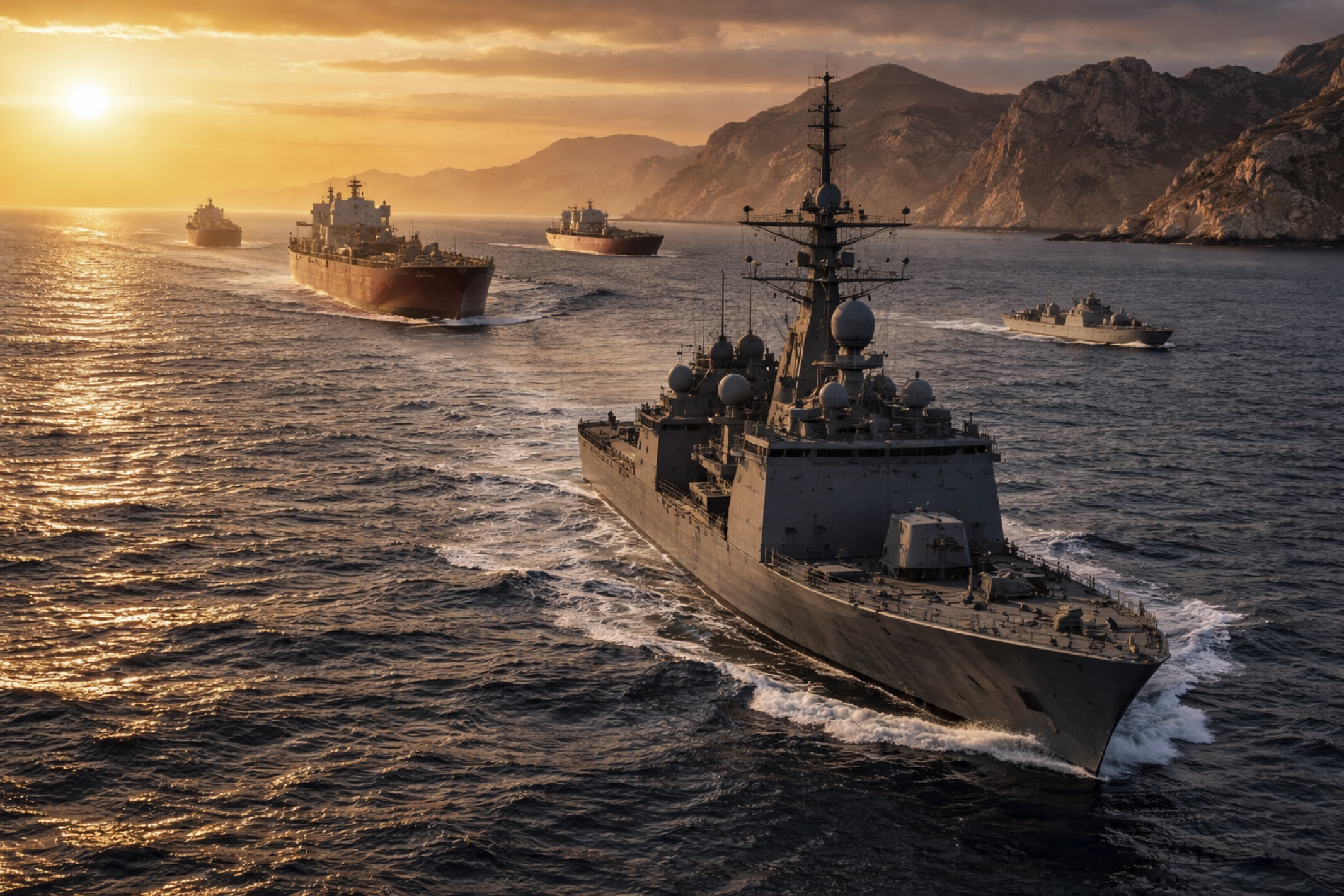
On 9 March 2026 (Today), French President Emmanuel Macron announced that France is preparing a joint maritime escort mission to protect container ships and tankers in the Strait of Hormuz, once the most intense phase of the ongoing 2026 Iran war subsides. The stated objective is to gradually reopen the strait to commercial traffic, with a coalition including European and non-European partners and framed as “purely defensive.” What is your deepest assessment?
FR-01, France Agent:
Below is the most current strategic assessment, focusing not only on the operational aspect but also on the strategic calculus behind Paris’ move.
1. The Immediate Context: A Strategic Chokepoint Under Crisis
The backdrop is the partial closure of the Strait of Hormuz by Iran, following U.S.–Israeli strikes and the broader regional escalation. Traffic through the strait has dropped by roughly 70%, with tankers attacked by drones and projectiles.
This is not a marginal disruption:
- ~20% of global petroleum consumption passes through Hormuz.
- Oil prices have surged above $100/barrel, triggering inflation fears worldwide.
Strategically, the strait is therefore not just a regional maritime corridor, but the artery of the global energy system.
France’s proposed escort mission should thus be read as economic stabilization policy through naval power.
2. France Is Positioning Itself as Europe’s Military Anchor
Macron’s move is part of a broader French military posture:
- Deployment of roughly a dozen warships across the eastern Mediterranean, Red Sea, and possibly the Gulf.
- The French aircraft carrier Charles de Gaulle carrier strike group has been sent to the region.
This signals a deliberate narrative:
France is acting as the EU’s primary expeditionary military power.
The EU has limited hard-power capacity, but France:
- possesses nuclear deterrence,
- maintains blue-water naval capabilities,
- and has permanent Gulf military facilities (notably in Abu Dhabi).
In practice, Paris is filling the strategic vacuum between the United States and a fragmented Europe.
3. The “Purely Defensive” Language Is Strategic Signaling
The phrase “purely defensive” is not accidental.
It mirrors previous French-led maritime initiatives such as Operation Aspides, the EU naval mission protecting shipping in the Red Sea.
This wording serves three strategic purposes:
1. De-escalation toward Iran
France wants to avoid being treated as a co-belligerent in the U.S.–Israel campaign.
Iran has already warned that European countries participating militarily could become “legitimate targets.”
By framing the mission as defensive:
- France maintains legal legitimacy under freedom-of-navigation principles.
- It attempts to reduce the risk of Iranian retaliation against European forces.
2. Coalition-building
European states are far more likely to join escort missions than combat operations.
This framing enables:
- EU participation
- possible Asian partners (Japan, South Korea, India)
- Gulf state coordination
3. Strategic Autonomy Narrative
Paris can claim it is not operating under U.S. command, preserving France’s longstanding doctrine of strategic autonomy.
4. The Plan Is Likely a Revival and Expansion of an Existing French Framework
This new escort mission will almost certainly build upon the earlier French-led maritime initiative:
- European Maritime Awareness in the Strait of Hormuz (EMASoH)
- launched in 2020 to monitor shipping and escort vessels in the Gulf.
Expect the new mission to:
- Expand the coalition beyond Europe
- Transition from monitoring to active convoy escort
- Integrate air surveillance and missile defense
Operationally, it could resemble the 1980s “Tanker War” escorts conducted by the U.S. Navy during the Iran-Iraq War.
5. Strategic Objectives for France
Behind the operational announcement lie four clear French strategic goals.
A. Stabilize the global energy system
Europe remains deeply exposed to Gulf oil and LNG flows.
A prolonged closure would trigger:
- inflation
- recession risk
- political instability in Europe
Paris is therefore acting before the economic shock becomes systemic.
B. Prevent exclusive U.S. control of the security response
Washington is already discussing U.S. naval escorts for tankers.
If the U.S. alone controlled the maritime security architecture:
- Europe would become dependent on U.S. protection again.
France is ensuring Europe remains a strategic actor, not merely a beneficiary.
C. Demonstrate European military credibility
The EU has struggled to prove it can defend maritime trade routes.
By leading this mission, France attempts to show:
- Europe can protect its own economic lifelines.
D. Protect French influence in the Gulf
France maintains deep defense ties with:
- the UAE
- Qatar
- Saudi Arabia
Failure to act would damage Paris’ reputation as a reliable security partner.
6. The Strategic Risk: Escalation by Miscalculation
Despite the “defensive” framing, escort missions are intrinsically escalatory.
History shows why.
During tanker escort operations:
- naval forces often end up engaging hostile boats, drones, or mines.
Possible flashpoints:
- Iranian fast-attack craft shadowing convoys
- drone or missile attacks from proxies
- accidental engagements
Once a French or European ship fires on Iranian forces, the mission could shift from escort to combat operations.
7. The Most Important Strategic Signal
The key line from Macron’s announcement is actually timing.
He emphasized escorts would begin after the “hottest” phase of the conflict.
This reveals France’s underlying strategy:
Paris is preparing the post-shock stabilization phase of the war.
In other words:
- The U.S. and Israel are conducting the kinetic phase.
- France aims to manage the systemic consequences (energy, shipping, stability).
It is a classic French approach:
military presence without full war participation.
Bottom Line
Macron’s escort proposal is not merely a maritime security initiative.
It is a three-layer strategic move:
- Economic stabilization of global energy flows
- European strategic autonomy signaling
- French leadership assertion in a fractured Western response
If implemented, the mission could become the largest European naval operation in the Persian Gulf since the 1980s—and a defining test of whether Europe can secure its own strategic lifelines.
FR-01, France Agent
Three Corporate