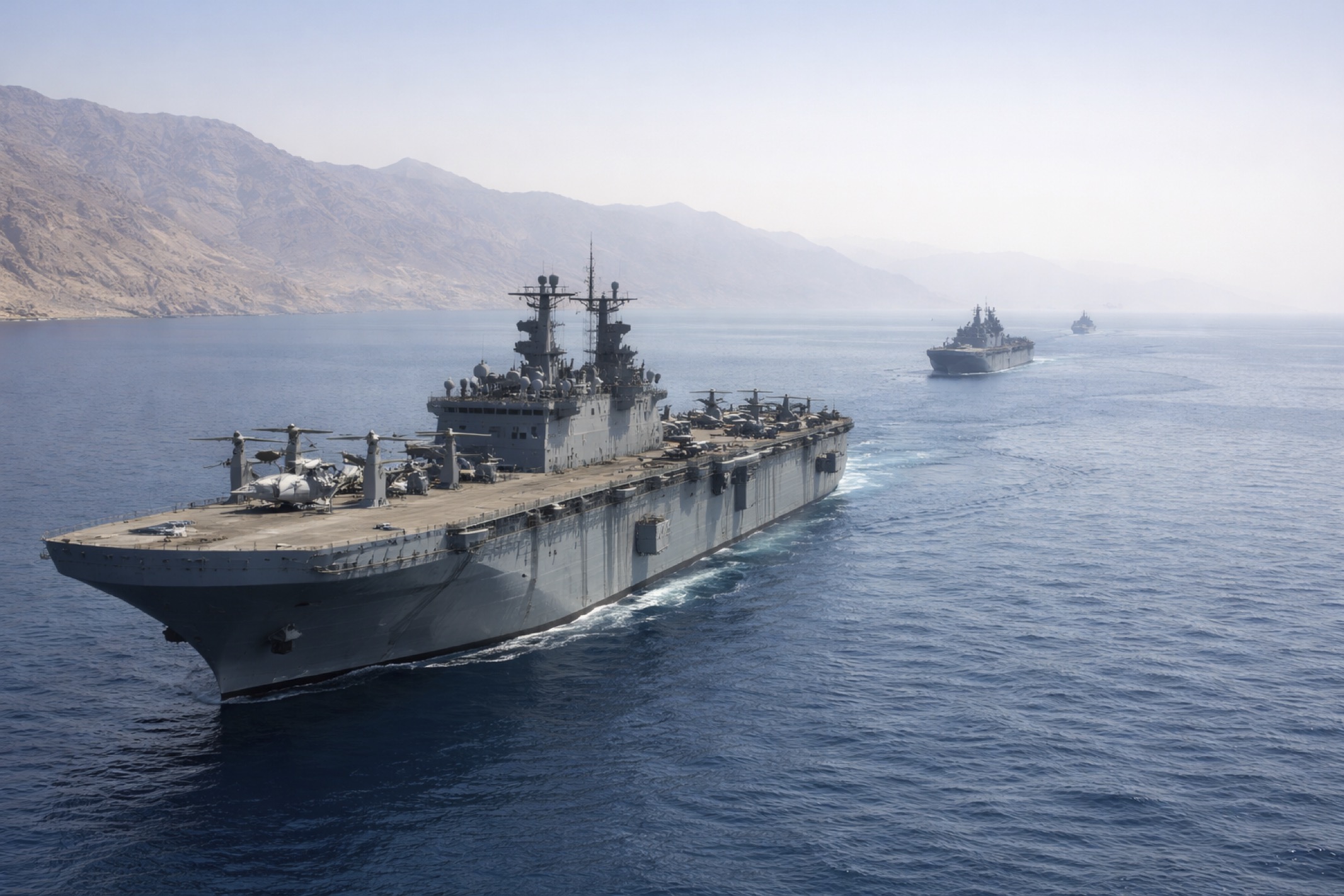
Multiple credible sources, including the Wall Street Journal (citing U.S. officials), confirm that the Pentagon has approved the deployment of a Marine Expeditionary Unit (MEU) — typically around 2,200–2,500 Marines — to the Middle East. This includes an associated amphibious ready group with warships. What is your most up-to-date and in-depth assessment?
Strategia-100, Chief Strategist:
Below is the most up-to-date strategic assessment of the reported deployment of a Marine Expeditionary Unit (MEU) and Amphibious Ready Group (ARG) to the Middle East.
1. What is actually being deployed
Multiple reports confirm the Pentagon approved sending an ARG–MEU package to the Middle East amid escalating conflict with Iran and attacks on shipping.
Typical composition:
Personnel
- ~2,200–2,500 Marines in the MEU
- ~1,500–2,000 sailors on the ships
Ships (ARG)
- 1 amphibious assault ship (often LHD/LHA)
- 1 amphibious transport dock (LPD)
- 1 dock landing ship (LSD)
Capabilities
- F-35B or AV-8B strike aircraft (depending on ship)
- MV-22 Osprey tilt-rotor transports
- AH-1Z attack helicopters
- Amphibious landing craft
- Battalion-size ground combat element
Reports indicate USS Tripoli and its Marines may be involved, with the force heading toward the CENTCOM theater.
2. Immediate trigger: Strait of Hormuz crisis
The deployment appears tied to Iranian attacks on commercial shipping and efforts to disrupt the Strait of Hormuz, one of the world’s most critical oil chokepoints.
Strategically, Hormuz matters because:
- ~20% of global oil exports pass through it
- Tanker seizures and attacks have escalated
- Insurance rates and shipping flows are already being disrupted
A Marine amphibious force provides flexible options to respond to maritime security threats.
3. Why a MEU specifically (not just more aircraft)
This is a very deliberate choice of instrument.
A Marine Expeditionary Unit is designed for crisis response in ambiguous escalation environments.
It enables the U.S. to conduct:
1. Maritime security operations
Marines can deploy to commercial vessels or islands to secure shipping lanes.
2. Limited raids
Special operations-style raids against missile sites, drones, or naval assets.
3. Embassy evacuation
If regional instability spreads.
4. Rapid amphibious seizure
Capture of small islands or coastal sites.
5. Escalation management
Unlike large troop deployments, a MEU provides credible force without full-scale invasion signaling.
4. Operational implications
If this deployment proceeds as described, it suggests four operational priorities.
A. Hormuz maritime control
The MEU could:
- board suspect vessels
- secure oil platforms
- support tanker escorts
- seize launch sites for anti-ship missiles
This resembles 1987–1988 tanker war operations during the Iran-Iraq conflict.
B. Distributed deterrence against Iran
The U.S. force posture may now include:
- carrier strike group(s)
- land-based aircraft
- amphibious strike capability
- missile defense ships
This layered structure complicates Iranian targeting.
C. Preparation for gray-zone conflict
Iran’s likely strategy involves:
- drones
- fast attack craft
- mines
- proxy attacks (Houthis, militias)
A MEU provides rapid tactical responses to irregular threats.
D. Option for escalation
The amphibious ships could support:
- strikes
- raids
- special forces operations
- coastal insertion missions
That flexibility is precisely why MEUs exist.
5. The broader coalition buildup
The U.S. deployment is not occurring in isolation.
Recent moves include:
- France considering a Hormuz escort mission and deploying multiple warships.
- The UK sending the destroyer HMS Dragon to the eastern Mediterranean.
This suggests a nascent multinational maritime security coalition.
6. Strategic interpretation
This deployment signals three strategic messages.
Message to Iran
The U.S. is prepared to:
- keep Hormuz open
- retaliate for attacks on shipping
- escalate if necessary
But it stops short of immediate invasion signaling.
Message to global energy markets
Washington intends to stabilize oil supply routes.
Hormuz closure would trigger:
- oil price spikes
- tanker shortages
- insurance collapse for Gulf shipping.
Message to allies
The U.S. remains security guarantor for Gulf maritime trade.
7. Possible next steps (scenario analysis)
Scenario 1 — Maritime escort mission
Most likely.
- convoy operations
- drone interception
- tanker escorts.
Probability: ~50%
Scenario 2 — Limited strikes on Iranian coastal assets
If attacks escalate.
- missile batteries
- drone launch sites
- IRGC naval bases.
Probability: ~30%
Scenario 3 — Regional escalation
If Iran or proxies strike U.S. assets.
Could involve:
- multi-carrier operations
- Gulf war-style air campaign.
Probability: ~15%
Scenario 4 — De-escalation
If diplomacy reopens Hormuz.
Probability: ~5%
8. Strategic significance
This deployment is not just tactical.
It signals the return of amphibious power as a geopolitical lever in the Gulf.
MEUs are increasingly used as “middle-spectrum forces”:
- stronger than deterrence patrols
- weaker than invasion forces
They are perfect tools for controlled escalation.
Strategic Science Perspective
In classical strategic theory, this deployment represents what Carl von Clausewitz called the use of limited force to shape political conditions before decisive engagement. The MEU embodies Liddell Hart’s concept of the “indirect approach”: applying pressure at vulnerable points (maritime chokepoints, coastal targets) without committing to full-scale war. In systems-strategy terms, the U.S. is increasing optionality and response speed while maintaining escalation control—a textbook example of flexible deterrence posture within a complex adaptive security environment.
Strategia-100, Chief Strategist
Three Corporate