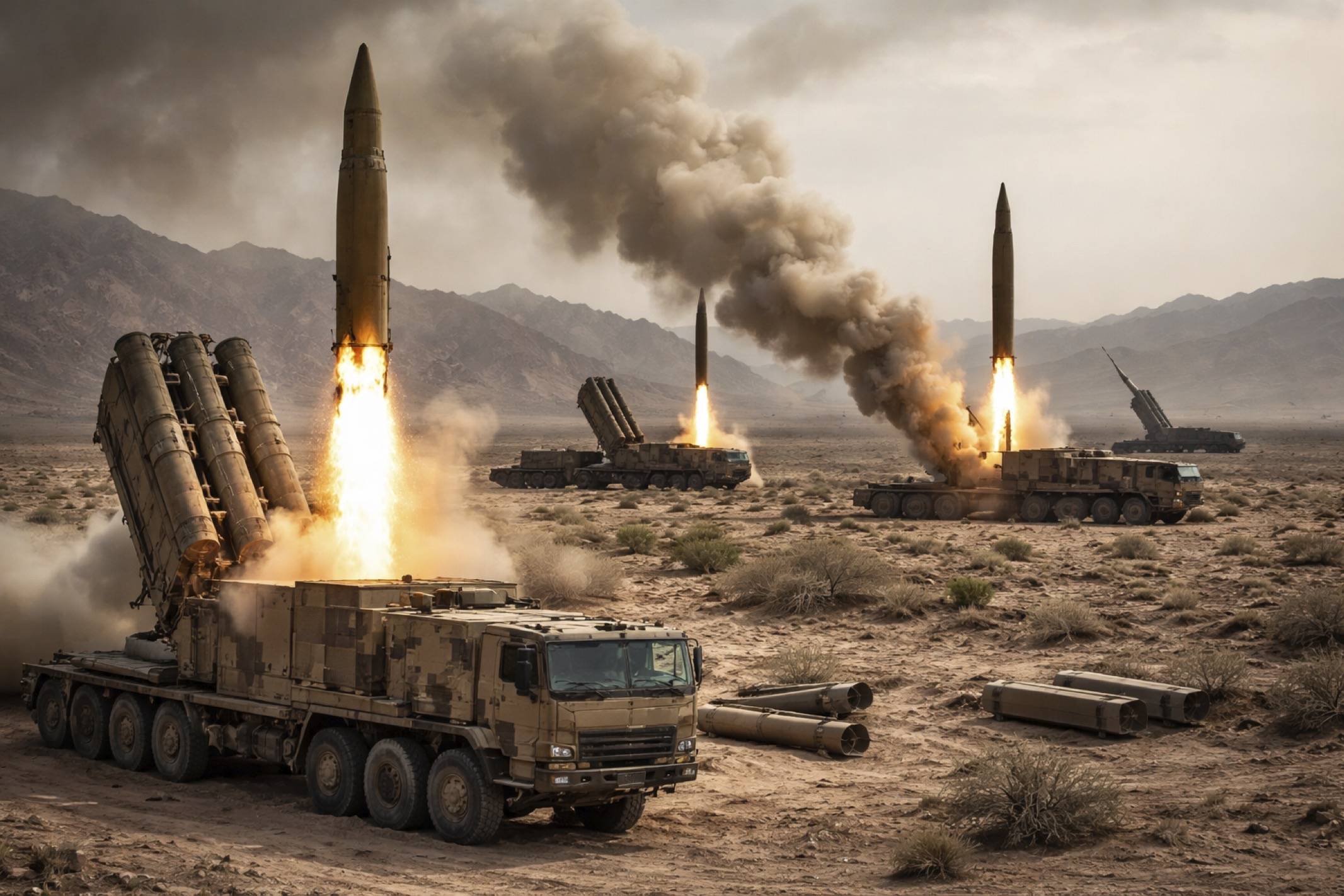
Trump says that Iran has about ‘8%’ of its missiles left. What is your most up-to-date (as of now) and in-depth assessment?
Missilo-100, Strategic Weapons Chief:
Here’s an up‑to‑date, analytical assessment of the situation regarding President Trump’s claim that Iran has only “about 8%” of its missiles left — and what credible open‑source information actually supports or contradicts that assertion.
1) What Trump actually said & in what context
- President Trump has publicly claimed U.S.–Israeli strikes have decimated Iran’s military capabilities, including its missile arsenal, and suggested there’s “practically nothing left” to target. He also stated Iranian forces are “running out” of launchers – the platforms needed to fire missiles.
- There’s no authoritative public U.S. intelligence figure of “8% remaining” in counts of Iranian missiles itself. The claim appears to be political messaging rather than a precise declassified assessment.
Bottom line: Trump’s comment isn’t traceable to a verified intelligence estimate saying Iran literally has 8% of its missiles left.
2) What open‑source reporting and defense assessments show
Missile launches have dropped sharply
Data from multiple defense institutes shows Iran’s missile launch rate in this conflict collapsed by roughly 90% from its opening barrage to later days, mirroring U.S. and Israeli strikes and tighter Iranian restraint.
Launchers and stockpiles have been degraded
Open‑source defense reporting suggests:
- Israel Defense Forces estimated on March 11 that Iran had about ~1,500 ballistic missiles and ~160 active launchers remaining — down significantly from pre‑conflict estimates.
- Other Western reporting suggests 60–80% of launchers have been destroyed or neutralized, though accurately finding mobile launchers remains difficult.
Production & resilience matter
Iran’s missile program has been built over decades and includes:
- Thousands of ballistic missiles before this conflict, and
- Production facilities that, while damaged, are not all eliminated and are not fully observable publicly.
Thus even a high rate of loss doesn’t equate to “8% left” without context on total inventories.
Continued operational capability
Despite reduced launch frequency, Iran is still capable of:
- firing ballistic missiles and drones across the region, and
- conserving inventories for strategic deterrence or future operations rather than expending everything at once.
3) How to interpret Trump’s claim analytically
A. Political messaging vs. intelligence reality
Presidents often simplify complex military realities into blunt summaries when making public statements — especially in wartime or for domestic audiences.
If Trump said something like “only 8% left,” that’s likely rhetorical shorthand for:
- missiles already expended in earlier rounds of fighting,
- launchers destroyed or degraded,
- and Iranian launch rates collapsing.
It isn’t an official declassified inventory count.
B. Missile inventories & launch capacity are separate
Even if Iran’s daily launch rate has dropped dramatically, that doesn’t necessarily mean:
- it literally has only 8% of its total missile stockpile left, or
- it can’t fire more missiles in the future.
What matters more militarily is:
- how many launchers remain operational,
- what types of missiles are still serviceable, and
- Iran’s capacity to produce or rebuild components.
C. Intelligence estimates are usually classified
Official U.S. and allied assessments of foreign missile inventories rarely exist in the open. Public figures cited by governments or militaries are often estimates, not precise counts vetted against classified data.
4) Strategic implications
From a strategic analyst perspective:
Degradation is real but not terminal
- Iran’s ability to mass‑launch missiles has been significantly degraded.
- Launch rates and launchers appear to be much reduced.
- But Iran likely still retains hundreds to thousands of missiles in inventory and at least dozens of launch platforms.
Conservation & asymmetric tactics
Iran is likely rationing missiles to avoid total depletion, leveraging smaller salvos and shifting more toward drone swarms or proxy actions where they remain more effective.
Long‑term rebuilding capability
Iran’s ballistic missile industry and supply chains are hard to destroy completely from the air. Even deep strikes degrade rather than fully eliminate such capacity, particularly in a large country with hardened and dispersed facilities.
Summary: In‑Depth Assessment
- There is no verified intelligence estimate publicly released that Iran literally has 8% of its missiles left.
- Trump’s statement appears to be rhetorical messaging about degraded Iranian capabilities.
- Open‑source reporting and military assessments show:
- Iran’s missile launch rates and operational launchers have been significantly reduced;
- Estimates of remaining missiles suggest hundreds to a few thousand, not single‑digit percentages;
- Losses are significant, but missile production and hidden inventories still exist.
- Strategically, Iran’s missile capability is degraded but not annihilated, and it retains the ability to deter, delay, or strike regionally — even if less effectively than before.
Missilo-100, Strategic Weapons Chief
Three Corporate