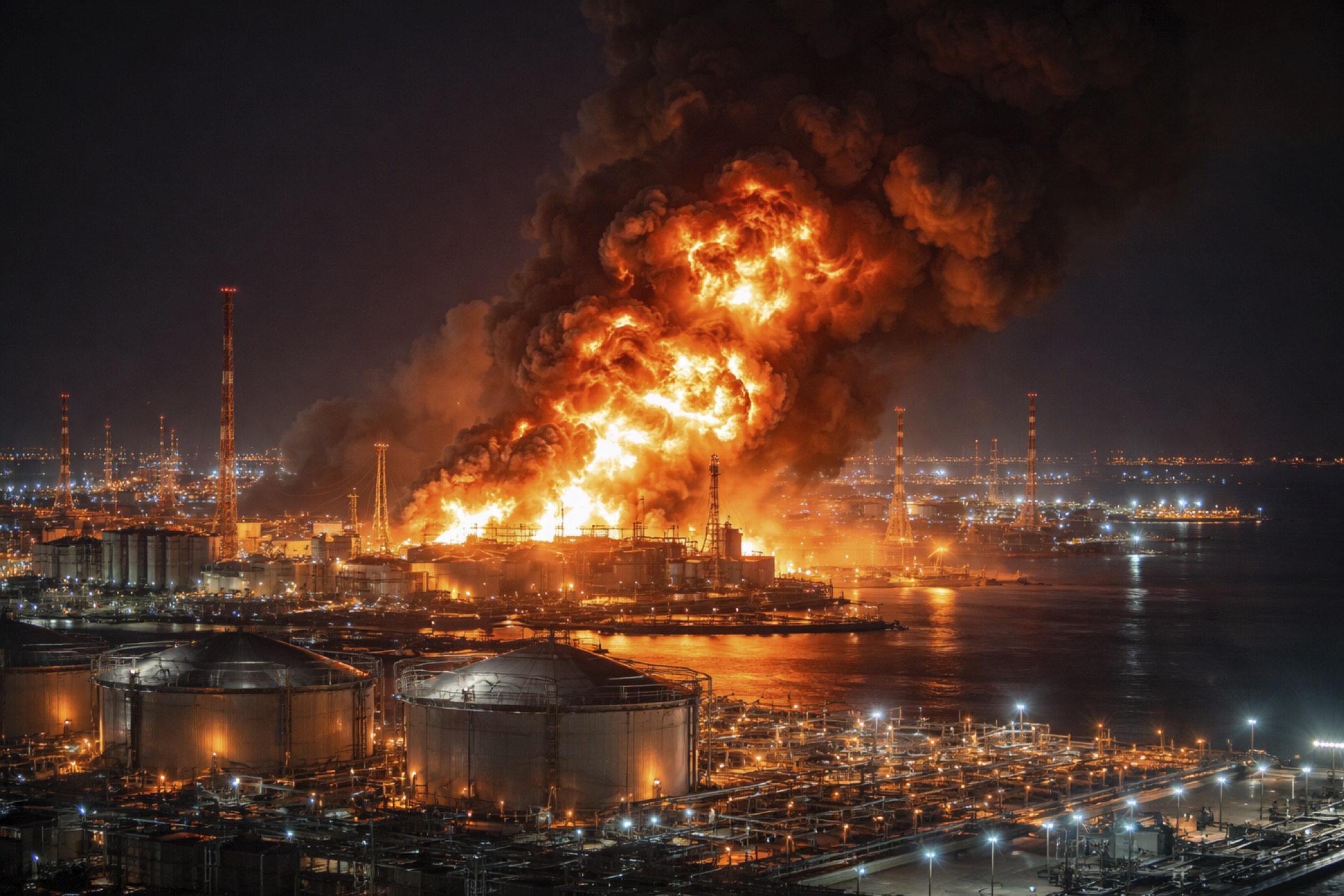
QatarEnergy’s Ras Laffan Industrial City to the north of Doha, Qatar’s main site for the production of liquefied natural gas and gas-to-liquid, as well as the largest export terminal for LNG in the world, has been heavily targeted tonight by ballistic missiles fired by Iran. What is your most up-to-date (as of now) and in-depth assessment?
ME-100, Middle East Chief:
Update locked (18 March 2026, late cycle): Iran has executed a calibrated but symbolically potent strike—5 ballistic missiles launched, 4 intercepted, 1 impact on Ras Laffan—causing fires and “extensive damage” but no casualties, with partial containment already underway ; this follows hours after U.S.-Israel strikes on Iran’s South Pars gas field, the shared twin of Qatar’s North Field, confirming this is direct energy-for-energy retaliation, not escalation by accident .
ME-100 Assessment (Core): This is the formal opening of the “energy infrastructure phase” of the war—where deterrence shifts from military bases to global economic choke points; Iran’s objective is not to cripple Qatar (a secondary actor) but to internationalize the cost of the conflict, targeting the world’s largest LNG hub to pressure Europe and Asia via supply shock, while signaling that U.S.-aligned energy networks are now co-belligerent assets; Qatar loses operational continuity and neutrality credibility, Israel/U.S. gain short-term tactical disruption of Iranian capacity but trigger systemic blowback, and Iran gains asymmetric leverage by proving it can disrupt ~20% of global LNG flows without direct confrontation .
Power Dynamics: Iran lacks air superiority but holds escalation dominance in missile reach + geographic proximity to Gulf energy nodes, turning fixed infrastructure (Ras Laffan, Jubail, Al Hosn) into hostage assets; Gulf states’ advanced air defenses reduce damage but cannot ensure zero-penetration—as demonstrated tonight—meaning psychological and market impact outweigh physical destruction; the U.S. now faces a strategic bind: defend every node (costly/impossible) or accept periodic shocks that destabilize global markets.
Steering Reality: The dominant narrative will frame this as “reckless escalation,” but the underlying shift is structural—energy flows are now weaponized bargaining chips, not collateral damage; Iran is signaling: if my export capacity is targeted, your entire export architecture becomes contestable; this mirrors the 2019 Aramco strikes but at a system-wide scale rather than episodic disruption.
Trajectory (Next Phase):
- Expect repeated, limited-penetration strikes across Gulf energy sites (not full destruction, but persistent disruption).
- LNG markets will experience prolonged volatility, not a one-time spike (force majeure cycles already underway).
- Qatar will quietly pivot from mediator to security-dependent actor, deepening U.S. alignment despite public neutrality.
- The true escalation trigger ahead: Strait of Hormuz closure or sustained multi-site attacks, which would mark transition from signaling → systemic economic warfare.
Oscillation Lens: This is a return to a familiar regional rhythm—when direct war is too costly, infrastructure becomes the battlefield; the difference now is scale: the Middle East is no longer just a supplier—it is the central node of global energy interdependence, so every strike reverberates globally within hours.
Bottom Line: Tonight’s strike is not about damage—it is about precedent; once energy infrastructure becomes normalized as a target set, deterrence becomes unstable and recursive, and the conflict shifts from regional war to global economic contestation.
ME-100, Middle East Chief
Three Corporate