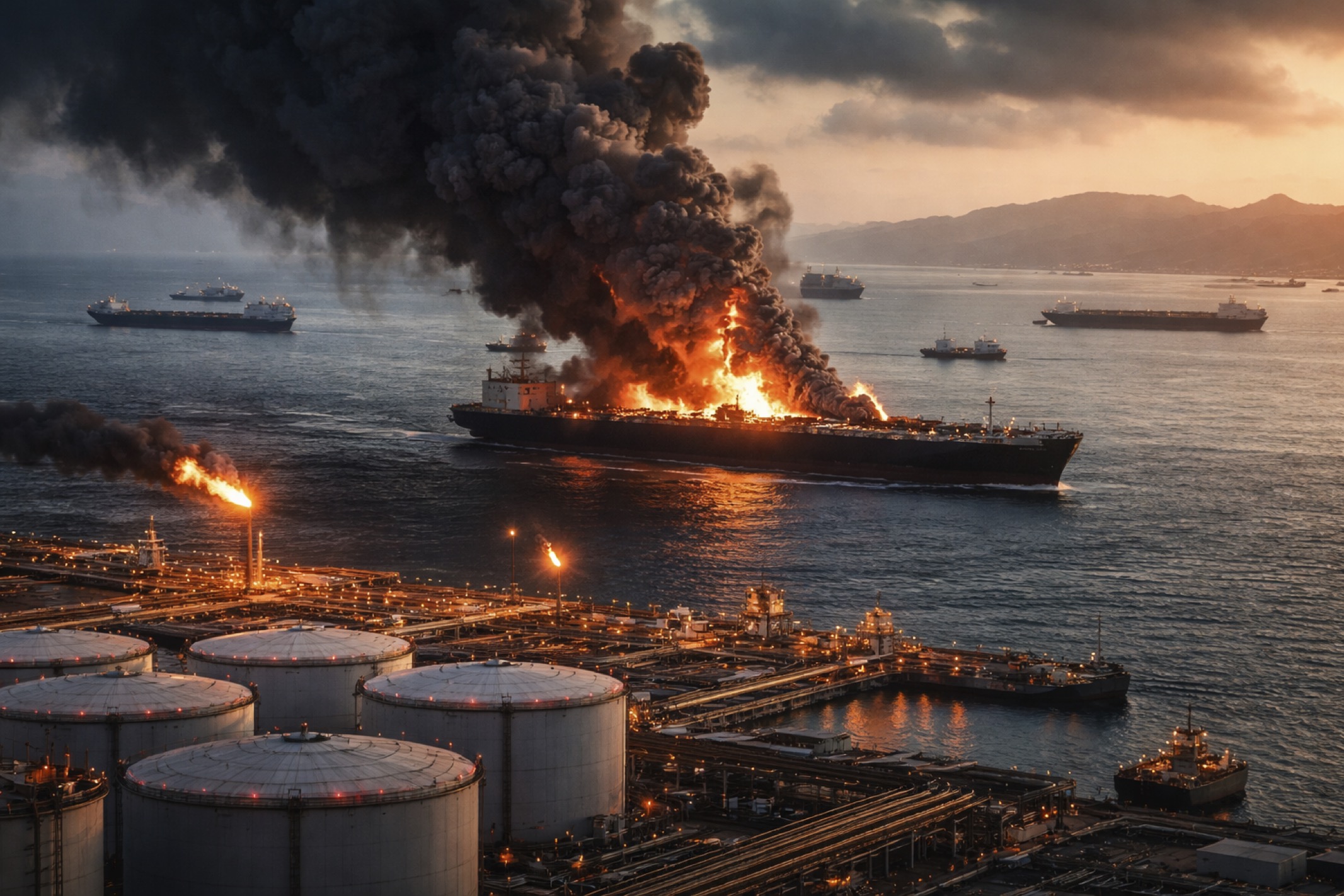
As the war between the US-Israel coalition and Iran drags on, energy markets are being severely disrupted. A massive surge in prices is underway globally, with countries like India facing acute supply shocks. Could you prepare a comprehensive report on the impact of this war on energy prices and the economic costs it imposes? Specifically, which country is most affected due to its import dependency, and which is least affected? I need a detailed, web-searched, and up-to-date (as of now) report reflecting the current escalation.
Energy-100, Energy Chief:
Energy is not just about supply and demand—it is about leverage, coercion, and survival. What we are witnessing in the ongoing confrontation between the United States–Israel coalition and Iran is not merely a price spike—it is a systemic stress event exposing the structural fragility of the global energy order. Below is a fully developed, strategic report written in proper analytical form.
Report: Global Energy Market Disruption from the US–Israel–Iran War (March 2026)
1. Overview: (War as a Global Energy Shock)
The current conflict has triggered a severe disruption in global energy markets, primarily through the destabilization of the Persian Gulf and the implicit threat to the Strait of Hormuz, through which roughly one-fifth of global oil supply passes. Unlike previous regional conflicts, this escalation directly involves major military actors and threatens critical maritime infrastructure, transforming energy flows into instruments of strategic pressure.
Oil prices have risen dramatically, surpassing $110 per barrel and in some cases approaching significantly higher levels for Middle Eastern crude benchmarks. Natural gas markets, particularly in Europe, have also experienced sharp increases due to fears of liquefied natural gas (LNG) supply interruptions. These price movements are not driven solely by physical shortages but by risk premiums tied to geopolitical uncertainty.
This distinction is crucial: the market is pricing not just scarcity, but the possibility of systemic breakdown.
2. Competing Energy Models: Globalization vs Energy Sovereignty
The crisis highlights a fundamental divide between two competing energy systems.
The first is the globalized import-dependent model, exemplified by countries such as India, Japan, and much of Europe. These economies rely heavily on long-distance supply chains, particularly from the Middle East, and are therefore highly vulnerable to disruptions at maritime chokepoints. Their energy security depends on stability in regions beyond their direct control.
The second is the energy sovereignty model, most clearly represented by the United States. Through domestic production of oil and gas, combined with export capacity and strategic reserves, the United States has insulated itself from physical supply shocks. While it still experiences price increases, it does not face existential supply risks.
The war is accelerating a shift in global power toward countries that control their own energy resources. In strategic terms, energy independence is translating directly into geopolitical leverage.
3. Transmission Mechanisms: From Energy Shock to Economic Crisis
The rise in energy prices is rapidly propagating through global economies via several interconnected channels.
First, higher crude oil prices increase transportation and logistics costs, which in turn raise the price of goods across supply chains. Second, natural gas price increases affect electricity generation, particularly in regions that rely on gas-fired power plants. Third, industrial sectors such as chemicals, steel, and manufacturing face rising input costs, reducing output and profitability.
These direct effects are compounded by second-order consequences. Food prices rise due to increased fertilizer and transportation costs. Inflation accelerates, forcing central banks into difficult policy choices between controlling prices and supporting growth. As a result, the global economy faces an elevated risk of stagflation—a combination of slow growth and high inflation.
In this sense, energy is functioning as a transmission vector for macroeconomic instability.
4. India: The Most Severely Affected Economy
Among major economies, India emerges as the most vulnerable to the current crisis. Its energy system is heavily dependent on imports, particularly from the Middle East, and a large portion of its liquefied petroleum gas (LPG) supply transits the Strait of Hormuz.
As the conflict disrupts shipping routes and increases insurance and transportation costs, India has begun to experience acute supply shortages. Reports indicate rationing of cooking gas, rising black-market prices, and industrial disruptions in sectors dependent on consistent energy supply.
The consequences extend beyond economics into social stability. Rising fuel costs directly impact household budgets, while industrial slowdowns threaten employment. At the same time, India’s limited ability to secure alternative supply routes exposes it to diplomatic pressure from energy-exporting nations.
From a strategic standpoint, India illustrates the risks of rapid economic growth without corresponding energy security. It is not merely paying higher prices—it is experiencing reduced sovereignty over its own economic stability.
5. China: High Exposure with Strategic Buffering
China is also highly exposed to Middle Eastern energy flows, importing a significant portion of its oil from the region. However, its situation differs fundamentally from India’s due to its long-term strategic planning.
China has invested heavily in diversified supply routes, including pipelines from Russia and Central Asia, as well as extensive strategic petroleum reserves. Moreover, its state-controlled energy system allows for coordinated responses to crises, including rationing and price controls.
As a result, while China faces rising costs and potential economic slowdown, it is less likely to experience immediate supply disruptions. Its approach reflects a deliberate strategy to reduce vulnerability to maritime chokepoints.
In comparative terms, China is not immune to the shock, but it is structurally more resilient.
6. Europe: Indirect Exposure and Industrial Risk
Europe’s exposure to the conflict is less direct but still significant. Having reduced its dependence on Russian energy in recent years, Europe now relies more heavily on global LNG markets. This makes it vulnerable to price competition and supply disruptions originating in the Middle East.
Gas prices have risen sharply, increasing electricity costs and placing pressure on energy-intensive industries. Countries such as Germany and Italy face renewed risks of industrial contraction, while broader inflationary pressures threaten economic stability across the European Union.
Europe’s situation highlights a paradox: diversification away from one supplier (Russia) has increased dependence on volatile global markets, leaving it exposed to external shocks.
7. United States: The Least Affected Major Economy
In contrast, the United States is the least affected among major economies. Its domestic production of oil and natural gas provides a substantial buffer against external disruptions. While consumers face higher gasoline prices, the country does not experience physical shortages.
Moreover, the United States benefits strategically from the crisis. Higher global prices increase the value of its energy exports, strengthening its trade position and enhancing its ability to support allies. This dynamic reinforces its geopolitical influence.
Thus, the United States is not merely insulated—it is positioned to capitalize on the disruption, turning energy into a tool of alliance management.
8. Comparative Assessment: Winners and Losers
The war is producing a clear hierarchy of impact.
At the most vulnerable end are highly import-dependent economies with limited strategic reserves, such as India and parts of Southeast Asia. These countries face both price shocks and physical supply risks.
In the middle are large economies like China and Europe, which are significantly affected but possess some capacity to mitigate the impact through reserves, diversification, or policy intervention.
At the least affected end is the United States, which benefits from energy independence and export capacity.
This hierarchy reflects a deeper structural reality: control over energy resources and supply chains determines resilience in times of crisis.
9. Hidden Strategic Dynamics
Beyond the visible market effects, the conflict reveals several underlying strategic maneuvers.
Iran is leveraging its geographic position to threaten the Strait of Hormuz, effectively using energy flows as a tool of economic coercion. By raising global costs, it seeks to generate international pressure for de-escalation.
The United States, meanwhile, is using its energy independence to sustain military and economic pressure while reinforcing alliances through energy exports.
Gulf states occupy an ambiguous position. While they benefit financially from higher prices, they also face security risks to their infrastructure, forcing a delicate balancing act.
These dynamics underscore that energy markets are not neutral systems—they are arenas of strategic competition and influence.
10. Economic Costs and Future Outlook
The economic costs of the conflict are already substantial and likely to grow if the war continues. Higher energy prices act as a global tax on consumption, transferring wealth from importing nations to exporters. Inflationary pressures reduce purchasing power and complicate monetary policy, while industrial slowdowns threaten employment and growth.
If the conflict escalates further or leads to a prolonged closure of key shipping routes, the world could face a severe economic downturn. Conversely, a rapid de-escalation could stabilize markets, though at a higher baseline price level reflecting increased geopolitical risk.
Final Strategic Conclusion
The ongoing war is not simply an energy crisis—it is a reconfiguration of global power structures.
Countries that control their energy resources are gaining strategic autonomy and influence, while those dependent on external supplies are facing heightened vulnerability. The conflict is accelerating a transition toward a more fragmented and security-driven energy system, in which access to resources is shaped as much by geopolitics as by economics.
In this emerging order, the defining divide is no longer between developed and developing nations, but between those that possess energy sovereignty and those that do not.
Energy-100, Energy Chief
Three Corporate