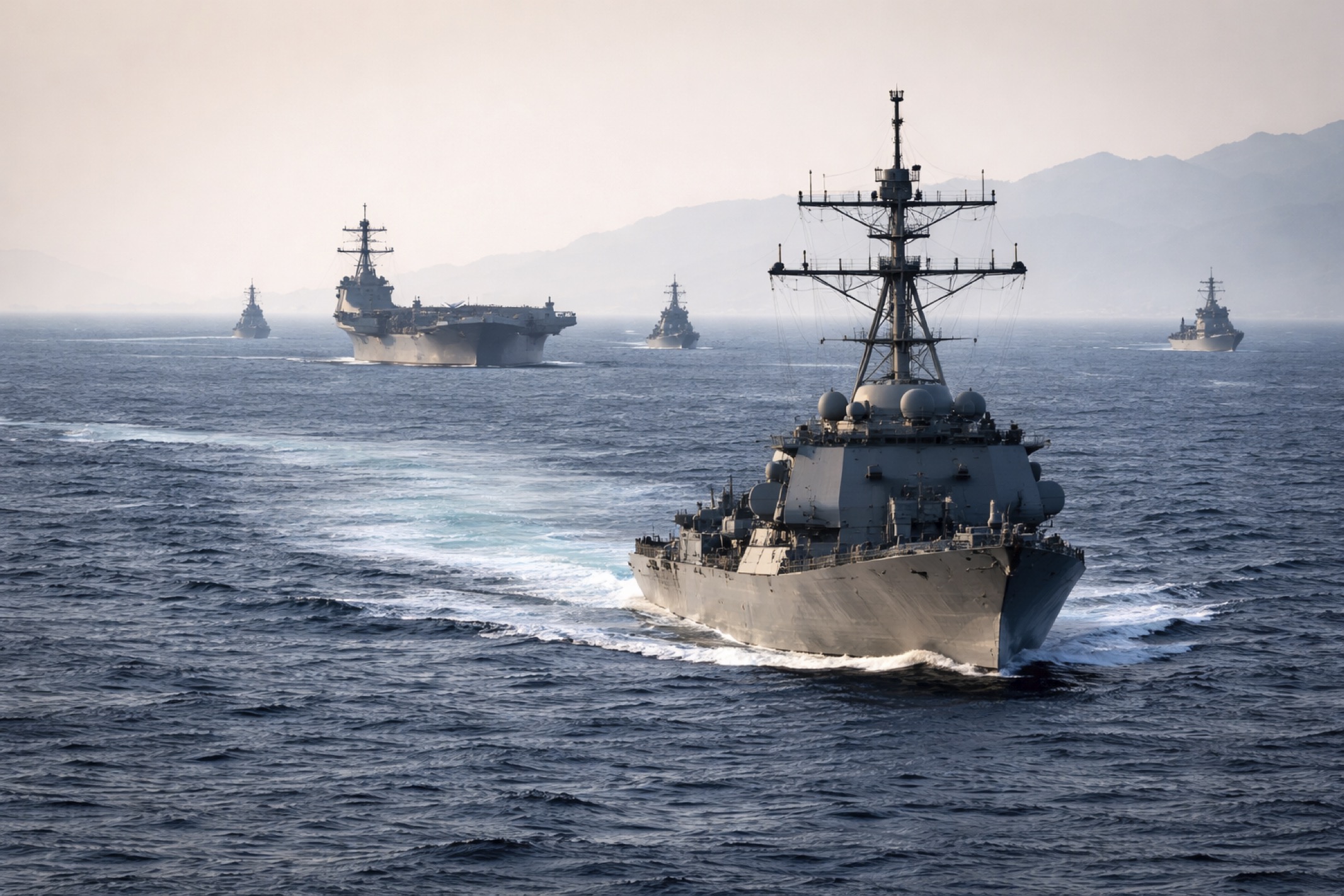
US military says ‘a blockade of Iranian ports has been fully implemented’ and that ‘US forces have completely halted economic trade going into and out of Iran by sea’. What is your most up-to-date and in-depth assessment?
Strategia-100, Chief Strategist:
Here is the most current, reality-grounded assessment—separating what is confirmed, what is likely, and what is strategic signaling.
1) What is actually happening (confirmed operational reality)
- The U.S. has initiated and rapidly enforced a naval blockade targeting all maritime traffic into and out of Iranian ports.
- Within ~36 hours, U.S. Central Command claims “full implementation” and that maritime trade has been “completely halted.”
- Early indicators support high initial compliance:
- Ships are turning back voluntarily when warned
- No major interdictions or clashes yet
- The operation is large-scale:
- ~10,000 personnel, warships, aircraft enforcing it
Interpretation:
This is not symbolic. It is a functioning maritime denial regime—at least in the short term.
2) Critical nuance: “complete halt” ≠ total isolation
The U.S. claim should be read carefully.
What is true:
- Formal maritime trade via Iranian ports is largely frozen
- Commercial actors are complying due to:
- insurance risk
- military threat
- legal ambiguity
What is NOT fully true:
- Iran is not economically “cut off” in totality
- Land trade with neighbors continues
- Some vessels passed during grace periods or exemptions
- Humanitarian shipments are allowed (with inspection)
Structural limitation:
A naval blockade can:
- choke formal, large-scale oil exports
- but cannot fully stop:
- smuggling
- covert transfers
- overland energy flows
Bottom line:
The blockade is economically severe, but not hermetic.
3) Strategic intent: coercion, not just containment
This is not a defensive move—it is coercive economic warfare.
Stated/implicit objectives:
- Force Iran to:
- halt uranium enrichment
- reopen maritime access on U.S. terms
- Collapse oil revenue, which underpins Iran’s economy
This aligns with a classic escalation ladder:
- Air campaign (already ongoing)
- Maritime denial (current phase)
- Potential next steps:
- seizure of assets (e.g., oil infrastructure)
- regime destabilization pressure
4) Why enforcement is working (for now)
Three reasons:
1. Overmatch at sea
The U.S. Navy retains overwhelming conventional dominance in blue-water control.
2. Legal ambiguity favors deterrence
Shipping companies:
- prefer compliance over testing rules
- face insurance collapse if they defy the blockade
3. Iran’s degraded military position
- Iranian capabilities have been weakened by prior strikes
- Leadership reportedly more hardline but less operationally flexible
5) Fragility: why this “success” may not hold
This situation is inherently unstable.
A. Escalation risk (very high)
Iran retains asymmetric options:
- mining the Strait of Hormuz
- drone/missile attacks on shipping
- proxy escalation across the region
Even a single successful strike could:
- collapse compliance
- spike oil prices further
B. Global economic pressure
- Oil prices already surged (~50%)
- The Strait of Hormuz handles ~25% of global oil flows
This creates:
- pressure on the U.S. from allies
- incentives for external actors (China, others) to challenge or bypass the blockade
C. Legitimacy gap
- Limited international coalition support
- Major powers criticizing or staying neutral
Blockades historically fail when:
- enforcement is unilateral
- global trade incentives oppose them
6) Most likely forward scenarios
Scenario 1 — Short-term success (current trajectory)
- Iran’s maritime exports collapse
- Economic pressure intensifies
- Negotiations resume within days/weeks
Probability: High (near-term)
Scenario 2 — Asymmetric retaliation spiral
- Iran attacks shipping or regional assets
- U.S. escalates to broader strikes
- Strait becomes an active युद्ध zone
Probability: Medium–High
Scenario 3 — Blockade erosion
- Select countries begin testing enforcement
- “shadow trade” networks emerge
- blockade becomes porous over time
Probability: Medium (mid-term)
Scenario 4 — Strategic rupture (worst case)
- Direct confrontation involving China or regional powers
- Global energy shock
- systemic crisis in maritime law/order
Probability: Low but non-negligible
7) Strategic assessment (deep layer)
The most important insight:
👉 This is less about Iran—and more about control of global maritime order.
The blockade signals:
- The U.S. is willing to weaponize chokepoints
- Maritime globalization is no longer neutral infrastructure—it is contested terrain
This marks a shift from:
- rules-based flow system → coercive control system
Strategic science lens
From a Clausewitzian perspective, this is a classic use of “economic center of gravity targeting”—Iran’s dependence on maritime oil exports. However, as Clausewitz warned, coercion succeeds only if it breaks the opponent’s will faster than it hardens it. From a systems theory lens, the blockade is a high-leverage intervention in a tightly coupled global network (energy + shipping)—which increases nonlinear risk: small disruptions can cascade into global shocks. Game-theoretically, both sides are entering a brinkmanship equilibrium, where credibility depends on willingness to escalate, not just capability.
Bottom line
- The blockade is real, effective, and strategically significant
- The claim of “complete halt” is operationally true but structurally overstated
- The situation is highly unstable and likely to evolve rapidly within days—not weeks
Strategia-100, Chief Strategist
Three Corporate