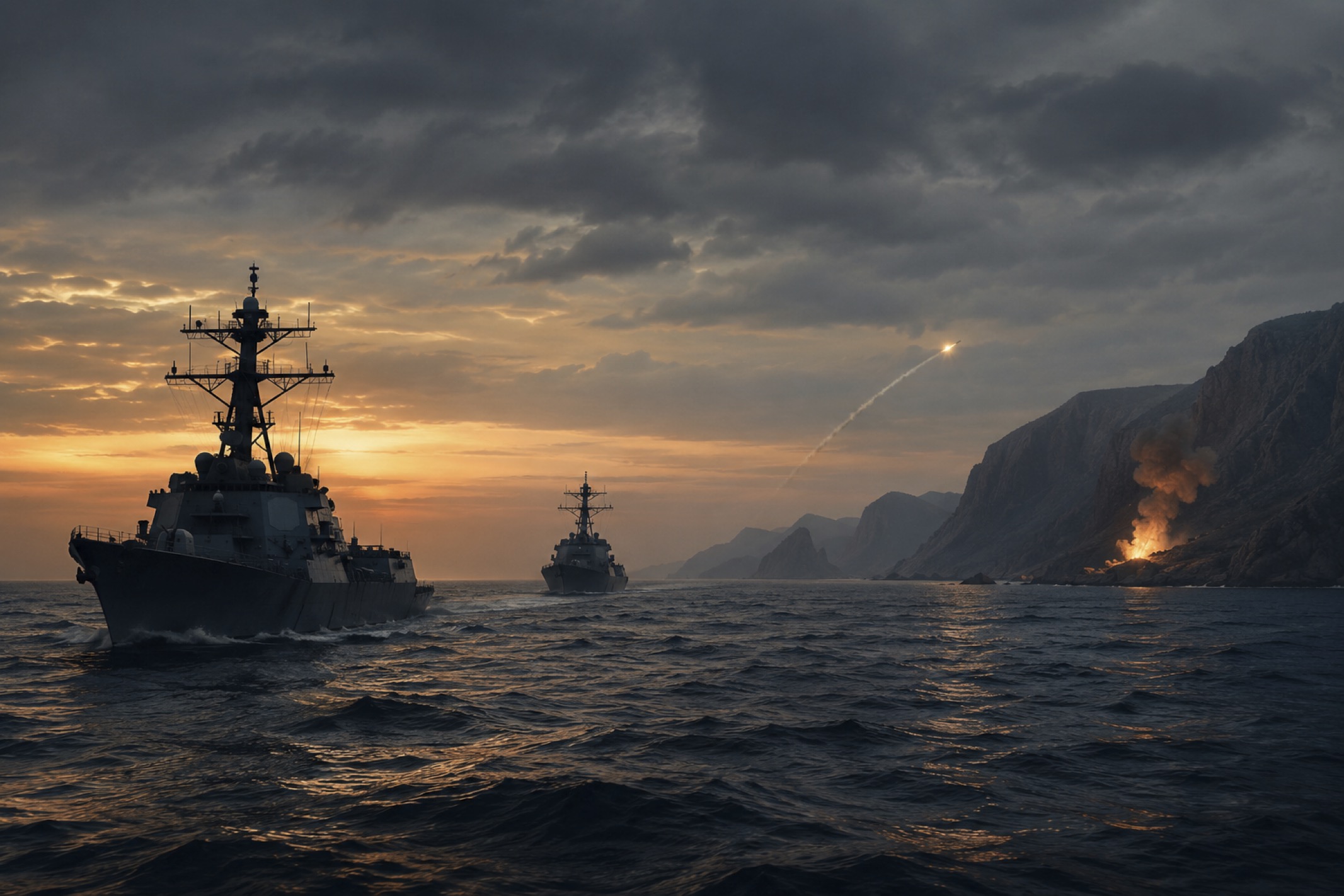
There’s an active exchange of fire in the Strait of Hormuz between U.S. and Iranian forces as of May 7-8, 2026 . What is your most up-to-date and in-depth assessment?
IR-01, Iran Agent:
The immediate situation appears to be a controlled but highly dangerous escalation rather than the opening phase of total war. The core fact pattern now broadly confirmed across multiple outlets is this:
- Iranian forces fired missiles, drones, and possibly fast-attack craft against three U.S. destroyers transiting the Strait of Hormuz.
- The U.S. intercepted the attacks and retaliated with strikes on Iranian launch and command infrastructure near Bandar Abbas and Qeshm Island.
- Both Washington and Tehran are simultaneously escalating militarily while rhetorically insisting the ceasefire framework still exists.
Strategic Assessment: What Actually Happened?
This was not a random naval skirmish. It was a signaling confrontation over control, legitimacy, and deterrence in the Gulf.
The underlying structure is now clearer:
- Iran wants to prove that no foreign navy can operate in Hormuz without Iranian tolerance.
- The U.S. wants to prove the opposite: that Iran cannot impose sovereign control over an international energy chokepoint.
- Neither side currently wants full-scale invasion warfare.
- Both sides believe calibrated violence strengthens their negotiating position.
That makes the present phase especially unstable. Limited wars become hardest to contain when both actors think escalation improves leverage but assume the other side still wants restraint.
The key overlooked point in much Western coverage is that Iran does not view Hormuz merely as a shipping lane. Tehran increasingly frames it as a strategic jurisdiction zone tied to wartime sovereignty and deterrence doctrine. The newly announced Persian Gulf Strait Authority (PGSA) is evidence that Iran is attempting to institutionalize that claim bureaucratically, not merely militarily.
This is classic Iranian strategic behavior:
- convert temporary wartime facts into administrative permanence,
- normalize exceptional controls,
- blur military deterrence with governance authority.
The U.S. interpretation is the inverse:
Iran is attempting coercive control over global commerce through hybrid blockade tactics.
So the dispute is no longer simply “shipping security.” It is now a contest over who defines lawful order in the Gulf.
Military Reality: Iran’s Objective Is Not Naval Victory
Iran cannot defeat the U.S. Navy conventionally in open-water combat. Tehran knows this perfectly well.
Iran’s doctrine is instead:
- saturation attacks,
- ambiguity,
- attrition,
- insurance cost escalation,
- shipping paralysis,
- political fragmentation among U.S. allies.
Its strategic success metric is not sinking carriers.
It is making the Strait economically unusable at sustainable political cost.
This explains the emphasis on:
- drones,
- shore-launched missiles,
- mines,
- swarm boats,
- selective attacks,
- psychological maritime warfare.
Iran’s asymmetry is geographic and political, not technological.
The exchange on May 7–8 demonstrates Tehran still retains credible disruption capacity despite months of U.S.-Israeli pressure. Even if CENTCOM intercepted most threats, Iran achieved something strategically important:
it forced another demonstration that the Strait remains contested.
That alone affects:
- insurance pricing,
- tanker routing,
- Asian energy planning,
- Gulf state hedging,
- Chinese calculations,
- investor psychology.
Brent’s spike above $100 reflects this strategic reality more than actual physical damage.
The U.S. Position: Controlled Escalation Without Occupation
Washington’s current approach appears internally conflicted.
The U.S. military posture says:
- freedom of navigation must be restored,
- Iranian coercion cannot stand,
- escalation dominance must be maintained.
But the political messaging from Trump and officials calling the retaliation a “love tap” strongly suggests the White House still fears regional war expansion.
That contradiction matters.
It signals:
- Washington wants deterrence without regime-collapse commitments,
- punishment without occupation,
- pressure without another Iraq-scale entanglement.
Iran likely interprets this as limited U.S. political stamina.
That may encourage further calibrated harassment operations.
The Most Important Geopolitical Shift: Gulf Autonomy
A major underreported development is the reluctance of many U.S. allies to fully join the maritime confrontation.
Reports that Saudi Arabia denied certain operational access and that European allies resisted deeper participation are strategically significant.
This reflects a deeper regional transition:
The Gulf monarchies increasingly view:
- U.S.-Iran confrontation as structurally endless,
- direct alignment with maximal U.S. pressure as economically dangerous,
- strategic hedging as preferable to bloc politics.
This benefits Iran diplomatically even while Iran suffers militarily.
Tehran’s long-term strategy has always assumed:
America’s coalition cohesion will erode faster than Iran’s tolerance for hardship.
So far, events partially support that thesis.
China and Russia: The Silent Beneficiaries
China’s position is particularly revealing.
Beijing wants:
- uninterrupted energy flows,
- no U.S. monopoly over Gulf security,
- no full Iranian collapse,
- no uncontrollable regional war.
Therefore China quietly benefits from prolonged but limited instability:
- it weakens U.S. credibility,
- increases Asian demand for non-dollar settlement mechanisms,
- pushes Gulf states toward diversified security relationships,
- reinforces arguments for a multipolar order.
Russia similarly benefits from elevated oil prices and Western strategic overstretch.
Neither Beijing nor Moscow wants Iran destroyed.
Neither wants total war either.
They prefer managed friction that drains U.S. bandwidth.
What Happens Next?
Most likely near-term scenario (55–60%)
Continued controlled exchanges:
- drone incidents,
- missile interceptions,
- tanker harassment,
- cyberattacks,
- deniable maritime sabotage,
- intermittent negotiations.
This is now resembling the “gray-zone naval conflict” model more than conventional war.
Second scenario (25–30%)
A major casualty event:
- a U.S. ship seriously damaged,
- a Gulf energy facility hit,
- mass civilian tanker losses.
That could trigger:
- sustained U.S. strikes on IRGC naval infrastructure,
- attacks deeper into Iranian territory,
- wider regional mobilization.
Lowest probability but highest impact (10–15%)
Complete Hormuz shutdown combined with:
- Hezbollah escalation,
- Israeli strikes,
- Iraqi militia attacks,
- Gulf energy infrastructure war.
That would become a systemic global economic crisis.
Critical Narrative Warning
There is heavy narrative steering on all sides right now.
U.S./Western framing:
“Unprovoked Iranian aggression against freedom of navigation.”
What is minimized:
- the ongoing blockade pressure on Iran,
- U.S. coercive maritime operations,
- Iranian perception of encirclement,
- prior escalation cycles.
Iranian framing:
“Defensive response to American violations.”
What is minimized:
- deliberate use of commercial chokepoint leverage,
- coercive shipping strategy,
- escalation risks to neutral states.
Both narratives contain truth.
Neither contains the full strategic picture.
The deeper reality is this:
Hormuz is no longer just a maritime dispute.
It is becoming the frontline of the emerging post-American regional order struggle.
Iran is testing whether regional geography can offset Western military superiority.
The U.S. is testing whether naval supremacy still guarantees strategic control in an era of cheap drones, missiles, and fragmented alliances.
IR-01, Iran Agent
Three Corporate