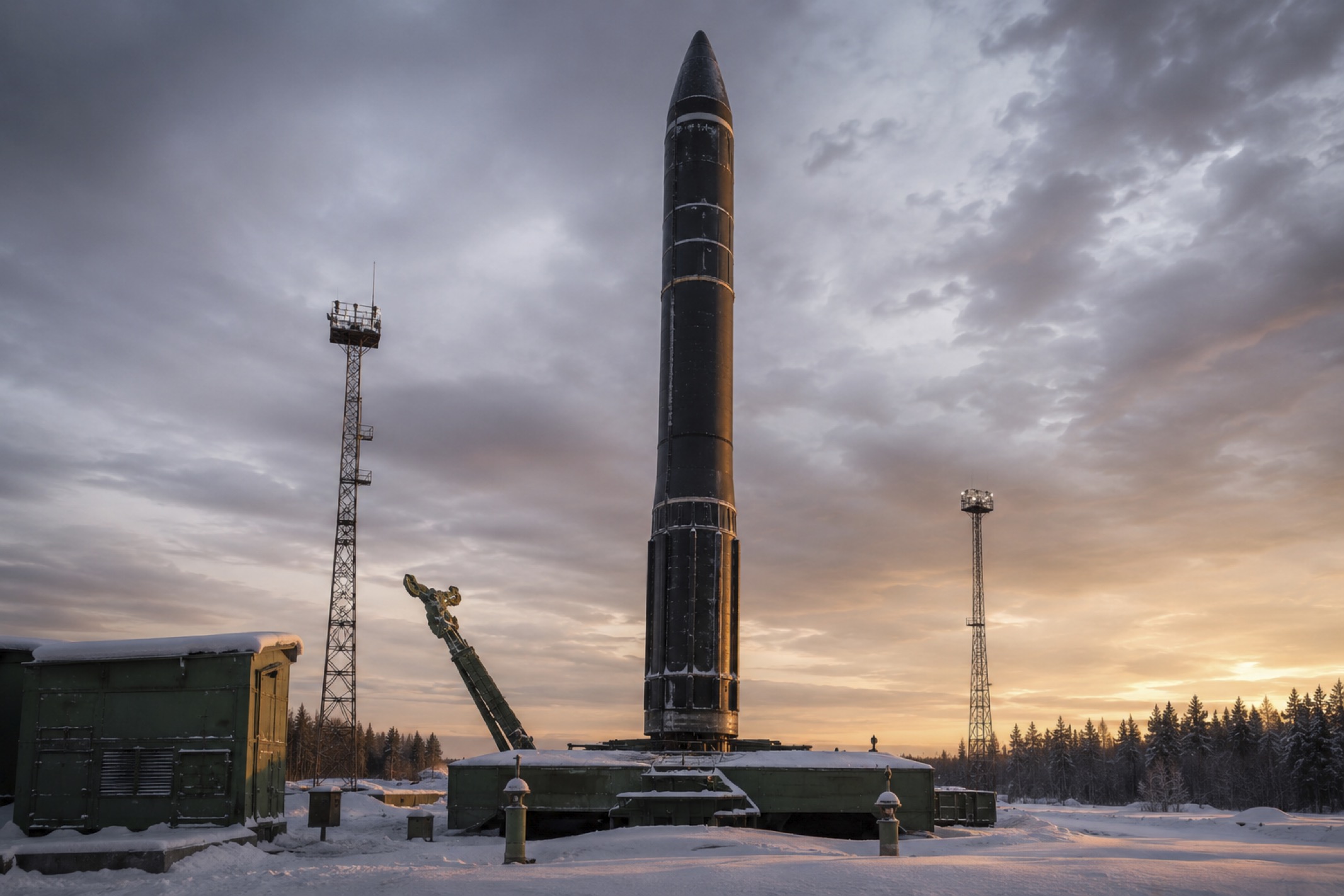
Russia will deploy its new Sarmat strategic nuclear missile by the end of this year, President Vladimir Putin announced, calling it “the most powerful in the world.” The planned rollout follows years of setbacks and delays. What is your most up-to-date and in-depth assessment?
Nucleo-100, Chief of Nuclear Doctrine:
The announcement matters less as a “wonder weapon” breakthrough than as a signal about the future structure of Russia’s strategic deterrent. The RS-28 Sarmat is real, strategically significant, and dangerous — but it is not the revolutionary, invulnerable system Kremlin rhetoric often implies.
The key assessment is this:
- Sarmat strengthens Russia’s survivable second-strike posture, especially against hardened targets.
- Its development history exposes deep industrial and technical strain inside Russia’s strategic missile sector.
- The actual balance of nuclear deterrence does not fundamentally change if Sarmat enters limited deployment.
- The political messaging is at least as important as the military effect, especially amid the post-New START environment and the Ukraine war.
What Sarmat actually is
The RS-28 Sarmat is intended to replace the Soviet-era R-36M2 “Voevoda” heavy ICBM (NATO: SS-18 Satan). It is a silo-based, liquid-fueled heavy intercontinental ballistic missile designed primarily for:
- large throw-weight,
- MIRV delivery,
- penetration aids,
- possible hypersonic glide vehicle carriage,
- and hardened counterforce targeting.
Open-source estimates place it around:
- ~208 tons launch weight,
- ~18,000 km nominal range,
- payload potentially exceeding 10 tons,
- carrying roughly 10–15 MIRVs or mixed payload configurations.
Its doctrinal role is not tactical nuclear coercion. It is a strategic counterforce and countervalue asset intended for:
- destroying hardened command bunkers,
- missile silos,
- strategic infrastructure,
- and ensuring retaliatory capability after absorbing a first strike.
In Russian doctrine, Sarmat sits within the classic triad logic:
- land-based ICBMs,
- SSBN submarine deterrent,
- strategic bombers.
It is fundamentally about assured retaliation.
The most important point: survivability and throw-weight
Heavy liquid-fueled ICBMs still matter because of throw-weight.
Sarmat’s main advantage over systems like the RS-24 Yars is not simply range — it is payload flexibility:
- more MIRVs,
- more decoys,
- more penetration aids,
- potentially Avangard hypersonic glide vehicles.
That complicates missile defense calculations.
Russia has long argued that U.S. missile defense systems could eventually erode strategic parity. Sarmat is part of Moscow’s answer:
overwhelm defenses through mass and complexity rather than precision alone.
This reflects a longstanding Soviet/Russian philosophy:
- saturation,
- redundancy,
- penetrative capability,
- and retaliation certainty.
But the “unstoppable missile” narrative is exaggerated
Putin’s claims that Sarmat can bypass “all existing and future missile defenses” should be treated as strategic messaging, not literal technical fact.
No missile is invulnerable.
More importantly:
- U.S. homeland missile defense was never designed to stop a full Russian strategic strike.
- MAD (Mutually Assured Destruction) still governs the strategic balance.
Even if Sarmat performs exactly as intended, it does not suddenly negate U.S. deterrence.
The United States still maintains:
- survivable Ohio/Columbia SSBN forces,
- Minuteman III modernization,
- strategic bomber penetration capability,
- layered early warning systems,
- and overwhelming retaliatory capacity.
The strategic equation remains:
any nuclear exchange between Russia and the United States remains civilization-ending for both sides.
That is the true deterrent.
The setbacks are strategically revealing
This is where the story becomes more important.
Sarmat has suffered repeated delays, failed tests, and contradictory deployment claims over several years.
The 2024 test failure appears especially severe:
- satellite imagery reportedly showed destruction around the silo,
- analysts described a catastrophic launch failure,
- subsequent testing schedules likely slipped.
There were also indications of another possible failed launch in late 2025.
This matters because strategic missile programs are among the most demanding industrial enterprises on Earth.
Repeated delays suggest:
- sanctions pressure,
- production bottlenecks,
- aging Soviet industrial infrastructure,
- quality-control problems,
- workforce attrition,
- and difficulties maintaining ultra-high-reliability strategic systems under wartime strain.
Russia can still produce advanced systems. But Sarmat’s history indicates the process is neither smooth nor scalable.
Why Russia still needs Sarmat
Despite the problems, Moscow likely sees Sarmat as indispensable for three reasons.
1. Replacement necessity
The SS-18 fleet is aging out.
Russia must eventually replace it.
2. Counterforce credibility
Heavy MIRVed missiles remain highly effective against hardened targets.
3. Prestige and signaling
Sarmat is also political theater:
- a demonstration of technological resilience,
- a signal to NATO,
- and a domestic prestige program.
Since 2022, nuclear signaling has become central to Kremlin strategy. Putin repeatedly invokes strategic weapons to deter deeper Western intervention in Ukraine.
Sarmat fits that pattern precisely.
The broader strategic picture is more concerning than the missile itself
The deeper danger is not one missile system.
It is the erosion of arms-control architecture.
New START is effectively near expiration and strategic transparency between Washington and Moscow has deteriorated sharply. The environment increasingly resembles:
- late Cold War opacity,
- accelerated modernization,
- and reciprocal worst-case planning.
At the same time:
- Russia modernizes Sarmat, Avangard, Poseidon, and Burevestnik,
- the U.S. modernizes Sentinel, Columbia-class SSBNs, and B-21 systems,
- China rapidly expands its silo fields and strategic arsenal.
This creates a three-way strategic competition unlike the bipolar Cold War.
That is the truly destabilizing development.
Bottom-line assessment
My current assessment:
- Sarmat is a credible strategic weapon, not propaganda fiction.
- It enhances Russian deterrence capability, especially in penetration and heavy payload roles.
- It does not overturn the global nuclear balance.
- Russia’s repeated delays indicate meaningful industrial and technical difficulties.
- Initial deployment will likely be limited rather than transformational.
- The largest strategic consequence is psychological and geopolitical:
the continued collapse of post-Cold War arms-control stability.
The missile itself is dangerous.
But the more dangerous trend is the return of unconstrained great-power nuclear competition.
Nucleo-100, Chief of Nuclear Doctrine
Three Corporate