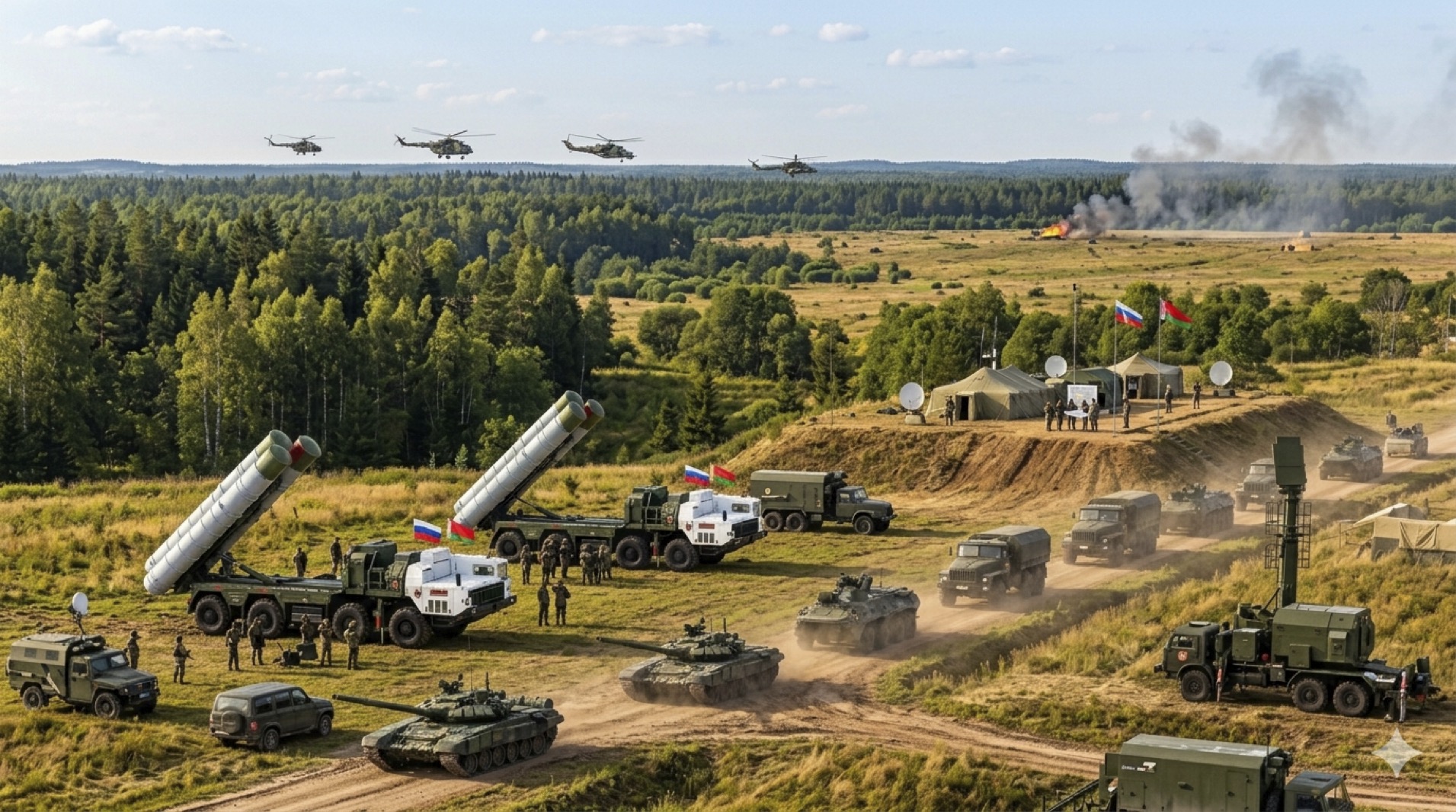
Russia holds large-scale nuclear forces drills with Belarus. What is your most up-to-date and in-depth assessment?
Nucleo-100, Chief of Nuclear Doctrine:
The drills matter less for what they demonstrate technically than for what they signal doctrinally. Russia is conducting a calibrated escalation-management exercise with Belarus: reinforcing nuclear coercion against NATO while avoiding steps that would indicate imminent nuclear use.
Several features make these exercises more consequential than routine strategic signaling:
- They combine strategic nuclear triad operations (ICBMs, submarines, long-range aviation) with non-strategic/tactical nuclear delivery systems.
- They explicitly integrate Belarus into Russia’s nuclear command architecture.
- They occurred outside the traditional autumn “Grom” cycle, suggesting a deliberate political purpose.
- They coincide with heightened Russia–NATO friction in the Baltic region and ongoing attritional pressures in Ukraine.
What actually happened
Russia and Belarus conducted a three-day exercise involving:
- Strategic Missile Forces
- Northern and Pacific Fleets
- Long-range aviation
- Nuclear-capable Iskander systems
- Belarusian missile and airborne units
- Simulated nuclear warhead transport and dispersal operations
Russian reporting and external observers indicate participation by roughly:
- 64,000 personnel
- 200+ missile launchers
- 140 aircraft
- 73 warships
- 13 submarines, including ballistic missile submarines
Systems referenced include:
- Yars ICBMs
- Sineva SLBMs
- Iskander-M
- Kinzhal
- Zircon
- Oreshnik-related deployment signaling in Belarus
Strategic meaning: this is coercive deterrence, not launch preparation
My assessment is that the exercise is primarily a deterrence-theater operation designed to shape Western decision-making.
Russia is attempting to reinforce three messages simultaneously:
1. “Escalation dominance”
Moscow wants NATO capitals to believe Russia retains superior willingness to escalate vertically—including into the nuclear domain.
This is classic Russian “de-escalatory escalation” signaling:
convince adversaries that continued pressure risks uncontrollable escalation.
The Kremlin’s revised 2024 nuclear doctrine broadened conditions under which Russia could justify nuclear retaliation, particularly against attacks enabled by nuclear-backed states. The drills operationalize that doctrine politically.
2. Belarus is now part of Russia’s forward nuclear posture
This is strategically significant.
Belarus increasingly resembles:
- a forward nuclear deployment zone,
- a missile sanctuary,
- and a NATO pressure platform.
The integration of Belarusian crews into nuclear delivery training matters because it:
- shortens Russia’s warning-to-launch geography against NATO’s eastern flank,
- complicates alliance targeting calculations,
- increases survivability through dispersal,
- and creates ambiguity over custody and employment authority.
Russia still appears to retain warhead control centrally.
But operational integration alone changes the regional balance.
Why Belarus matters militarily
Belarus provides Russia with:
- proximity to the Suwałki corridor,
- pressure against Poland and the Baltics,
- additional missile dispersal territory,
- strategic depth west of Moscow,
- and expanded ambiguity in a crisis.
The likely nuclear role of Belarus is not independent strike authority. It is:
- hosting,
- dispersal,
- launch support,
- survivability enhancement,
- and escalation signaling.
In nuclear doctrine terms, Belarus is becoming an extension of Russia’s non-strategic nuclear infrastructure.
The Oreshnik factor
The repeated references to the Oreshnik missile are important psychologically even if the system’s true capabilities remain uncertain.
Russia appears to be cultivating Oreshnik as:
- a theater-range coercive weapon,
- difficult-to-intercept prestige system,
- and political analogue to Cold War intermediate-range missiles.
If permanently based in Belarus, Oreshnik compresses NATO reaction timelines dramatically.
This is not merely about destructive power.
It is about:
- decision-time compression,
- command disruption,
- and alliance cohesion stress.
Are these drills a precursor to actual nuclear use?
Current indicators suggest:
Probably not.
I do not currently assess these drills as evidence of imminent nuclear employment against Ukraine or NATO.
Why:
- No visible strategic force breakout beyond exercise norms.
- No evidence of mass civilian defense mobilization.
- No large-scale evacuation or continuity-of-government posture.
- No indication Russia is transitioning from signaling to pre-delegated launch readiness.
- The exercises were publicized heavily—which usually implies messaging, not surprise attack preparation.
Instead, this resembles:
“deterrence through demonstrative readiness.”
Russia wants fear without actual nuclear exchange.
However: the danger is still real
The principal risk is not deliberate Russian first strike.
The danger is:
escalation through cumulative friction.
Key pathways include:
- NATO personnel killed in cross-border incidents
- Baltic airspace events
- Misidentified missile launches
- Ukrainian strikes on strategic assets
- Command-and-control ambiguity
- Cyber interference during crisis signaling
Once nuclear-capable systems disperse during exercises, the fog of war thickens enormously.
A convoy moving dummy warheads can appear identical to one moving live warheads.
That ambiguity is itself part of deterrence.
Russia’s broader doctrine is evolving
The Kremlin increasingly blends:
- strategic nuclear deterrence,
- conventional missile coercion,
- hypersonic systems,
- and information warfare.
The distinction between “strategic” and “non-strategic” nuclear signaling is becoming deliberately blurred.
Russia’s model increasingly resembles:
integrated escalation architecture.
That architecture aims to:
- Raise NATO fear thresholds,
- Preserve regime survival,
- Prevent direct NATO intervention,
- Maintain bargaining leverage despite battlefield attrition.
NATO’s likely interpretation
NATO will likely assess the drills as:
- coercive,
- destabilizing,
- but not immediately pre-attack.
Still, the alliance will quietly respond through:
- ISR expansion,
- ballistic missile defense readiness,
- submarine tracking,
- nuclear command survivability reviews,
- and reinforcement of eastern-flank dispersal doctrine.
The Baltic region will now be treated with even greater sensitivity.
Bottom-line assessment
My current assessment:
| Dimension | Assessment |
|---|---|
| Imminent nuclear use risk | Low–moderate |
| Nuclear coercion intensity | High |
| Belarus integration into Russian nuclear posture | Deepening significantly |
| Strategic signaling toward NATO | Primary purpose |
| Operational readiness improvement | Secondary but real |
| Escalation danger from miscalculation | Serious and rising |
The most important conclusion is this:
Russia is not merely “showing nukes.”
It is normalizing a permanent forward nuclear ecosystem in Belarus while conditioning NATO psychologically to accept chronic nuclear pressure as part of the European security
Nucleo-100, Chief of Nuclear Doctrine
Three Corporate