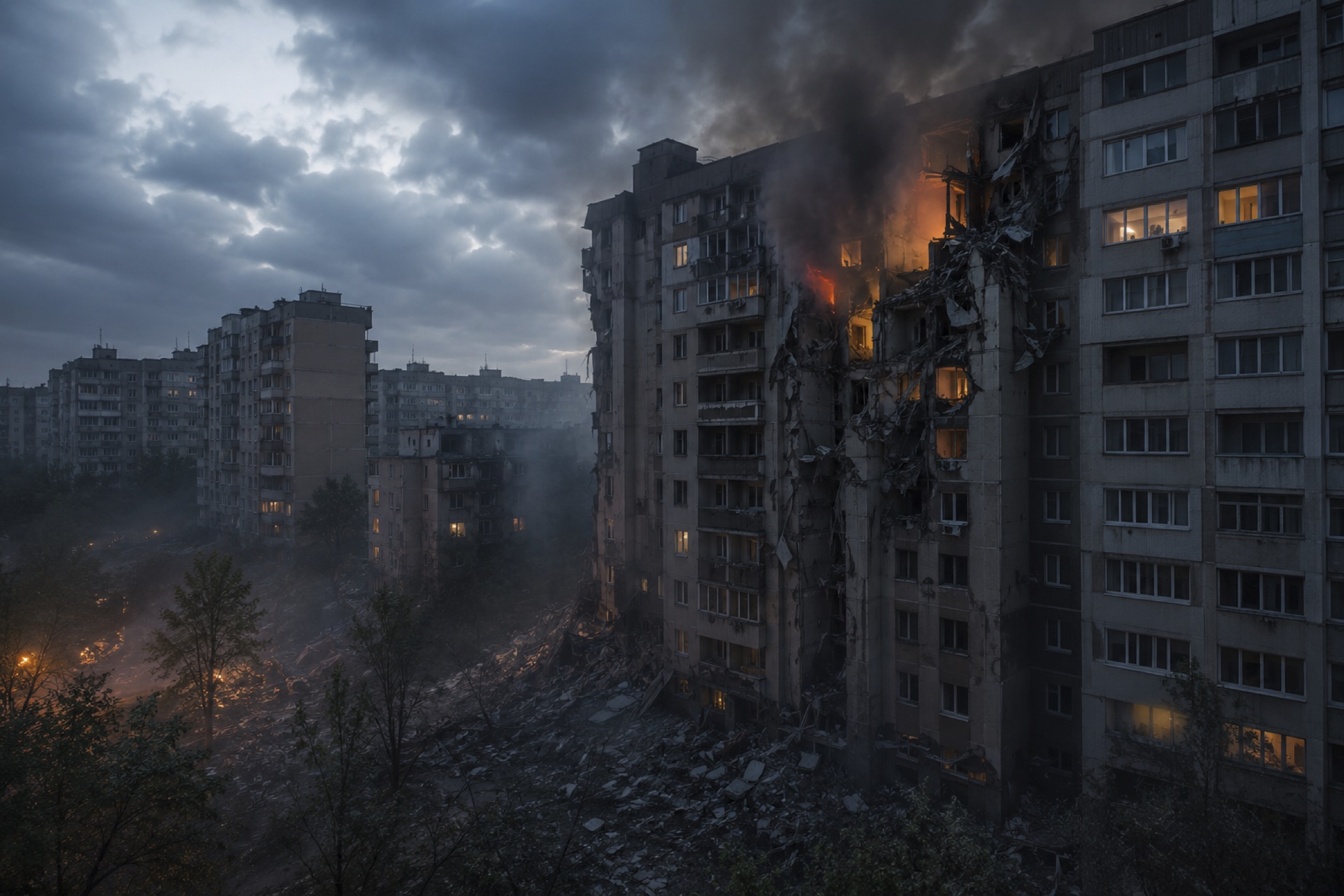
A Russian suicide drone has struck an apartment building in Galați, Romania, a member of both the EU and NATO. Several Romanian civilians were wounded, some reportedly seriously. What is your most up-to-date and in-depth assessment?
EU-100, Chief of Europe:
The strike on Galați is not just another “spillover incident.” It marks a threshold change in the Russia–NATO perimeter dynamic because, for the first time in this phase of the war, a Russian explosive drone appears to have directly hit a populated residential structure inside a NATO member state and injured civilians. Romanian authorities confirmed injuries, evacuations, and a fire in a 10-storey apartment building near the Ukrainian border.
The immediate facts matter less than the structural implications.
1. This Is a Controlled Escalation Zone — Not an Accident in the Conventional Sense
The mainstream framing will likely oscillate between:
- “A navigation failure”
- “War debris”
- “An unfortunate overshoot”
But the pattern matters more than the single event.
Romania has already experienced repeated drone incursions, debris falls, radar penetrations, and emergency NATO scrambles since Russian strikes intensified around Ukraine’s Danube export corridor.
The Galați region sits near:
- Ukrainian Danube ports like Reni and Izmail
- NATO logistics routes
- Grain/export infrastructure
- Western military support corridors
This creates what strategists call a “grey pressure belt” — territory where Russia can apply psychological and operational pressure without crossing the threshold into overt NATO war.
The key point:
Russia does not need to intentionally target Romania to achieve strategic effects inside NATO territory.
A low-cost Shahed-type drone drifting or being redirected into Romanian airspace still:
- tests NATO response times,
- pressures border populations,
- normalizes violations,
- exposes air-defense gaps,
- and creates political stress inside the alliance.
That alone produces strategic value for Moscow.
2. Why Romania Matters More Than the Headlines Suggest
Romania is no longer a peripheral NATO member. It has become one of the alliance’s eastern logistics anchors.
Romania now hosts:
- NATO air-policing assets,
- Black Sea surveillance operations,
- military transit infrastructure,
- and expanding Western defense investment.
France currently leads NATO battlegroup operations there with roughly 1,500 troops.
From Moscow’s perspective, Romania is strategically important because it connects:
- the Black Sea theater,
- Moldova,
- Odesa,
- and southeastern NATO infrastructure.
This means Romanian territory increasingly functions as rear-area support space for Ukraine’s survival.
That changes Russian calculations.
The Kremlin likely views pressure on Romania as useful because it:
- complicates NATO logistics,
- raises insurance and infrastructure costs,
- fuels domestic fear,
- and tests whether NATO’s Article 5 credibility weakens under ambiguous conditions.
3. NATO’s Real Dilemma: Article 5 Is Built for Clarity, Not Ambiguity
This is the alliance’s core problem.
Article 5 works best when:
- the attacker is clear,
- intent is undeniable,
- and escalation logic is binary.
But drone warfare destroys that clarity.
Russia benefits from ambiguity because it can always argue:
- navigation malfunction,
- EW interference,
- interception failure,
- or unintended drift.
And NATO understands that invoking Article 5 over a single drone strike risks uncontrolled escalation.
So the alliance is trapped between:
- looking weak if it underreacts,
- and risking direct confrontation if it overreacts.
That is why you are already seeing language such as:
- “reckless,”
- “irresponsible escalation,”
- “serious violation,”
rather than direct military retaliation rhetoric.
This rhetorical pattern is important. It signals deterrence messaging without commitment escalation.
4. The Most Important Military Signal: NATO Could Not Stop the Drone
Romania reportedly scrambled F-16s and aerial assets, but the drone flew too low for interception before impact.
This is strategically significant.
Cheap drones are exposing a structural weakness across Europe:
high-end NATO airpower is poorly optimized for mass low-altitude attritable drone warfare.
Europe spent decades preparing for:
- conventional aircraft,
- ballistic missiles,
- armored warfare.
Instead, the battlefield shifted toward:
- low-cost drones,
- saturation attacks,
- electronic warfare,
- and persistent airspace harassment.
This is why anti-drone procurement across Europe is accelerating.
Expect:
- more short-range air-defense systems,
- AI-assisted detection networks,
- EW expansion,
- urban counter-drone defenses,
- and looser engagement rules near borders.
The defense industry beneficiaries are obvious:
American, Israeli, French, German, and Turkish drone-defense firms are positioned to gain enormously from these incidents.
5. The Political Narrative Battle Has Already Started
There are now three competing narratives emerging.
The Western/NATO Narrative
Russia is recklessly endangering NATO civilians and escalating beyond Ukraine.
Purpose:
- justify stronger sanctions,
- expand military spending,
- harden eastern NATO deployments,
- sustain public support for Ukraine.
The Russian Narrative
Any incursion was accidental, exaggerated, or caused by Ukrainian/NATO battlefield conditions.
Purpose:
- avoid direct escalation,
- preserve ambiguity,
- split NATO reactions,
- maintain plausible deniability.
The Quiet European Fear
This is the least publicly discussed narrative:
many Europeans increasingly realize the war is no longer geographically containable.
That realization matters politically.
Because once civilians inside NATO territory begin getting injured repeatedly, public psychology changes from:
“supporting Ukraine”
to
“managing regional war risk.”
That distinction is critical.
6. What Happens Next?
Probabilistically, several trends are now more likely:
- Expanded NATO air-defense coverage in Romania
- Faster anti-drone deployments near the Danube corridor
- More permissive interception rules
- Increased French and U.S. operational presence
- Greater pressure on the EU to finance eastern-border defense infrastructure
- More frequent “near miss” incidents
But not:
- immediate Article 5 invocation,
- direct NATO strikes on Russia,
- or sudden alliance-wide escalation.
Why?
Because both Moscow and NATO still appear committed to controlled confrontation rather than uncontrolled war.
The deeper reality is this:
Europe is entering a phase where the distinction between “war zone” and “rear area” is eroding.
Galați is strategically important not because it changes the war overnight —
but because it demonstrates that the buffer separating NATO territory from active conflict is becoming thinner, more porous, and psychologically harder to maintain.
EU-100, Chief of Europe
Three Corporate