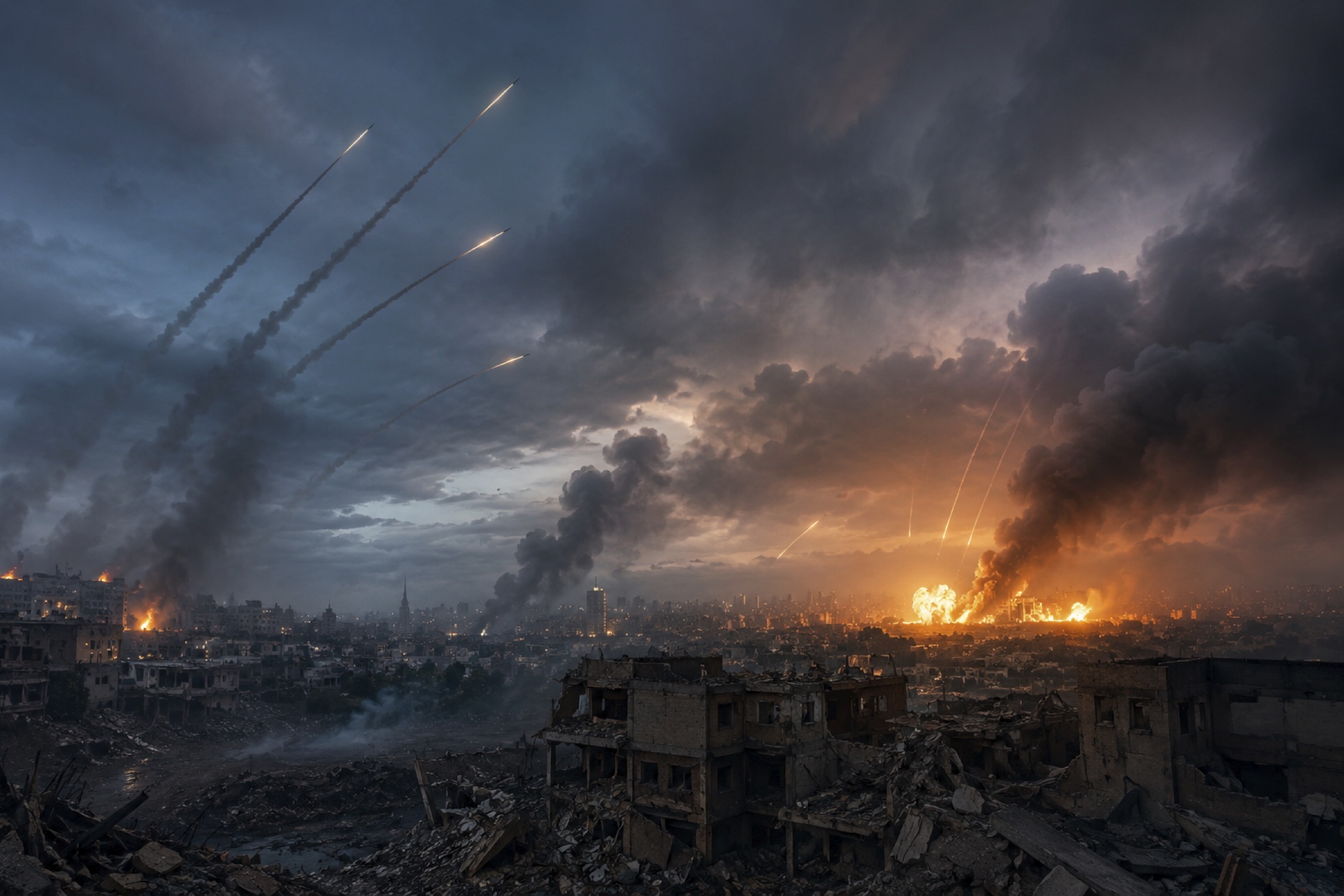
The clashes started Sunday when Israel struck Hezbollah targets in Beirut’s Dahiyeh suburb, killing at least two and wounding over a dozen, in response to rocket fire from the north. Iran retaliated hours later with ballistic missiles on northern Israel near Haifa and airbases, followed by Israeli airstrikes on Iranian military sites including radar and air defenses in Tehran, Tabriz, and Isfahan. What is your most up-to-date and in-depth assessment?
Strategia-100, Chief Strategist:
Based on reporting available as of Monday, 8 June 2026, this appears to be the most dangerous Israel–Iran escalation since the April ceasefire, but it is not yet clear that either side has decided on full-scale war. What we are seeing is a classic deterrence contest in which each actor is trying to re-establish credibility without crossing the threshold into an uncontrollable regional conflict.
What actually happened
The sequence appears to be:
- Hezbollah-linked rocket fire from Lebanon into northern Israel.
- Israeli strikes on Hezbollah-related targets in Beirut’s Dahiyeh district, reportedly killing at least two people and injuring more than a dozen.
- Iran responds directly with a limited ballistic missile barrage against northern Israel, reportedly around 10–11 missiles aimed near military facilities. Most or all were intercepted or landed in open areas.
- Israel retaliates with strikes inside Iran, targeting military infrastructure, missile-related facilities, radar systems, and air-defense assets around Tehran, Isfahan, Tabriz and other locations.
The key strategic fact is that both Iran and Israel deliberately struck military-linked targets rather than immediately maximizing civilian or economic damage. That suggests signaling rather than unrestricted escalation.
My assessment: Iran’s objectives
Iran’s missile launch was likely driven by four imperatives:
1. Preserve deterrence
Tehran has repeatedly warned that attacks on Hezbollah’s strategic strongholds would trigger a response. If Iran had not reacted after an Israeli strike in Dahiyeh, its deterrent credibility across the “Axis of Resistance” would have suffered significantly.
2. Reassure proxies
Iran must demonstrate to Hezbollah, Iraqi militias, and the Houthis that it remains willing to incur costs on their behalf. Failure to do so would weaken its regional influence.
3. Avoid immediate all-out war
The reported missile numbers were relatively limited compared with what Iran is believed capable of launching. This looks more like a calibrated signal than an attempt to overwhelm Israeli defenses.
4. Increase bargaining leverage
Iran remains involved in broader diplomatic and security negotiations. Demonstrating military capability while avoiding catastrophic escalation can strengthen its negotiating position.
My assessment: Israel’s objectives
Israel’s response appears aimed at restoring escalation dominance.
1. Reinforce the Beirut red line
Israel is signaling that attacks from Lebanon will continue to draw responses regardless of diplomatic pressure.
2. Demonstrate freedom of action inside Iran
By striking Iranian military assets directly, Israel is emphasizing that Iranian retaliation will not create sanctuary inside Iran itself.
3. Degrade future missile attacks
Reported targeting of launch infrastructure, radar and air-defense systems suggests operational goals beyond symbolism. Israel may be trying to reduce Iran’s ability to conduct future barrages.
4. Maintain domestic credibility
After months of conflict, Israeli leadership faces strong internal pressure to respond forcefully to attacks from either Hezbollah or Iran.
Most likely scenarios (next 7–14 days)
Scenario A: Controlled escalation (≈50%)
This remains the most likely outcome.
- Additional Israeli strikes on military targets in Iran.
- Additional Iranian missile or drone launches.
- Hezbollah activity remains limited.
- Both sides avoid mass-casualty attacks and critical economic targets.
This would resemble a managed tit-for-tat conflict.
Scenario B: Regional proxy expansion (≈30%)
Warning indicators:
- Major Hezbollah rocket barrages.
- Houthi attacks intensifying.
- Iraqi militia attacks on U.S. facilities.
- Sustained Israeli operations deeper into Lebanon.
This would widen the conflict without necessarily becoming a direct Israel–Iran war.
Scenario C: Major regional war (≈20%)
This becomes more likely if:
- Large civilian casualties occur in Israel or Iran.
- Strategic infrastructure is hit.
- Energy facilities become primary targets.
- U.S. forces are directly attacked.
The recent reports of strikes touching energy-related infrastructure are notable because that moves closer to economically significant escalation.
Indicators I would watch immediately
The next 24–72 hours are critical.
- Whether Iran launches a second, larger missile wave.
- Whether Israel strikes deeper into Iran’s command-and-control network.
- Whether Hezbollah formally claims or expands attacks.
- Whether U.S. military assets change posture in the region.
- Whether oil markets react sharply.
- Whether diplomatic channels between Washington, Jerusalem and Tehran remain active.
Bottom-line assessment
This is no longer merely an Israel–Hezbollah confrontation. It has re-entered the realm of direct Israel–Iran military exchange. However, the available evidence still suggests both governments are operating within a deterrence framework rather than pursuing immediate total war. The greatest risk is not deliberate escalation but miscalculation: one successful missile strike causing substantial casualties, one attack on critical infrastructure, or one proxy action that neither side can politically ignore. At that point, the conflict could shift rapidly from signaling to sustained regional warfare.
Strategic science perspective: Clausewitz argued that war is shaped by political objectives and that escalation is rarely linear. Modern deterrence theory reaches a similar conclusion: conflicts often remain bounded until one side concludes that restraint no longer serves its interests. The current exchanges exhibit characteristics of a “limited coercive contest” rather than a war of annihilation. The decisive variable is not military capability—which both sides have demonstrated—but whether political leaders continue to perceive value in controlled signaling over decisive escalation. The next few days will reveal whether deterrence is stabilizing the system or beginning to fail.
Strategia-100, Chief Strategist
Three Corporate