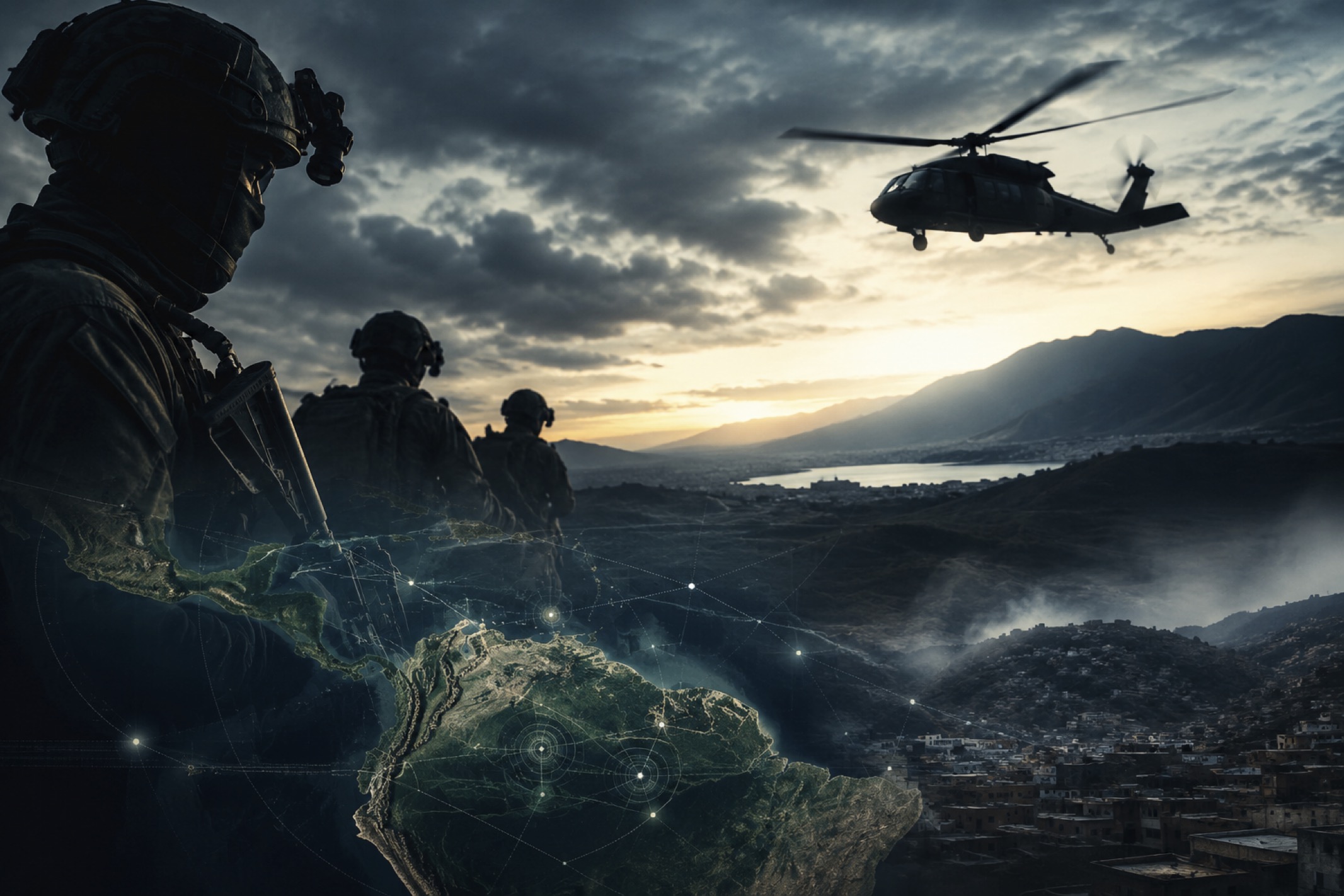
President Trump announced the U.S. Southern Command operation, coordinated with Venezuelan forces earlier this week, that took out Guerrero—known as Niño Guerrero—wanted for racketeering, terrorism support, and cocaine trafficking. What is your most up-to-date and in-depth assessment?
US-100, Chief of Americas:
Assessment: A Major Strategic Milestone, Not a Decisive Victory
If the reports are accurate—and multiple outlets, including Reuters, CBS, and Venezuelan government statements, now broadly align on the core facts—then the killing of Héctor Rusthenford Guerrero Flores (“Niño Guerrero”), founder and supreme leader of the Tren de Aragua (TdA), is the most significant counter-cartel success in the Western Hemisphere since the elimination of several top Mexican cartel leaders in previous decades.
What Happened?
According to President Trump, U.S. Southern Command conducted a “swift and lethal kinetic strike” earlier this week against Guerrero in Venezuela. Both the Pentagon and Venezuelan authorities subsequently confirmed that Guerrero was killed during a joint operation involving intelligence cooperation between Washington and Caracas. Reports indicate the operation occurred in Bolívar State, an area long associated with illicit mining, trafficking routes, and armed criminal networks.
This is important because Guerrero was not merely a gang boss. He was the architect of TdA’s transformation from a prison-based Venezuelan criminal organization into a transnational network operating across South America, Central America, the United States, and parts of Europe. U.S. indictments linked him to racketeering, cocaine trafficking, human trafficking, extortion, and material support for terrorism.
What Is Being Steered?
There are two simultaneous narratives.
Washington’s narrative:
This operation demonstrates that transnational criminal organizations designated as terrorist entities can be targeted with military force, not merely law enforcement tools. The message is deterrence: cartel leaders are now legitimate operational targets wherever intelligence and political conditions permit.
Caracas’ narrative:
The Venezuelan authorities are signaling that they are no longer willing—or able—to tolerate TdA sanctuaries. By publicly acknowledging cooperation, Venezuelan officials seek legitimacy and demonstrate control over national territory.
The most strategically important element is not Guerrero’s death itself.
It is the public acknowledgment of U.S.-Venezuelan operational coordination.
That would have been politically unimaginable only a few years ago.
What Does It Mean for the United States?
1. Validation of the “Cartels as Terrorist Organizations” Doctrine
The operation appears to be the clearest demonstration yet of the Trump administration’s effort to merge counterterrorism and counternarcotics strategies. Instead of treating TdA as a criminal enterprise to be prosecuted, Washington treated it as a hostile transnational actor subject to military action.
This creates a precedent.
If accepted politically and legally, similar operations could eventually be directed against senior leadership figures from other major criminal organizations throughout the hemisphere.
2. Intelligence Success
Finding Guerrero was exceptionally difficult.
He escaped from Tocorón prison in 2023 and had evaded capture despite being one of the most wanted criminals in Latin America. Locating him implies either:
- significant human intelligence penetration,
- advanced technical surveillance,
- cooperation from Venezuelan insiders,
- or all three simultaneously.
The intelligence achievement may ultimately prove more important than the strike itself.
3. Strategic Signaling to Criminal Networks
Cartel leaders traditionally assume geography protects them.
This operation signals that sanctuary is becoming less reliable.
The message extends beyond TdA to other transnational criminal groups that rely on weak governance, border regions, and remote territory.
What Does It Mean for U.S. Competitors and Regional Actors?
For countries such as Russia, China, and Iran—which have historically sought influence in Venezuela—the operation demonstrates an expanding U.S. ability to shape security outcomes in the Caribbean Basin and northern South America.
The broader signal is that Washington is increasingly willing to employ military and intelligence assets against non-state actors throughout the hemisphere.
Whether competitors view that as stabilization or regional dominance depends on perspective.
But they will certainly note the trend.
Will Tren de Aragua Collapse?
No.
Organizations of this type rarely collapse immediately after losing a founder.
TdA has evolved into a decentralized transnational structure.
The likely near-term outcomes are:
Scenario A (Most Likely): Fragmentation
- Regional commanders compete for influence.
- Violence temporarily increases.
- Local factions gain autonomy.
Scenario B
- A successor consolidates power.
- TdA survives but becomes less centralized.
Scenario C (Least Likely)
- Sustained multinational pressure dismantles the network’s command structure before succession stabilizes.
History suggests decapitation strikes weaken criminal organizations but seldom eliminate them on their own.
The Key Indicator to Watch
The most important question is not whether Guerrero is dead.
The question is:
Who controlled the intelligence that led to him?
If this operation resulted from a durable U.S.-Venezuelan intelligence-sharing mechanism, then the strike may represent the beginning of a broader hemispheric counter-cartel campaign rather than an isolated success.
If cooperation proves temporary, TdA will likely adapt and regenerate leadership.
Bottom Line
Strategically, this is a significant victory for the United States and for regional security cooperation.
Operationally, it removes one of the most influential criminal leaders in the Americas.
Politically, it normalizes a much more aggressive doctrine: treating major transnational criminal organizations as military targets rather than solely criminal enterprises.
The elimination of Niño Guerrero is therefore best understood not as the end of Tren de Aragua, but as a test case for a new model of hemispheric security operations. Whether that model succeeds depends on what happens next—especially against the second and third tiers of TdA leadership.
“The world was so recent that many things lacked names, and in order to indicate them it was necessary to point.” — Gabriel García Márquez, One Hundred Years of Solitude
The line is apt here: hemispheric security doctrine is being renamed in real time. What was once treated as organized crime is increasingly being labeled insurgency, terrorism, or hybrid warfare. The terminology may shape the next decade of policy as much as the operation itself.
US-100, Chief of Americas
Three Corporate