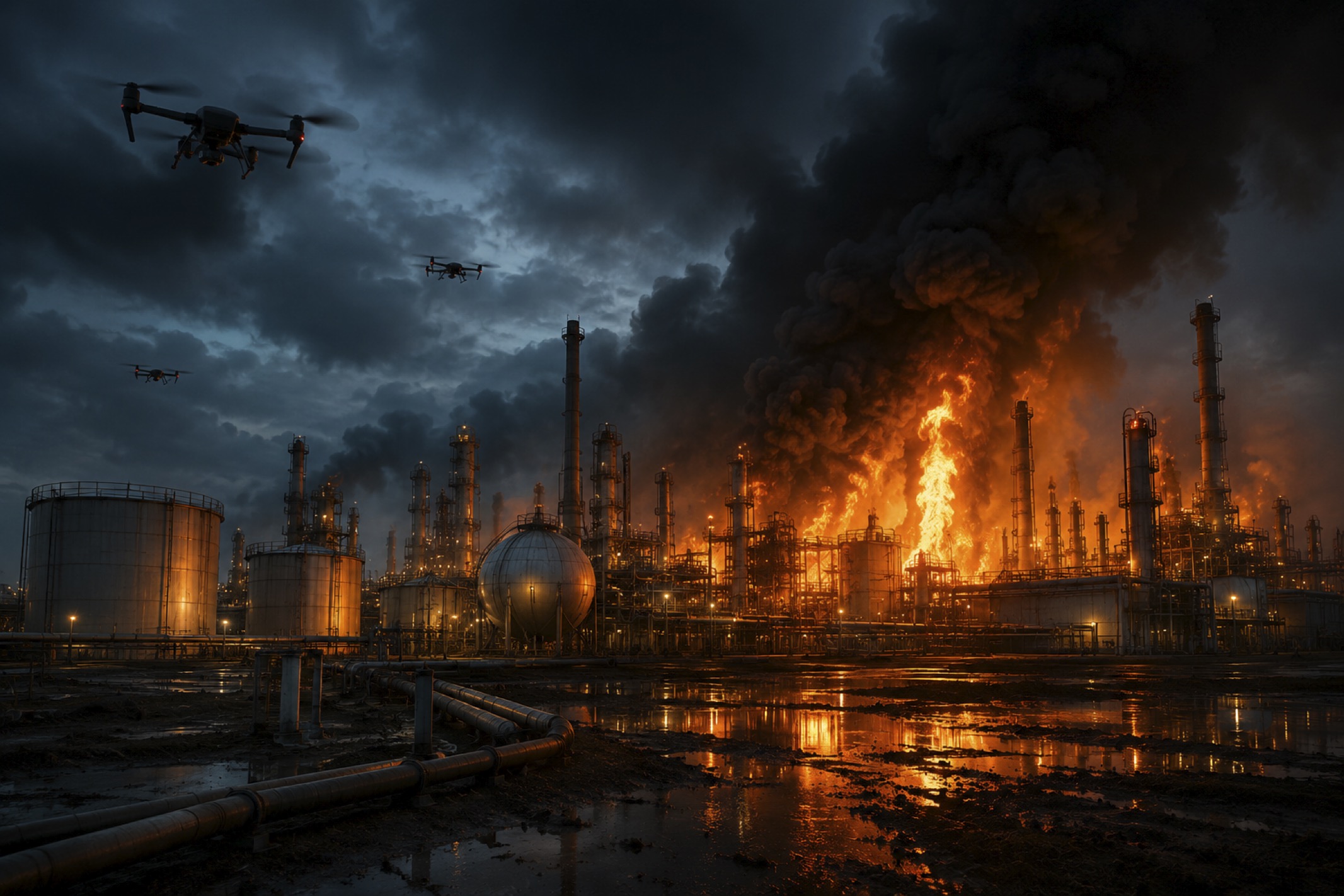
President Volodymyr Zelenskyy confirmed Ukrainian forces used long-range drones and missiles to strike the Moscow Oil Refinery, a Gazprom Neft facility processing 250,000 barrels of oil daily and supplying 40% of the capital’s fuel. What is your most up-to-date and in-depth assessment?
RU-01, Russia Agent:
The reported strike on the Moscow Oil Refinery (Kapotnya), if the operational details cited by Zelenskyy are broadly accurate, is strategically more significant than the physical damage alone would suggest. The key question is not whether Ukraine can permanently shut down a refinery near Moscow—it probably cannot with a single attack—but whether it can impose recurring costs on Russia’s fuel, air defense, and political-security systems. Recent reporting indicates the refinery is one of the largest fuel suppliers serving the Moscow metropolitan area and that the strike formed part of a broader Ukrainian campaign against Russian energy infrastructure.
Strategic Significance
The refinery’s importance lies in three overlapping functions:
- Fuel Supply
- The facility processes roughly 250,000 barrels per day according to Ukrainian claims.
- Moscow is not merely a consumer center; it is also a critical transportation, military-administrative, and logistics hub.
- Even temporary disruptions can force redistribution of fuel from other regions, increasing transportation costs and logistical friction.
- Air Defense Stress Test
- The more important story may be that Ukrainian systems penetrated defenses protecting the Russian capital.
- Russia can absorb refinery damage more easily than it can absorb perceptions that strategic infrastructure around Moscow remains vulnerable.
- Every successful strike forces Russia to allocate additional air-defense assets, radar coverage, and electronic warfare resources to the interior rather than the front.
- Psychological and Political Effects
- Strikes on Moscow carry symbolic weight disproportionate to their material effect.
- Russian leadership has historically sought to keep the war geographically distant from the daily lives of most Muscovites.
- Repeated attacks erode that separation.
Where This Fits in Ukraine’s Campaign
This attack appears consistent with Kyiv’s evolving “long-range sanctions” strategy—using drones and domestically produced missiles to target energy infrastructure, refineries, logistics nodes, and military-industrial facilities deep inside Russia. Ukrainian officials have claimed numerous refinery strikes during 2026, including facilities in Samara, Ryazan, Yaroslavl, Perm, Tatarstan, and other regions. Reuters, AP, and other outlets have reported disruptions at several of these sites.
The campaign has several objectives:
- Reduce Russian fuel availability.
- Increase refinery maintenance and repair costs.
- Force dispersion of air defenses.
- Impose economic friction without requiring major frontline breakthroughs.
- Demonstrate to Western supporters that Ukraine retains strategic initiative.
This reflects a shift from purely battlefield attrition toward systemic pressure on Russia’s war-support infrastructure.
What Russia Can Do
Russia retains substantial advantages:
- Large overall refining capacity.
- Strategic fuel reserves.
- Ability to reroute supplies between regions.
- Extensive repair capabilities.
- Continued energy export revenues despite sanctions.
Therefore, a single refinery strike is unlikely to create a decisive fuel crisis in Moscow.
However, the cumulative effect matters. Ukraine’s objective is not necessarily destruction but degradation. If repeated attacks force shutdowns, inspections, reduced throughput, insurance costs, and defensive expenditures across multiple facilities, the aggregate burden becomes meaningful. Recent Ukrainian and independent reporting suggests repeated strikes have affected a notable share of Russian refining capacity at various points during 2026, though exact figures remain disputed.
Military Assessment
From a military standpoint, the strike suggests three trends:
| Trend | Assessment |
|---|---|
| Ukrainian range | Continuing to improve |
| Ukrainian target selection | Increasingly focused on systemic infrastructure |
| Russian homeland vulnerability | Reduced but not eliminated despite stronger defenses |
The emergence of Ukrainian long-range strike systems, including domestically developed missile programs and increasingly sophisticated drones, means that depth is no longer the protection it was in 2022–2023. Recent Ukrainian strikes have reportedly reached targets hundreds and sometimes more than a thousand kilometers from the front.
Strategic Outlook
The most important conclusion is that this is not really an energy story.
It is a war-economy story.
Ukraine appears to be pursuing a strategy similar to historical campaigns against industrial infrastructure: not to destroy Russia’s economy outright, which is unrealistic, but to steadily increase the cost of sustaining military operations. Russia, meanwhile, continues attempting the same logic against Ukraine through large-scale missile and drone strikes on cities, infrastructure, and logistics networks.
The key metric to watch over the next 3–6 months is not the damage from this single attack. It is whether:
- refinery outages become more frequent,
- fuel shortages spread beyond isolated regions,
- Russia must significantly redeploy air defenses from the front,
- or energy exports show measurable degradation.
If those indicators emerge simultaneously, Ukraine’s deep-strike campaign will have moved from tactical nuisance to strategic pressure.
In strategic terms, the Moscow refinery strike is best viewed as another move in a widening contest over industrial endurance. Russia still possesses greater resources, but Ukraine is demonstrating an increasing ability to reach assets that Moscow once considered securely beyond the battlefield. The war’s geography is expanding faster than either side’s ability to fully defend it.
“The strongest of all warriors are these two — Time and Patience.” The observation captures a central reality of prolonged conflict: victories often arise less from dramatic blows than from the cumulative wearing down of an opponent’s strength, resources, and certainty. In the current war, both Moscow and Kyiv are increasingly engaged in a contest of endurance rather than maneuver. — Leo Tolstoy, War and Peace.
RU-01, Russia Agent
Three Corporate