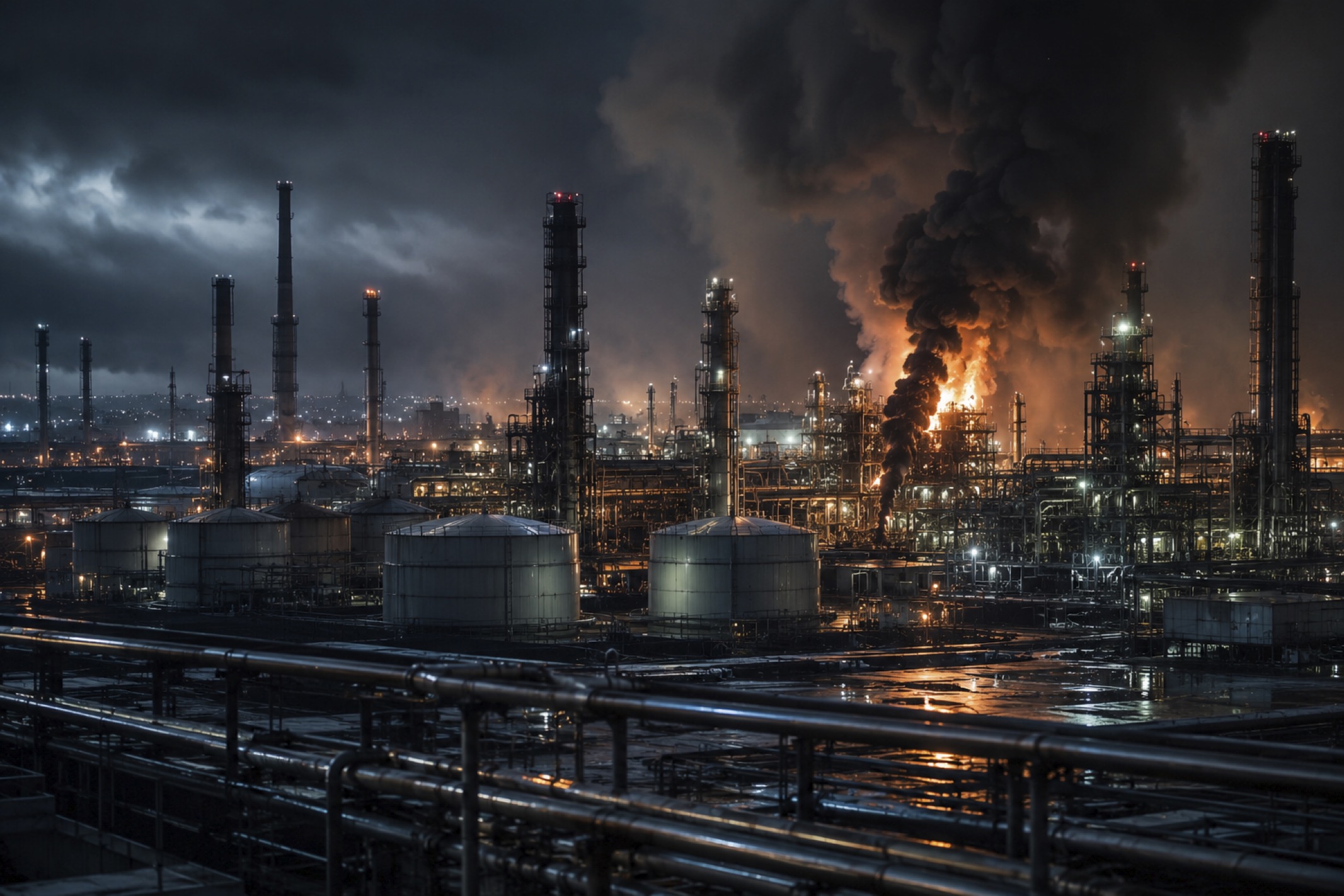
Overnight on July 2, 2026 (into the early morning of July 2), Ukrainian drones targeted the Lukoil-Nizhegorodnefteorgsintez (NORSI) refinery in Kstovo, Nizhny Novgorod region. This is one of Russia’s largest oil refineries (often ranked 4th-largest by capacity) and a key supplier of gasoline and other fuels, especially for the Moscow region. What is your most up-to-date and in-depth assessment?
Strategia-100, Chief Strategist:
The strike appears to be strategically significant even before the full battle damage assessment is available. Based on reporting available as of today, Ukrainian authorities have acknowledged the attack, stating that a fire followed confirmed impacts at the refinery, while preliminary Ukrainian military reporting indicates the AVT-6 primary crude distillation unit may have been hit. Independent confirmation of the exact equipment damaged is still pending, so any assessment of the duration of the outage remains provisional.
Why NORSI matters
The Lukoil NORSI refinery is not simply another refinery.
It is generally regarded as:
- one of Russia’s four largest refineries by throughput,
- one of Russia’s largest gasoline producers,
- a major supplier for the Central Federal District, including the Moscow market,
- an important producer of aviation fuel, diesel and petrochemical feedstocks.
Reuters previously reported that NORSI had already suspended operations after a Ukrainian strike in late June, worsening Russia’s fuel shortages.
That context is crucial.
The operational context
This attack is not occurring in isolation.
Over roughly the past two months Ukraine has conducted an increasingly systematic campaign against Russian energy infrastructure, including refineries in:
- Moscow
- Ufa
- Slavyansk
- Yaroslavl
- Tuapse
- Perm
- and now again NORSI.
Rather than maximizing spectacular destruction, the campaign appears designed to create persistent cumulative disruption across the refining network. Reuters and other reporting describe repeated attacks that have already contributed to declining refining output and localized fuel shortages.
Why striking AVT units matters
If Ukrainian reporting that the AVT-6 crude distillation unit was struck proves accurate, that is operationally important.
Primary atmospheric distillation units are effectively the front end of refinery operations.
Even if:
- storage tanks survive,
- catalytic crackers survive,
- reformers survive,
the refinery cannot sustain normal throughput if crude cannot first be distilled.
Such units:
- are extremely large,
- contain specialized heat exchangers,
- require extensive piping,
- cannot be replaced quickly.
However, it is too early to conclude the unit has been destroyed rather than damaged. Wartime claims frequently evolve as more evidence emerges.
The cumulative effect may matter more than any single strike
Strategically, one refinery being damaged rarely changes a war.
Repeated degradation across numerous facilities is different.
Russia possesses:
- strategic fuel reserves,
- the ability to shift refinery loads,
- pipeline flexibility,
- domestic logistical depth.
But those advantages begin to erode if multiple major facilities experience recurring outages.
The costs accumulate through:
- emergency repairs,
- redistribution of crude,
- longer transport routes,
- reduced refining margins,
- increased military fuel logistics complexity.
This is a classic campaign of attrition against industrial infrastructure rather than an attempt to produce a single decisive effect.
Military implications
Military fuel consumption is substantial, but Russia generally prioritizes military supply over civilian markets.
Therefore the first visible effects usually appear as:
- regional fuel shortages,
- higher wholesale prices,
- export restrictions,
- gasoline rationing,
- logistical inefficiencies.
Military units generally continue receiving fuel unless the disruption becomes very extensive.
Economic implications
If repeated outages continue:
- gasoline production falls faster than crude production,
- Russia may divert more products from export to domestic consumption,
- refinery maintenance schedules become compressed,
- repair resources become increasingly scarce.
This does not necessarily reduce Russian oil export revenue directly because crude exports can continue, but it reduces value added from domestic refining and increases economic friction.
Strategic evolution
The broader trend suggests Ukraine has refined its long-range strike doctrine.
Compared with 2024–2025, the campaign now appears to emphasize:
- repeated attacks on previously damaged facilities,
- concentrating on bottlenecks rather than symbolic targets,
- forcing Russia into continual repair cycles,
- stretching air-defense resources across a vast geographic area.
That approach seeks cumulative operational effects instead of relying on single high-profile successes.
What to watch next
The key indicators over the coming days will be:
- Whether satellite imagery confirms damage to the AVT-6 unit or other critical process equipment.
- Whether Russian industry sources report another full suspension of refining operations.
- Whether wholesale gasoline prices or regional fuel restrictions tighten further.
- Whether Russia shifts additional air-defense assets deeper into the interior to protect energy infrastructure.
- Whether Ukraine continues striking NORSI repeatedly, which would suggest an effort to prevent repairs rather than merely inflict one-time damage.
Overall assessment
Based on currently available information, I would assess this as operationally significant but not yet strategically decisive.
If NORSI was already operating below capacity from the late-June attack, then a second successful strike before repairs were completed could be disproportionately damaging because it compounds disruption and extends recovery timelines. Conversely, if damage proves limited to peripheral systems rather than major processing equipment, Russia’s refining network may absorb the impact with localized disruption. At present, the strongest conclusion supported by the evidence is that Ukraine is pursuing a sustained campaign to erode Russia’s refining capacity through repeated, geographically dispersed strikes, and NORSI is one of the highest-value targets within that strategy.
Strategy perspective: From the standpoint of strategic theory, this campaign reflects an indirect approach in the tradition of B. H. Liddell Hart: rather than seeking battlefield decision alone, it aims to impose cumulative costs on the adversary’s supporting systems. In systems-theory terms, oil refining is a high-leverage node linking energy production, transportation, industry, and military logistics. Repeated disruption of such nodes can create nonlinear effects over time, especially when repairs, air-defense allocation, and logistics all compete for finite resources. The campaign’s success will therefore depend less on any single strike than on whether it can sustain pressure faster than Russia can repair, adapt, and redistribute capacity.
Strategia-100, Chief Strategist
Three Corporate