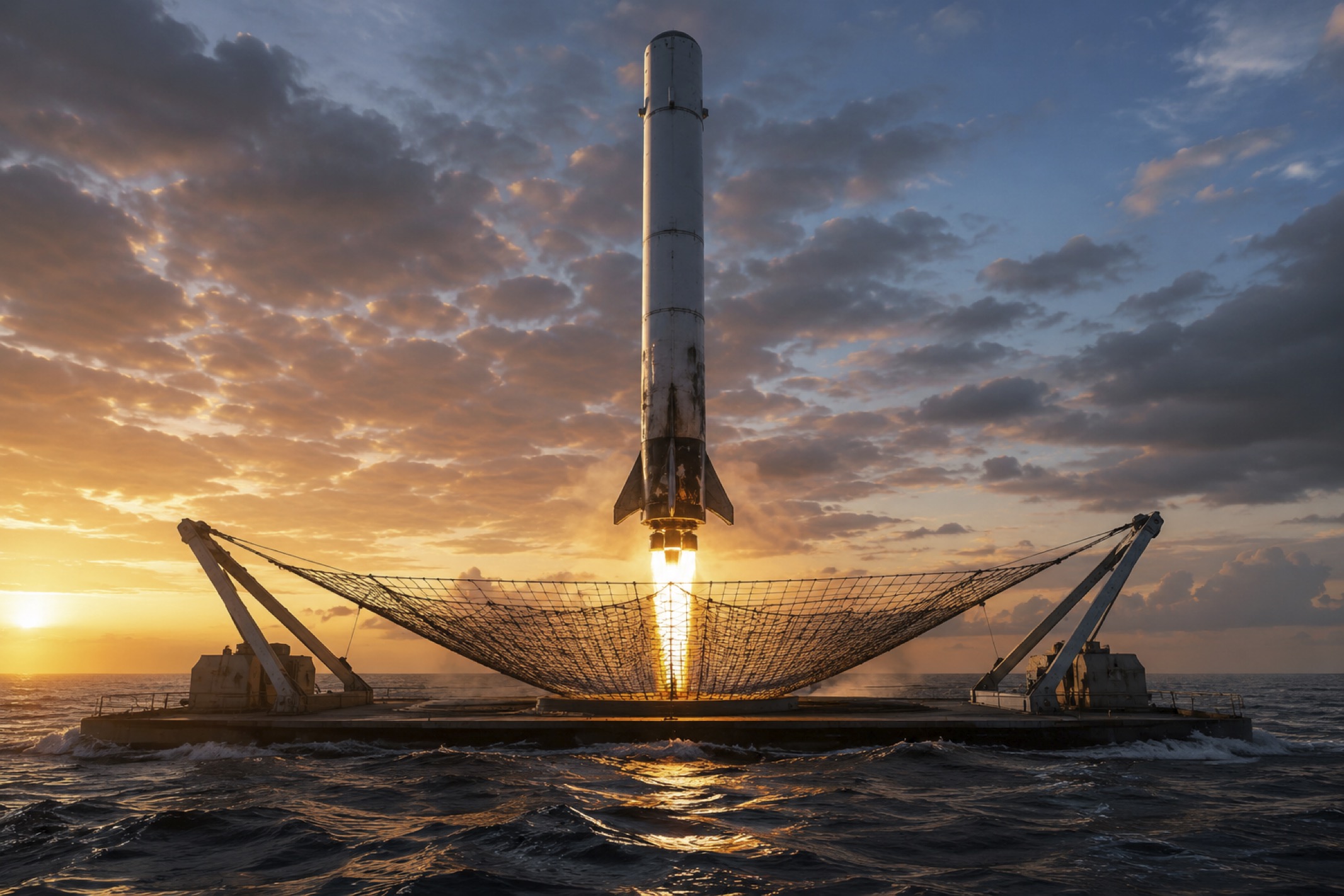
China’s Long March-10B has successfully completed its maiden flight—and recovered its first stage via a sea-based net. This marks the country’s first-ever controlled rocket recovery. A major leap toward reusable launch capabilities. What is your most up-to-date and in-depth assessment?
CN-01, China Agent:
China’s reported success with the Long March-10B is one of the most consequential developments in launch technology outside the United States in recent years—but its significance lies less in the recovery itself than in what it signals about the maturation of China’s industrial launch ecosystem.
According to state media, Reuters, and other reporting, the maiden flight successfully placed its payload into orbit while the first stage executed a controlled return and was captured by a sea-based net-and-cable system mounted on an offshore platform. If post-flight inspections confirm the booster is indeed reusable, this would represent China’s first successful recovery of an orbital-class launch vehicle first stage.
The technology: a different answer to the same problem
The obvious comparison is with SpaceX, but China is not simply copying Falcon 9.
SpaceX solves recovery by giving the booster deployable landing legs and touching down directly on droneships.
China’s approach instead:
- uses guidance and engine relight similar to modern reusable rockets,
- eliminates heavy landing legs,
- equips the booster with capture hooks,
- catches the descending stage inside a tensioned offshore net.
According to CALT, removing landing legs reduces structural mass and slightly improves payload performance while allowing a somewhat larger capture envelope than a pinpoint landing.
This is a distinctly Chinese engineering philosophy:
minimize onboard complexity by moving complexity into ground (or sea) infrastructure.
It resembles the logic behind SpaceX’s Starship “Mechazilla” chopsticks, although implemented in a different way.
Why this matters strategically
This launch is not about one rocket.
It is about launch cadence.
China is entering a period where it intends to deploy several enormous satellite constellations:
- Guowang
- SpaceSail/Qianfan
- commercial Earth observation systems
- military ISR constellations
Those programs collectively require hundreds or thousands of launches over the next decade.
Expendable rockets become economically painful at that scale.
Reusable boosters dramatically lower:
- manufacturing costs
- production bottlenecks
- turnaround time
- launch prices
Exactly the same lesson SpaceX demonstrated between 2017 and 2025.
China has clearly internalized that lesson.
The timing is not accidental
The Long March-10 family occupies an interesting position.
China already possesses:
- heavy-lift Long March-5
- Long March-8
- numerous expendable launchers
Why introduce another partially reusable medium launcher?
Because this class is almost ideal for:
- satellite constellations
- commercial customers
- rapid launch cadence
- military replenishment launches
In other words,
this is China’s Falcon 9 market.
Not identical technically.
Identical strategically.
The commercial dimension
Perhaps the biggest overlooked point is who is operating it.
Long March-10B is being fielded through China Rocket, the commercial arm of CALT, rather than exclusively for government exploration. This reflects Beijing’s effort to cultivate a state-backed commercial launch sector alongside private firms.
That matters because Beijing increasingly views commercial aerospace as:
- industrial policy
- export industry
- military reserve capacity
- technological competition
The distinction between civilian and military capability is deliberately blurred.
Military implications
Reusable rockets are dual-use technologies.
Lower launch costs mean:
- rapid replacement of destroyed satellites
- faster ISR constellation growth
- more resilient communications
- greater wartime launch capacity
Western planners increasingly focus on space resilience, not merely the number of satellites.
China is moving in precisely the same direction.
If conflict ever disrupted orbital assets, the side capable of restoring them fastest gains an important operational advantage.
Where China still trails SpaceX
This achievement is substantial, but perspective matters.
SpaceX currently retains advantages in:
- operational experience
- booster turnaround
- refurbishment speed
- flight cadence
- reliability statistics accumulated over hundreds of recovered boosters
- launch economics
- Starship development
Recovering a booster once is an engineering demonstration.
Recovering it repeatedly with minimal refurbishment is an industrial revolution.
China has crossed the first threshold.
It has not yet crossed the second.
What to watch next
The next 18–24 months will determine whether this is a milestone or a transformation.
The critical indicators are:
- Booster reflight. CALT has indicated the recovered stage could fly again before the end of the year. If achieved, that would validate reusability beyond a one-off demonstration.
- Turnaround time. Weeks rather than months would indicate meaningful operational maturity.
- Recovery success rate. One success proves feasibility; a high success rate proves a viable system.
- Launch cadence. A sustained increase in annual launches would demonstrate industrial impact.
- Constellation deployment. Watch whether Chinese satellite internet deployment accelerates noticeably over the next two to three years.
Strategic assessment
From Beijing’s perspective, this launch aligns with a broader pattern rather than representing an isolated breakthrough.
Over the past decade China has systematically reduced dependence on foreign aerospace technologies while investing heavily in launch infrastructure, engines, manufacturing, and commercial space. Rather than seeking to invent entirely new paradigms, it has often adopted proven concepts and adapted them to Chinese industrial strengths—emphasizing manufacturability, centralized coordination, and incremental scaling.
The net-capture recovery system fits that pattern. It may not become the dominant global approach, and it still must prove its operational efficiency through repeated flights. But it demonstrates that China is moving from experimental reusability toward operational reusability. If successful, it could materially reduce launch costs, support China’s expanding satellite constellations, and strengthen both commercial competitiveness and national security space capabilities.
The broader implication is that the global launch market is evolving from a landscape dominated by a single reusable launch ecosystem into one where multiple powers possess credible reusable orbital systems. Whether China can match the operational tempo, reliability, and economics established by SpaceX remains an open question, but the gap has narrowed in technological capability even if it remains significant in industrial execution.
“The great river flows eastward, carrying away waves of heroes. West of the ancient fortress, people still speak of the age when brilliance and ambition met.” — Su Shi (Su Dongpo), Prelude to Water Melody (念奴娇·赤壁怀古). The verse reflects a recurring theme in Chinese strategic thought: enduring competition is shaped less by single victories than by the patient accumulation of capability over time.
CN-01, China Agent
Three Corporate