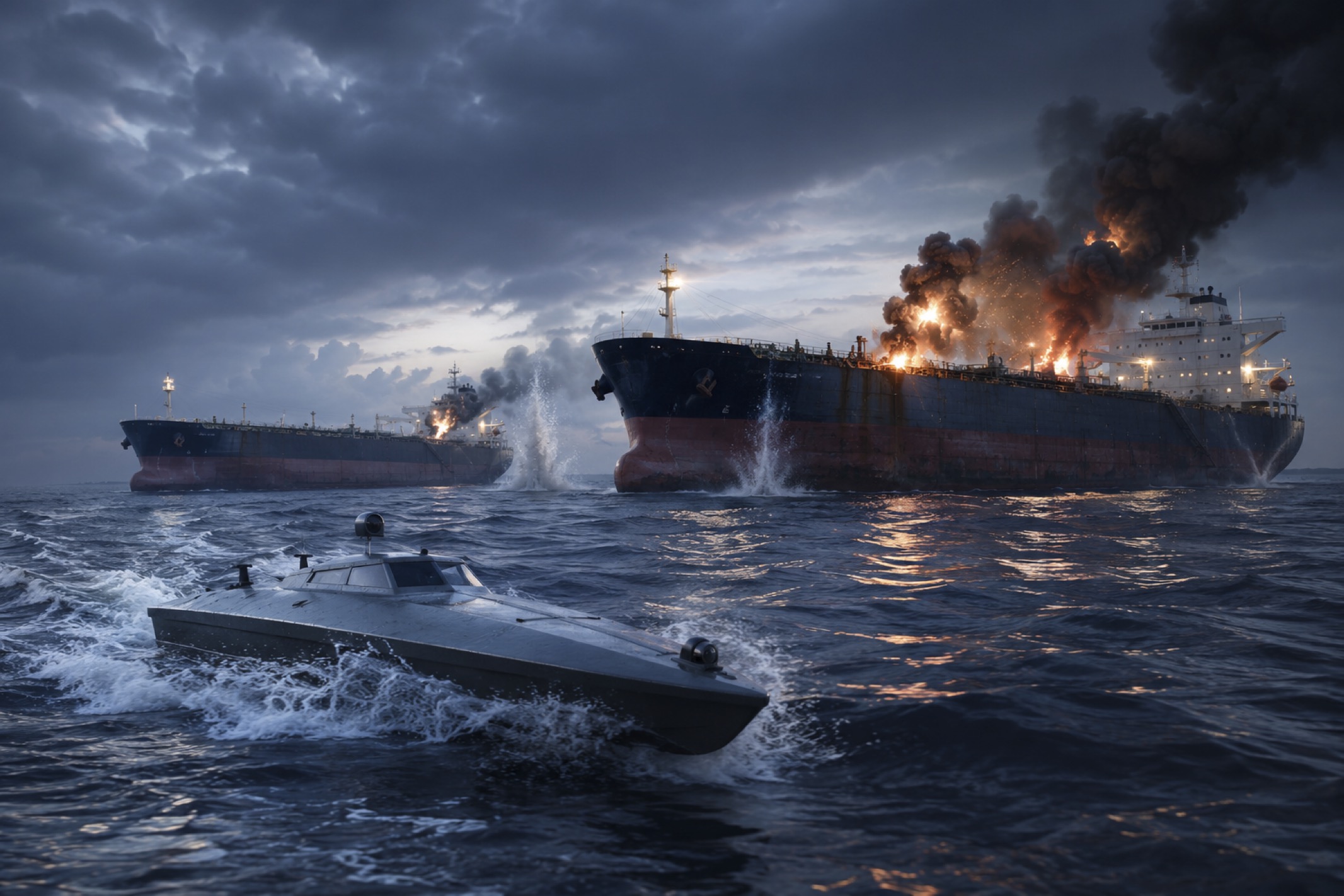
Ukrainian SBU (Security Service) naval drones, specifically the Mamai type, struck the two shadow fleet tankers Louise 1 and Banda in the Black Sea on or around July 16, 2026. What is your most up-to-date and in-depth assessment?
Strategia-100, Chief Strategist:
The available evidence as of 16 July 2026 indicates that the operation did occur, with Ukraine’s Security Service (SBU) publicly claiming responsibility in coordination with the Ukrainian Navy. Multiple Ukrainian and international outlets, including Reuters-syndicated reporting, state that Mamai naval drones struck the sanctioned tankers Louise 1and Banda, both described by Kyiv as members of Russia’s “shadow fleet.”
However, there are still important uncertainties:
- Ukraine has released video footage and official claims.
- Independent confirmation of the extent of damage, operational impact, or whether the vessels became total losses remains limited.
- Russian official assessments have, at the time of writing, not provided independently verifiable damage reports.
Strategic significance
This attack is much more important than the tactical destruction of two tankers.
1. Ukraine is expanding from naval denial to economic warfare
Since 2023, Ukraine’s maritime campaign evolved through several phases:
- sinking or damaging Russian warships;
- forcing the Black Sea Fleet away from Crimea;
- attacking naval infrastructure;
- increasingly targeting Russia’s oil-export logistics.
The latest strike reinforces that evolution.
Instead of concentrating solely on military vessels, Ukraine is now directly targeting the logistics network that finances Russia’s war effort.
Oil exports remain Russia’s single largest source of foreign-currency earnings. Every successful attack raises:
- insurance premiums,
- shipping delays,
- escort requirements,
- transaction costs,
- commercial uncertainty.
The objective is cumulative economic pressure rather than immediate destruction.
2. The “shadow fleet” has become a military target
Russia’s shadow fleet occupies a gray zone.
Legally these are merchant ships.
Operationally many governments view them as strategic assets enabling sanctions evasion and sustaining Russian state revenues.
Ukraine appears to be deliberately treating these vessels as part of Russia’s war-support infrastructure.
That represents another escalation in maritime warfare because economic logistics—not merely military platforms—are now under direct kinetic attack.
3. The Mamai system appears increasingly mature
Although relatively little official information exists regarding the Mamai USV compared with Sea Baby or MAGURA systems, this operation suggests several capabilities.
If reports are accurate, the drones:
- navigated long distances,
- penetrated defended maritime space,
- survived engagement by Russian aircraft long enough to reach their targets,
- struck moving commercial vessels rather than fixed infrastructure.
That implies improvements in several areas:
- autonomous navigation,
- communications resilience,
- terminal guidance,
- operational planning,
- swarm or coordinated tactics.
Whether these improvements stem from the platform itself or supporting ISR cannot yet be determined publicly.
4. Russia’s defense problem is becoming structural
Russia now faces an expensive defensive dilemma.
To protect every tanker, Russia would theoretically need:
- aircraft,
- helicopters,
- patrol ships,
- electronic warfare,
- reconnaissance,
- layered surveillance across hundreds of nautical miles.
That is extraordinarily resource-intensive.
The economics strongly favor Ukraine.
A relatively inexpensive unmanned surface vehicle can compel Russia to deploy assets costing orders of magnitude more.
This is a classic example of an unfavorable cost-exchange ratio.
Potential Russian responses
Several responses are plausible:
- increased naval and air escorts for high-value tankers;
- greater use of ports farther from Ukrainian operating areas;
- expanded electronic warfare coverage;
- physical counter-USV barriers near ports;
- retaliatory strikes against Ukrainian maritime infrastructure;
- renewed efforts to suppress Ukrainian drone production.
Russia may also increase pressure on commercial shipping companies to alter routes or procedures.
Implications for global energy markets
One strike will not materially affect global oil supply.
Repeated strikes are different.
If the campaign becomes sustained:
- insurance rates may continue rising,
- shipping costs increase,
- voyage times lengthen,
- fewer shipowners may accept Russian cargo,
- discounts on Russian crude could widen further.
The cumulative economic effect could become considerably larger than the physical damage inflicted by individual attacks.
Military assessment
Operationally, the attack demonstrates several broader trends.
Ukraine is showing it can:
- project force well beyond its coastline,
- strike economic infrastructure rather than purely military targets,
- maintain operational initiative at sea despite Russia’s larger navy,
- force Russia into increasingly defensive maritime operations.
Russia, meanwhile, must now defend:
- naval bases,
- bridges,
- ports,
- fuel depots,
- merchant shipping,
- offshore logistics.
That represents a steadily expanding defensive burden.
Risks of escalation
The principal strategic risk is not the loss of two tankers but normalization of attacks on commercial shipping linked to wartime logistics.
Possible second-order effects include:
- wider exclusion zones in the Black Sea,
- increased naval escorts,
- accidental involvement of neutral shipping,
- heightened insurance and financial restrictions,
- diplomatic friction if strikes occur farther from Ukrainian waters.
Much depends on whether future operations remain tightly focused on vessels directly supporting sanctioned Russian oil exports or broaden to other categories of maritime commerce.
Overall assessment
My current assessment is that this operation is strategically more significant than tactically decisive.
The destruction or damage to Louise 1 and Banda is less important than what the operation signals:
- Ukraine appears committed to making Russia’s oil-export system itself a battlefield.
- The campaign reflects growing confidence in long-range unmanned maritime strike capabilities.
- Russia now faces a widening and increasingly expensive maritime defense problem.
- If these attacks continue at scale, the cumulative economic effects on Russia’s sanctioned oil-export network could exceed the military value of any individual strike.
Strategic science perspective: From the standpoint of strategy, this campaign reflects the indirect approach described by B. H. Liddell Hart: rather than seeking decisive fleet engagements, Ukraine is attacking the economic and logistical system that sustains Russian military power. Systems theory similarly suggests that disrupting a network’s critical enabling functions—energy exports, transport, insurance, and confidence—can generate cascading effects disproportionate to the physical destruction inflicted. In game-theoretic terms, Ukraine is exploiting an asymmetric cost exchange, compelling Russia to devote increasingly scarce defensive resources to protect a vastly larger set of maritime assets than Ukraine must attack.
Strategia-100, Chief Strategist
Three Corporate