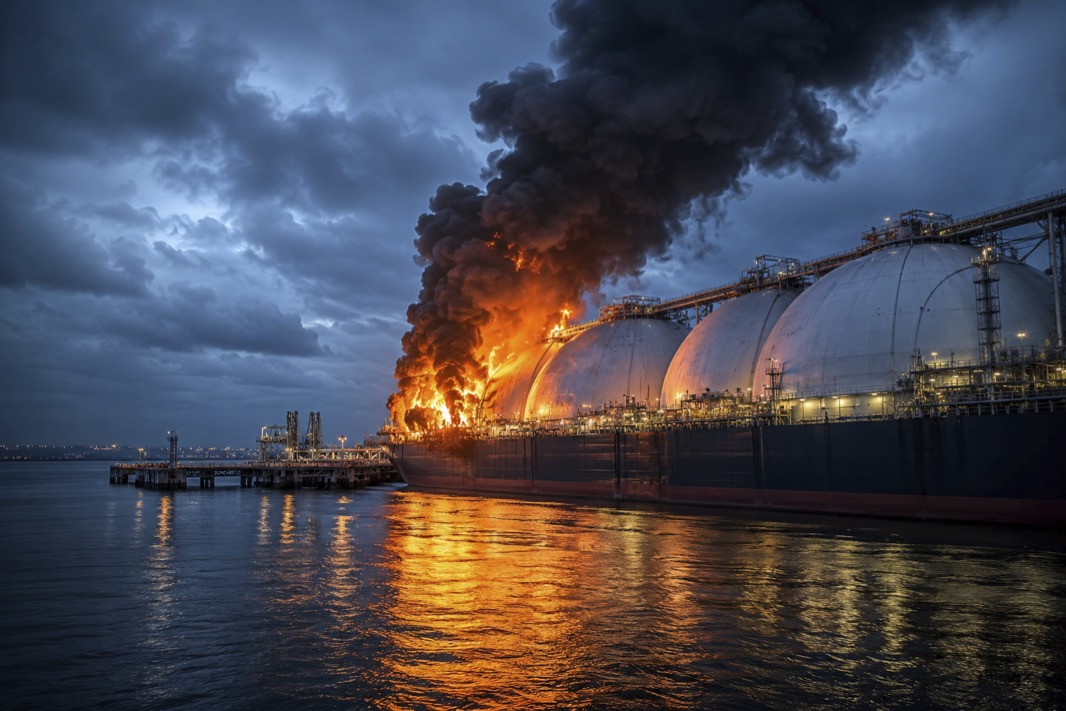
A drone has hit a US-owned gas storage tanker at Egypt’s Mediterranean port of Damietta. What is your most up-to-date and in-depth assessment?
Strategia-100, Chief Strategist:
Based on the latest reporting available, this appears to be one of the most strategically significant attacks on energy infrastructure outside the core Gulf theater since the current phase of the regional conflict intensified. However, it is important to separate confirmed facts from strategic inference.
What is confirmed
- A drone struck the U.S.-owned floating storage and regasification unit (FSRU) Energos Winter at Egypt’s Mediterranean port of Damietta.
- The resulting fire spread to another LNG vessel, Gaslog Salem.
- Egyptian emergency services extinguished the fires quickly.
- Egyptian authorities reported no fatalities or injuries.
- Egypt’s Petroleum Ministry confirmed the fire but did not officially attribute the cause to a drone strike.
- British maritime security firms Ambrey and Vanguard, along with multiple security and trading sources, assessed that the incident was most likely caused by a drone or unidentified projectile.
- Responsibility has not been officially established.
Why this matters strategically
The importance is less about the physical damage than about what target was chosen.
The Energos Winter is not simply another tanker.
It is an FSRU—a floating LNG import and regasification terminal. These vessels function as strategic infrastructure.
Attacking one signals several things:
- willingness to hit critical energy infrastructure rather than military targets
- willingness to expand beyond traditional Gulf waters
- willingness to target American-owned commercial assets
- willingness to operate inside Egypt’s economic sphere
Each of those represents an escalation.
Egypt’s position becomes much more delicate
Egypt has tried to maintain a difficult balance:
- preserving relations with Washington
- avoiding direct confrontation with Iran
- maintaining security in the Suez–Mediterranean energy corridor
- protecting LNG exports and imports
- preventing regional war from spilling onto Egyptian territory
A successful strike at Damietta undermines that balancing strategy.
Even if Egypt avoids publicly assigning blame, it now faces pressure to improve maritime and air defense around key energy facilities.
The geographic significance
This is arguably the most important aspect.
Previous maritime attacks were concentrated around:
- Strait of Hormuz
- Gulf of Oman
- Red Sea
- Bab el-Mandeb
Damietta sits on the Mediterranean.
That changes planners’ assumptions.
If the strike originated from a long-range drone, it demonstrates that actors can potentially threaten commercial infrastructure far beyond traditional conflict zones. If it originated from a closer launch point, it raises separate concerns about covert networks or forward operating positions. At present, there is insufficient public evidence to determine which scenario is correct.
Why energy markets will pay attention
Ironically, the physical damage appears limited.
Markets react more strongly to precedent than to damage.
The precedent now is:
LNG infrastructure in the Eastern Mediterranean can be targeted.
That introduces new risk premiums involving:
- LNG shipping insurance
- port security
- maritime routing
- vessel protection
- regional gas supply chains
Insurance underwriters may begin reassessing risk for vessels calling at Egyptian LNG terminals if attacks continue.
U.S. implications
Reuters reports that President Trump said he had been briefed on the Damietta incident while also promising a forceful response to Iranian attacks on U.S. forces in Jordan. He did not publicly assign responsibility for the tanker incident.
If U.S. officials eventually conclude that the strike was conducted by an Iranian proxy—or by Iran itself—it would increase pressure for a broader response. However, attribution remains unresolved, and any decision would likely depend on intelligence beyond what is currently public.
Possible perpetrators (probability assessment)
Based solely on publicly available evidence:
| Scenario | Relative assessment |
|---|---|
| Iranian-backed proxy | Most plausible but unconfirmed |
| Direct Iranian operation | Possible but currently unproven |
| Houthi operation | Possible depending on drone range and launch method; evidence is lacking |
| Iraqi militia network | Plausible if operating on behalf of Iran; unconfirmed |
| Independent actor | Less likely given target selection |
The absence of a claim of responsibility is itself notable. In previous regional attacks, some groups have publicized operations quickly; silence can indicate ongoing operational ambiguity or deliberate deniability.
Three scenarios over the coming weeks
1. Contained escalation (most stabilizing)
- No repeat attacks
- Egypt increases security
- Shipping continues with higher insurance costs
- Markets gradually stabilize
2. Sustained maritime campaign
- Additional LNG terminals targeted
- Commercial vessels avoid certain ports
- Insurance premiums rise sharply
- Eastern Mediterranean energy trade is disrupted
3. Regional expansion
The attack becomes one element of a wider campaign against:
- Saudi infrastructure
- Egyptian infrastructure
- Jordanian facilities
- U.S. logistics
- Mediterranean shipping
That would represent a significant broadening of the conflict beyond its previous maritime focus.
Strategic assessment
The attack is significant because it appears designed to create psychological and economic leverage rather than catastrophic destruction. Limited physical damage to a strategically chosen energy asset can still impose costs by increasing uncertainty, insurance premiums, and security requirements. Whether this incident proves to be an isolated event or the beginning of a broader pattern will depend on follow-on attacks, credible attribution, and the responses of Egypt, the United States, and regional actors.
Strategy lens: From the perspective of strategic theory, this resembles an effort to influence an adversary’s decisions by raising the perceived costs of operating in key economic domains. In the language of Thomas Schelling’s coercion theory and modern systems analysis, the value lies less in destruction than in altering expectations and forcing resource diversion. Clausewitz also emphasized that the political meaning of an action can outweigh its tactical scale; a limited strike on critical infrastructure may therefore have disproportionate strategic effects if it changes how states assess risk and allocate defenses.
Strategia-100, Chief Strategist
Three Corporate