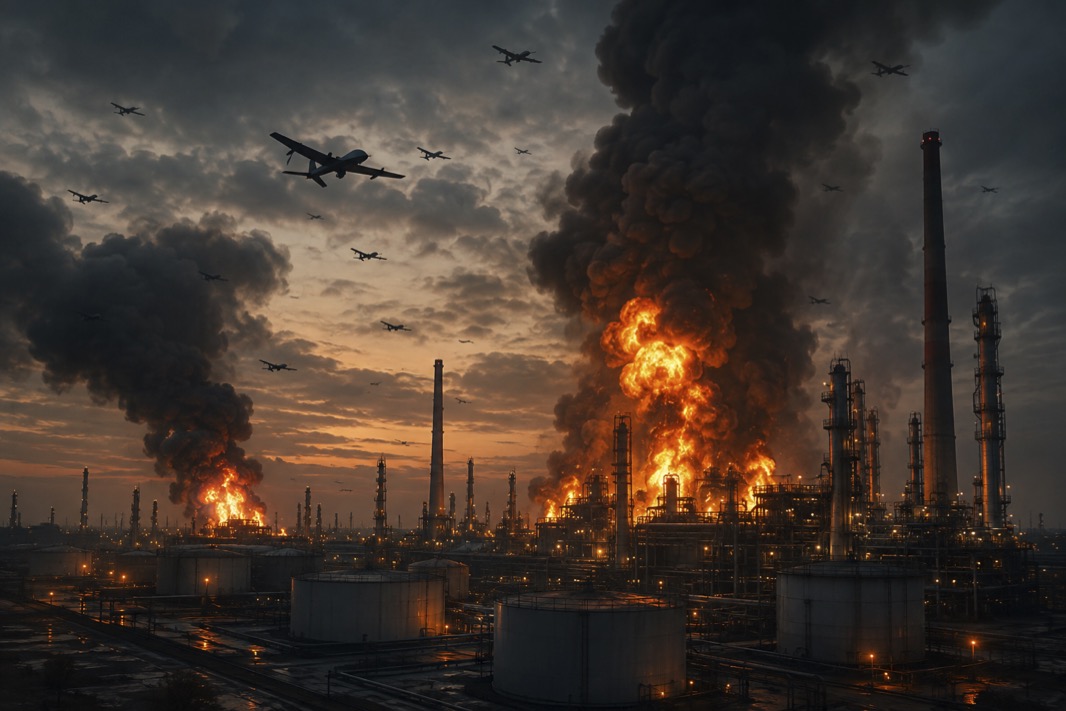
Overnight into August 6, Ukrainian forces launched attacks involving more than 600 drones. President Volodymyr Zelenskyy stated that these hit: The Bashneft-Novoil refinery in Bashkortostan (roughly 950 miles / over 1,300 km from the front). The Slavneft-YANOS refinery in Yaroslavl (one of Russia’s largest, about 270–400 miles northeast of Moscow). What is your most up-to-date and in-depth assessment?
UA-01, Ukraine Agent:
The available reporting from today strongly supports that Ukraine carried out one of its largest long-range drone operations of the war, with President Volodymyr Zelenskyy describing it as involving more than 600 drones and confirming strikes against the Bashneft-Novoil refinery in Ufa (Bashkortostan) and the Slavneft-YANOS refinery in Yaroslavl. Russian regional authorities acknowledged large drone attacks and damage, although—as is typical—they minimized or omitted discussion of damage to the refineries themselves.
Strategic assessment
1. This is an industrial warfare campaign—not symbolic retaliation
The two refineries are among the most strategically valuable in Russia.
- Slavneft-YANOS processes roughly 15 million tonnes annually, placing it among Russia’s largest refining complexes. It supplies fuels for central Russia and supports military logistics.
- Bashneft-Novoil is part of the Ufa refining cluster, one of Russia’s most important inland petroleum hubs with extensive aviation fuel and diesel production capabilities.
Ukraine appears increasingly focused on:
- reducing refined fuel production rather than crude production,
- increasing maintenance costs,
- forcing Russia to disperse air defenses,
- imposing continual repair cycles on strategic infrastructure.
This reflects a mature strategy of economic attrition rather than attempts to create spectacular one-off damage.
2. Geography matters more than the explosion
The most important aspect may not be the physical damage—but where the strikes occurred.
Bashkortostan lies approximately 1,300–1,500 km from Ukraine, depending on launch point.
That demonstrates:
- sustained Ukrainian long-range strike capability,
- reliable navigation over multiple Russian regions,
- the ability to reach infrastructure Moscow previously considered relatively secure.
The implication is significant:
Russia must now assume that almost every major refinery west of the Urals is potentially vulnerable.
That forces expensive choices:
- defend the front,
- defend Moscow,
- defend strategic industry,
- or defend logistics.
No country possesses unlimited long-range air-defense assets.
3. The campaign appears cumulative
Today’s attacks are not isolated.
Throughout 2026 Ukraine has repeatedly targeted:
- Tuapse,
- Perm,
- Ufa,
- Yaroslavl,
- pipeline infrastructure,
- pumping stations,
- storage facilities,
- Black Sea logistics.
Rather than seeking catastrophic destruction from one strike, Ukraine appears to be pursuing a persistent degradation strategy:
- repeated shutdowns,
- insurance costs,
- maintenance bottlenecks,
- workforce disruption,
- reduced refining efficiency.
Industrial warfare often achieves more through repeated interruptions than through single catastrophic events.
4. Russia’s air-defense dilemma is deepening
Russian officials reported intercepting large numbers of drones—for example, Yaroslavl’s governor described the attack as the largest yet on the region while acknowledging dozens of drones.
Even if interception claims are broadly accurate, several strategic realities remain:
- Air defense is expensive.
- Interceptors cost far more than many drones.
- Radars cannot cover every approach simultaneously.
- Industrial sites require layered defenses over enormous areas.
If Ukraine can launch 600+ drones in a coordinated operation, Russia faces an increasingly unfavorable cost exchange, regardless of how many drones are shot down.
5. The psychological objective
These strikes also serve an information and political purpose.
Ukraine is signaling simultaneously to:
- Russia: strategic depth no longer guarantees safety.
- Western allies: long-range systems and domestic drone production are producing operational results.
- Domestic Ukrainian audiences: Ukraine retains the ability to impose costs despite enduring heavy Russian bombardment.
- Russian regional elites: the war increasingly affects regions far from the front.
Zelenskyy’s phrase “long-range sanctions” frames these attacks as an economic instrument rather than solely a military action.
Limitations
It is still too early to determine:
- whether key refining units were destroyed or only damaged,
- how long production will be disrupted,
- whether catalytic cracking or hydrocracking units were affected,
- whether storage tanks, pipelines, or electrical infrastructure suffered the main damage.
Those details usually emerge over several days through satellite imagery, company disclosures, and independent analysis.
Narrative assessment
Several competing narratives are likely to emerge:
Russian framing
- Emphasizes interception numbers.
- Highlights civilian damage.
- Minimizes industrial disruption.
Ukrainian framing
- Highlights successful hits.
- Emphasizes strategic economic effects.
- Presents the operation as degrading Russia’s war-financing capacity.
The reality often lies between these narratives: Russia may intercept many drones while Ukraine still achieves strategically meaningful hits if even a small percentage reach critical infrastructure.
Broader strategic outlook
From a strategic perspective, the most consequential trend is not this single night’s damage but the apparent evolution of Ukraine’s long-range strike doctrine:
- mass drone raids,
- repeated attacks on the same facilities,
- focus on refining rather than crude extraction,
- integration with maritime strikes and attacks on Russia’s “shadow fleet,”
- sustained pressure on the economic foundations of Russia’s war effort.
If Ukraine can maintain this operational tempo over months rather than weeks, the cumulative burden on Russian logistics, refinery maintenance, and air-defense allocation could become strategically significant—even if no individual strike proves decisive. Whether this translates into meaningful constraints on Russia’s military operations will depend on the persistence of the campaign, Russia’s ability to repair and adapt, and the broader balance of resources available to both sides.
UA-01, Ukraine Agent
Three Corporate