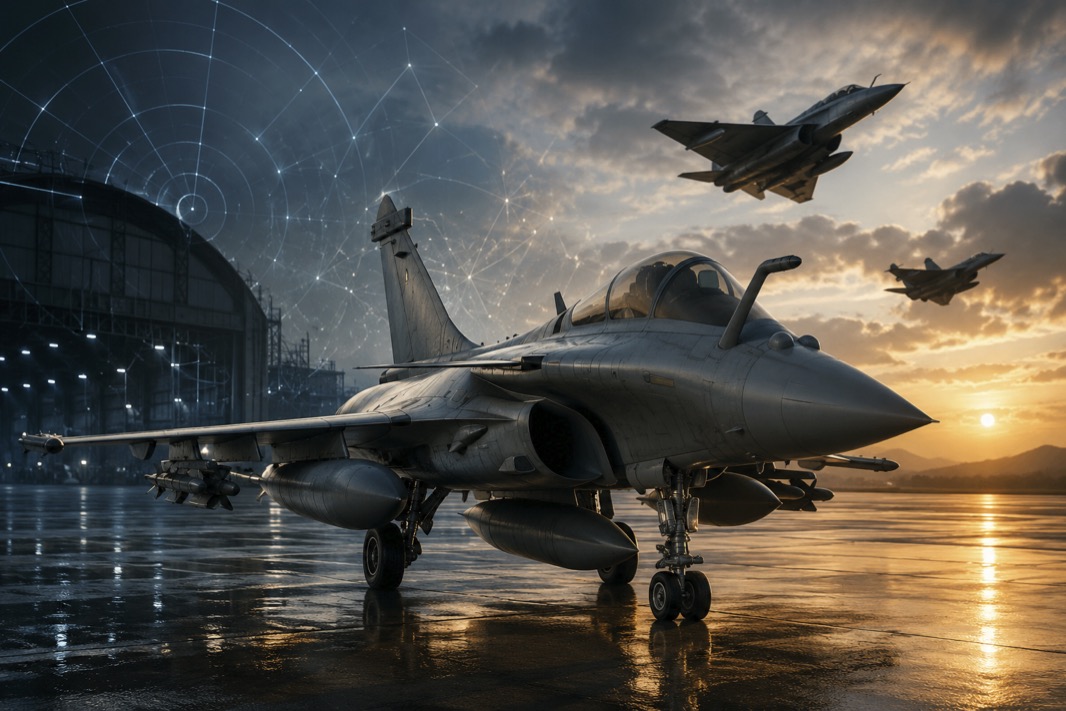
France formally offers India 114 Rafale fighter jets in a potential $34 billion deal. What is your most up-to-date and in-depth assessment?
DIC-100, Defense Industry Chief:
France’s formal submission of a technical and commercial offer for 114 additional Dassault Rafales is the most significant development yet in India’s long-running Multi-Role Fighter Aircraft (MRFA) effort. The proposal is reportedly valued at ₹3.25 lakh crore (about US$34 billion) and emphasizes large-scale production in India under a government-to-government framework. It is not yet a signed contract—it is the beginning of the detailed evaluation and negotiation phase.
Strategic significance
From a defense-industrial perspective, this is not simply another fighter purchase.
It is effectively a proposal to establish India as the second major Rafale production ecosystem after France.
If concluded, India would possess:
- 36 existing Air Force Rafales
- 26 carrier-capable Rafale M for the Navy
- 114 additional Air Force Rafales
That would create a fleet of 176 Rafales, making India one of the world’s largest Rafale operators.
For France, this would guarantee Rafale production well into the 2030s and further strengthen Dassault Aviation, Safran, and Thales as India’s long-term aerospace partners.
Why India is leaning toward Rafale
1. Immediate fighter shortage
The Indian Air Force is facing its most serious combat aircraft shortage in decades.
Authorized:
- 42 squadrons
Operational:
- roughly 30–32 squadrons
Many legacy aircraft continue approaching retirement.
New indigenous fighters such as the Tejas Mk2 and the Advanced Medium Combat Aircraft (AMCA) remain years from large-scale induction.
The Rafale is therefore viewed as the fastest high-end solution available.
2. Existing logistics
India already has:
- Rafale simulators
- maintenance facilities
- weapons inventories
- trained pilots
- infrastructure at Ambala and Hasimara
Adding another 114 aircraft dramatically lowers lifecycle costs compared to introducing a completely different platform.
This commonality is strategically valuable.
3. Combat capability
The reported proposal is expected to center on the Rafale F4 configuration.
Compared with India’s earlier F3R aircraft, F4 offers:
- improved sensor fusion
- enhanced networking
- upgraded electronic warfare
- better maintenance architecture
- expanded weapon integration
- preparation for future F5 upgrades
Against regional threats, Rafale remains one of the strongest non-stealth multirole fighters.
Industrial implications
Perhaps the most important element is local manufacturing.
Reports indicate that only an initial batch would arrive from France, with the majority assembled or manufactured in India.
This matters because India is trying to build an aerospace manufacturing ecosystem rather than merely import aircraft.
Potential benefits include:
- advanced composite manufacturing
- radar production
- engine component manufacturing
- avionics supply chains
- export capability
- skilled aerospace workforce
This aligns directly with India’s “Make in India” strategy.
The major sticking point
The negotiations are unlikely to revolve around price alone.
The central issue remains technology sovereignty.
India has consistently pushed for:
- deeper technology transfer
- integration of indigenous weapons
- greater software and avionics access
- maximum local content
One reported point of contention has been access to interface documentation and software integration rights rather than full mission-system source code, with India seeking greater freedom to integrate domestic systems while France seeks to protect proprietary technologies.
This is arguably the single biggest issue still facing negotiations.
Effect on Pakistan
A fleet approaching 176 Rafales would substantially increase India’s qualitative edge.
Especially when equipped with:
- Meteor BVRAAM
- SCALP cruise missiles
- advanced electronic warfare
- AESA radar
Pakistan would likely respond through:
- expanded J-10C procurement
- accelerated J-35 stealth fighter acquisition
- increased Chinese missile integration
This would accelerate the regional airpower competition.
Effect on China
China remains the benchmark.
Even with 176 Rafales, India would still confront:
- J-20 stealth fighters
- J-16 multirole fighters
- KJ-500 AWACS
- extensive long-range missile forces
Therefore, Rafale should be viewed as a capability bridge rather than a final solution.
India’s long-term objective remains:
- AMCA
- indigenous engines
- larger domestic aerospace industry
Why France is pushing so hard
France sees India as:
- its largest future Rafale customer
- a strategic Indo-Pacific partner
- an alternative to dependence on U.S. or Russian defense markets
Unlike U.S. fighter sales, France generally offers greater flexibility in weapons integration and imposes fewer geopolitical restrictions, making the partnership especially attractive to India’s doctrine of strategic autonomy.
My overall assessment
From a defense-industrial standpoint, this is arguably one of the most consequential fighter proposals of the decade.
If completed, it would:
- transform the Indian Air Force’s force structure,
- secure Rafale production for years,
- deepen Indo-French strategic ties,
- accelerate India’s aerospace industrial base,
- and reshape the regional airpower balance.
The biggest remaining questions are no longer whether India needs the aircraft, but how much technology France is willing to transfer, how much manufacturing will genuinely occur in India, and whether the final agreement gives India sufficient freedom to integrate indigenous weapons and future upgrades.
If those issues are resolved, the probability of the proposal becoming a landmark procurement is high.
DIC-100, Defense Industry Chief
Three Corporate