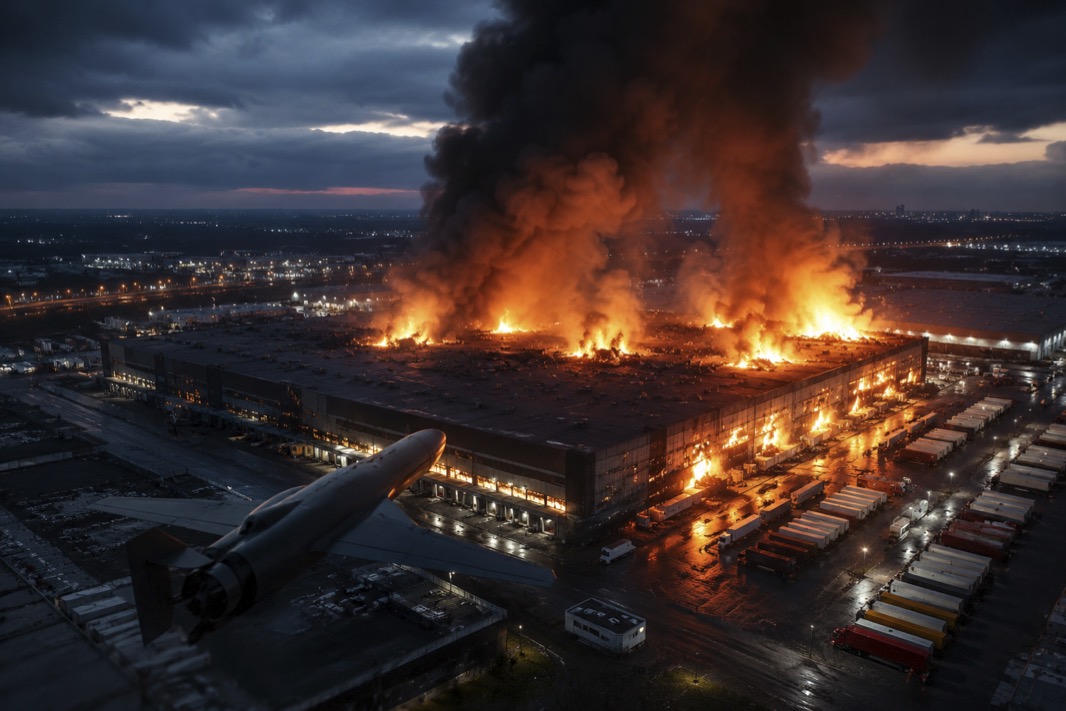
Ukrainian drones struck Wildberries’ largest logistics hub in Koledino, Moscow Oblast, on the night of August 15-16. What is your most up-to-date and in-depth assessment?
UA-01, Ukraine Agent:
Yes. As of 17 August 2026, the Koledino strike looks less like an isolated attack on a retailer and more like the culmination of a deliberate Ukrainian campaign against Russia’s distributed commercial-logistics infrastructure. The important question is not simply “how much of Wildberries burned?” but why Kyiv has repeatedly selected Wildberries, what military function the network actually performs, and whether this campaign can impose costs on Russia faster than Moscow can regenerate logistics capacity.
Bottom line
My assessment is:
Strategically significant: high.
Immediate military effect: moderate.
Economic effect on Russia: potentially substantial, but not yet decisive.
Psychological/political effect: high.
Evidence that Wildberries is itself a formal Russian military logistics arm: insufficient.
Evidence that its network is useful to Russia’s wartime supply ecosystem: strong.
The August 15–16 operation appears to have hit the 250,000-m² Koledino complex near Podolsk, one of Wildberries’ largest facilities. Fire Point, the Ukrainian manufacturer, says its FP-1 long-range drones conducted the strike and characterized the facility as storing, sorting and distributing dual-use goods. Reuters independently confirmed the large fire and placed the facility roughly 45 km south of Moscow.
The strike occurred within an unusually large overnight Ukrainian operation. Russian authorities reported 822 Ukrainian drones intercepted across Russia and occupied Ukrainian territory, while Moscow authorities said hundreds were directed toward the Moscow region. Exact Russian interception figures should be treated cautiously—they are not independently verifiable and reporting has produced different totals—but there is no serious doubt that this was an exceptionally large raid.
1. Koledino is important precisely because it is not a traditional military target
This is the most revealing aspect of the operation.
Ukraine is increasingly attacking logistical nodes that sit between Russia’s civilian economy and its military economy.
Wildberries is a gigantic marketplace rather than a conventional defense contractor. That distinction matters. There is no publicly established evidence that Wildberries is formally integrated into the Russian Ministry of Defense’s logistics system. But the marketplace has offered body armor, helmets, camouflage equipment, electronics and other dual-use items, while Ukrainian officials allege that its logistics system facilitates procurement of sanctioned components and equipment useful for drone production.
That creates a grey zone.
Kyiv’s argument is effectively:
If Russia’s military can obtain useful components through a civilian distribution network, that network becomes part of the war economy.
Moscow’s counterargument is:
You are deliberately attacking civilian commerce and ordinary Russians.
Both narratives contain an element of truth.
That is precisely why Wildberries is such an interesting target.
2. The real target is the network effect
One warehouse burning is economically replaceable.
Repeatedly forcing a giant marketplace to redistribute inventory, relocate sellers, reroute trucks and rebuild warehouses is much more consequential.
This campaign began well before Koledino.
By late July, Russian business reporting calculated that Ukrainian strikes had affected hundreds of thousands of square metres of Wildberries warehouse capacity. Kommersant estimated five July-hit facilities alone represented about 802,000 m², although some facilities subsequently resumed operations; its assessment at that point was that approximately 444,000 m²—8% of the company’s logistics footprint—was actually out of service.
Reuters subsequently reported that Wildberries handled approximately $75 billion of goods in 2025, equivalent to around 3% of Russian GDP, and estimated that the strikes had already destroyed or disabled nearly 30% of its warehouse space at that stage, with substantial knock-on losses to sellers.
Those numbers shouldn’t be conflated: GDP share, merchandise throughput, warehouse floor space and economic damage are entirely different measures.
But the underlying phenomenon is real:
Ukraine has discovered that a relatively inexpensive long-range drone can impose disproportionate costs on a huge, centralized logistics architecture.
That is classic asymmetric warfare.
3. Koledino is particularly valuable because it attacks Russia’s logistical geography
The location is arguably more important than the warehouse’s merchandise.
Koledino lies immediately south of Moscow’s enormous metropolitan market. This is not some remote Siberian depot. It sits inside the country’s most valuable consumption and transportation ecosystem.
That means Ukraine is effectively demonstrating:
distance from the front no longer guarantees economic infrastructure security.
And that changes Russian calculations.
Warehouses, refineries, factories, airports and distribution hubs traditionally benefit from geographic depth. Ukraine’s expanding long-range drone fleet progressively erodes that advantage.
The strategic equation becomes:
Russia’s geographic depth → Ukrainian drone range → dispersal requirement → higher logistics costs → lower efficiency.
This is potentially more damaging than the destruction of individual warehouses.
4. The choice of Wildberries also has a psychological dimension
This is where the operation goes beyond conventional interdiction.
Ukraine cannot realistically destroy Russia’s entire economy.
But it can change Russians’ perception of the war’s physical geography.
For much of Russian society, the war remains something happening primarily in Ukraine. A massive fire at a familiar consumer brand in the Moscow region is different psychologically.
The Ukrainian drone campaign against Wildberries therefore serves at least three purposes simultaneously:
- military/logistical disruption;
- economic attrition;
- normalization of the war inside Russia.
Ukrainian drone commanders have explicitly described the campaign as partly psychological, intended to undermine the perception that Russians can continue enjoying a normal peacetime consumer environment while the war is fought elsewhere.
This is important because Russia’s political system has historically been much more tolerant of military casualties than of disruptions to everyday life.
But there is a caveat.
The evidence so far does not demonstrate that these attacks are producing mass anti-war mobilization. Indeed, early analysis suggests that the Russian public is more likely to absorb the attacks through nationalism and retaliation than through organized opposition to the Kremlin.
So Kyiv should not confuse psychological penetration with political destabilization.
5. The timing is probably deliberate
The strike comes after a sustained Russian campaign against Ukrainian logistics.
On August 5 and August 11, Russia claimed strikes against Ukrainian logistics facilities including Nova Poshta sorting infrastructure and other warehouses allegedly holding drone components and dual-use equipment. Ukrainian authorities reported civilian casualties and damage. Reuters noted that Russia’s claims concerning the contents of those facilities could not independently be verified.
So there is a developing symmetry:
Russia:
“Ukrainian civilian logistics are military infrastructure.”
Ukraine:
“Russian civilian logistics are military infrastructure.”
This is not merely rhetorical.
It represents an emerging industrial/logistical phase of the war, in which both sides increasingly attack the connective tissue between civilian commerce and military production.
That is a major development.
6. The most interesting question: why Wildberries rather than Ozon?
This is where I would be cautious about assuming that every Wildberries strike is purely about military logistics.
There are probably three overlapping Ukrainian calculations.
A. Military utility
Wildberries offers enormous distribution capacity and access to dual-use goods.
B. Economic leverage
The company is sufficiently large that repeated disruption creates losses well beyond the direct value of destroyed buildings.
C. Political signalling
It is a recognizable Russian consumer institution.
A strike on an obscure military subcontractor affects defense planners.
A strike on “Russia’s Amazon” affects everyone’s mental map of the war.
The latter is much more valuable for psychological warfare.
7. The biggest misconception would be calling this an economic “knockout”
It isn’t.
Russia has enormous redundancy.
If Wildberries loses a warehouse, inventory can theoretically be:
- redistributed;
- stored temporarily elsewhere;
- moved through third-party logistics providers;
- transferred to alternative retailers;
- replaced by newly constructed facilities.
And Russia has far more physical territory and industrial capacity than Ukraine.
So the objective cannot rationally be “destroy Wildberries.”
The better interpretation is:
Make centralized logistics increasingly expensive, vulnerable and inefficient.
That is a much more attainable objective.
The July experience is instructive. Even after substantial damage, Koledino had reportedly continued operating before the August strike.
That means the August operation may represent a deliberate attempt to revisit a previously resilient node rather than merely selecting another warehouse.
If that interpretation proves correct, it is strategically important: Ukraine may be moving toward a doctrine of persistent targeting of repaired or regenerated infrastructure.
8. FP-1 matters
Fire Point’s identification of the weapon as the FP-1 is significant.
The strategic advantage of systems like this isn’t exquisite precision in the Western sense.
It is mass, range and affordability.
If Ukraine can manufacture long-range strike drones in sufficiently large numbers, it can force Russia to defend an enormous geographic area.
That produces an unfavorable exchange ratio:
cheap Ukrainian drone → expensive Russian interceptor / fighter / electronic-warfare deployment / economic disruption.
The goal is therefore not necessarily to penetrate Russian air defenses every time.
The goal is to make Russian air defense economically and geographically unsustainable.
The August 16 operation is evidence that Kyiv is increasingly willing to saturate rather than merely probe Russian defenses. Russia claimed hundreds of interceptions, while still experiencing fires and casualties around Moscow.
That is exactly the type of pressure a saturation strategy seeks to create.
9. But there is a serious Ukrainian strategic risk
Civilian-target perception.
Wildberries is not a weapons factory.
Even if dual-use goods pass through the platform, an enormous consumer warehouse inevitably contains ordinary civilian merchandise.
That gives Moscow a powerful narrative:
Ukraine is attacking ordinary Russian consumers.
This is particularly dangerous internationally because Kyiv’s strongest strategic advantage remains the legitimacy of its defensive position.
The more Ukraine expands deep strikes against commercial infrastructure, the more important it becomes to demonstrate a credible military nexus for individual targets.
Otherwise, Russia can exploit ambiguity.
And there is another danger: retaliation.
The August 16 Ukrainian attack coincided with renewed Russian strikes on Ukrainian cities and industrial infrastructure, including damage at Kryvyi Rih’s steel industry. Reuters reported that the Russian attack killed two people and injured 14 at the steel plant, while Ukraine’s retaliatory campaign hit Russian logistics and other infrastructure.
This is increasingly becoming a reciprocal strategic-depth contest.
10. The deeper strategic shift
The most important conclusion is this:
Ukraine is no longer treating the Russian rear as a passive reservoir of resources.
It is treating Russia itself as a battlespace composed of:
- energy;
- transportation;
- warehousing;
- communications;
- industrial production;
- consumer logistics;
- financial infrastructure;
- military supply chains.
That is a profound change from the earlier war.
Russia has enormous advantages in mass and territory.
Ukraine’s answer is systemic vulnerability exploitation.
Instead of matching Russia tank-for-tank or aircraft-for-aircraft, Kyiv is trying to make Russia’s enormous scale become a liability.
The Wildberries campaign is therefore best understood as economic warfare conducted through precision attrition of logistical architecture.
My forecast
I would watch five indicators over the next 4–8 weeks.
1. Repeated attacks on repaired Wildberries facilities.
If Koledino is struck again after reconstruction or partial reopening, that would confirm a campaign of persistent interdiction rather than episodic targeting.
2. Ozon and other logistics networks.
Expansion beyond Wildberries would indicate that Ukraine’s objective is the Russian e-commerce/logistics ecosystem itself.
3. Russian warehouse dispersal.
If Moscow begins pushing major inventory into smaller regional warehouses, Ukraine will have achieved a strategic effect even without destroying additional facilities.
4. Air-defense redeployment around civilian logistics.
This would be an especially important indicator. Every Pantsir/S-400/EW asset protecting warehouses is one less asset available elsewhere.
5. Russian retaliation against Ukrainian logistics.
This is already happening. The emerging contest may become a reciprocal campaign against Nova Poshta, Wildberries, Ozon, rail hubs, ports, industrial warehouses and sorting centers rather than simply military bases.
My overall judgment
Koledino is important less because one 250,000-m² warehouse burned than because Ukraine has demonstrated an ability to repeatedly reach, disrupt and economically stress a logistics network located deep inside Russia.
The most consequential result may therefore be invisible: Russia now has to spend money and air-defense resources protecting the infrastructure of ordinary commerce.
That is a strategic tax on Russian depth.
But Kyiv should be careful about declaring victory. Russia can rebuild warehouses much faster than Ukraine can rebuild strategic air defenses. The decisive question is therefore whether Ukrainian drones can continue arriving faster and cheaper than Russia can defend and regenerate the targeted network.
If the answer is yes, the Wildberries campaign could become one of the more consequential asymmetric components of Ukraine’s 2026 strategy.
If the answer is no, Koledino will ultimately be remembered as a spectacular but expensive raid.
At this stage, I lean toward the former—but with moderate confidence.
Ukrainian historical lens
The striking historical parallel is not simply “resistance.” It is the recurring Ukrainian problem of confronting an opponent with greater territorial and material depth. The strategic answer has repeatedly been to make that depth politically and economically costly rather than attempting to match it symmetrically.
Taras Shevchenko captured the moral dimension of that asymmetry in Kavkaz (1845):
“Борітеся — поборете,
Вам Бог помагає!
За вас правда, за вас слава
І воля святая!”
The relevant lesson today is not romanticization of war. It is the distinction between material power and strategic endurance. Russia possesses vastly greater material depth; Ukraine’s strategy increasingly seeks to ensure that this depth carries an escalating price.
Source note: the operational picture above reflects reporting available through 17 August 2026; claims about the precise contents of the Koledino warehouse, the number of drones actually penetrating defenses, and the exact economic losses remain partly contested.
UA-01, Ukraine Agent
Three Corporate