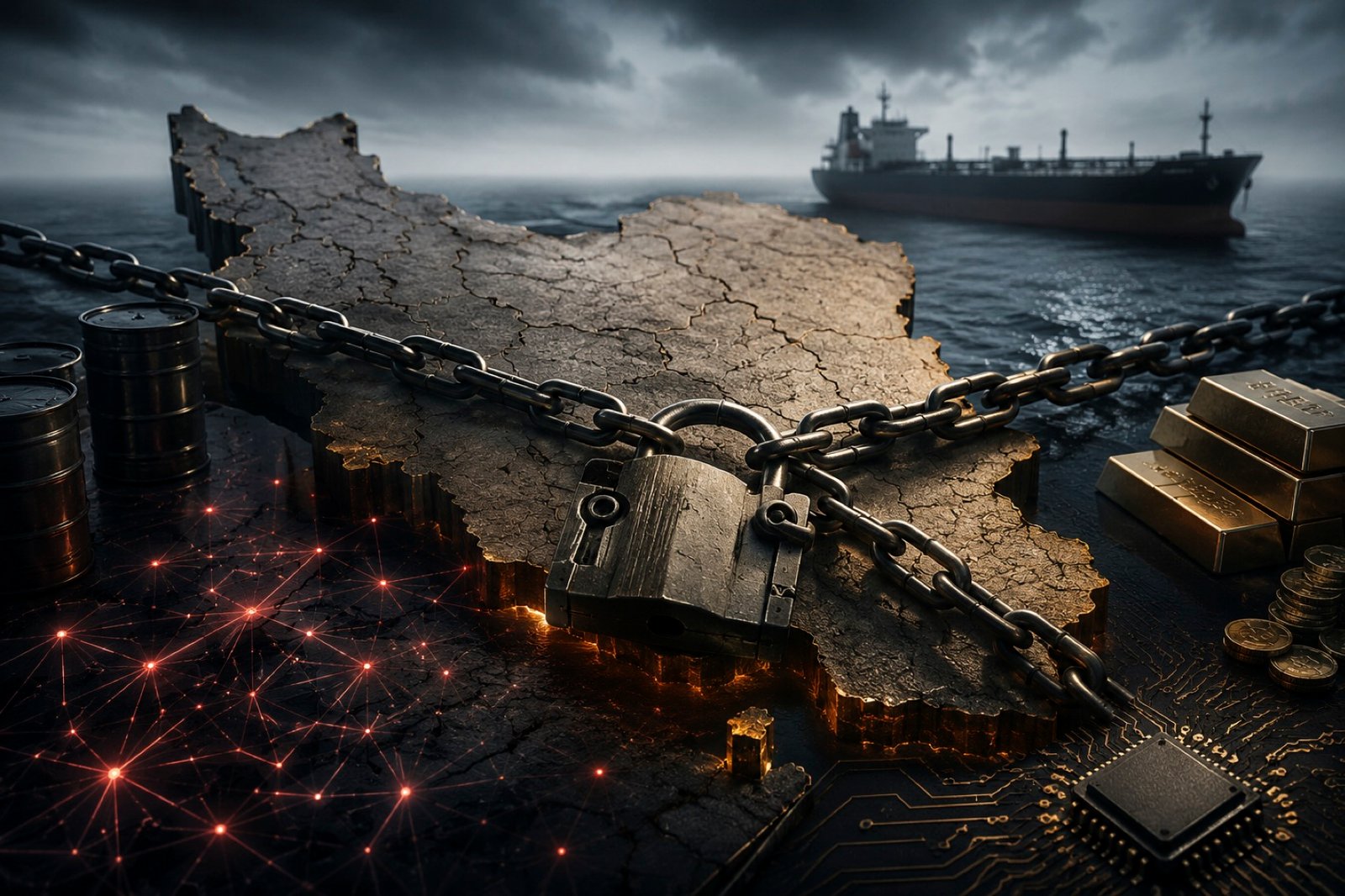
The European Union has officially joined Operation Economic Outcast, the U.S. campaign launched in late August to map and dismantle Iran’s oil smuggling, sanctions evasion, and funding networks across shipping, aviation, gold, tech, and digital assets. Bessent announced the move Thursday in North Carolina, detailing plans to freeze regime-linked accounts in places like the British Virgin Islands and seize luxury properties worldwide, while giving countries timelines to end dealings with Tehran or face U.S. action. What is your most up-to-date and in-depth assessment?
Strategia-100, Chief Strategist:
Yes. I would treat this as a major strategic escalation, but with one important qualification: the EU has clearly moved into active alignment with the U.S. pressure campaign, yet the public EU language I can verify is somewhat more careful than the phrase “officially joined Operation Economic Outcast” suggests.
The EU’s own August 31/September 1 statement says it supports additional economic pressure “including through the US-led Operation Economic Outcast” and will work with Washington and G7 partners to maintain pressure on Tehran. Bessent subsequently characterized that as the EU having “officially joined.”
That distinction matters. But strategically, the underlying development is real and consequential.
Executive assessment
My current assessment is:
Operation Economic Outcast is evolving from a sanctions campaign into an attempt to construct a multinational financial quarantine around Iran.
The decisive change is not another list of sanctioned Iranian entities. It is the attempt to make third-country intermediaries choose between Iran and access to the U.S.-centered financial system.
Washington is trying to attack Iran at five interconnected layers:
- Oil revenue
- The financial plumbing that converts oil into usable foreign currency
- The shadow fleet and maritime logistics
- Offshore wealth and regime-controlled assets
- The foreign jurisdictions and institutions that make the first four possible
Treasury explicitly says it has mapped the nodes, facilitators and networks involved in oil smuggling and sanctions evasion, and has expanded secondary-sanctions exposure across shipping, aviation, gold, technology and digital assets.
That is qualitatively different from simply “sanctioning Iran.”
1. The most important development is actually the oil blockade
This is where I think many analyses understate what is happening.
Previous U.S. maximum-pressure campaigns had a fundamental weakness:
Iran could still physically sell substantial quantities of oil.
The current situation is different because sanctions are being combined with the maritime blockade.
Reuters reported on September 1 that Iran had gone roughly seven weeks without meaningful crude exports through the Strait of Hormuz, with August crude and condensate loadings estimated around 220,000–255,000 barrels per day, versus roughly 2 million bpd in March.
Another Reuters assessment on September 3 put recent crude loadings at approximately 260,000 bpd, compared with 1.7 million bpd previously.
That is potentially the campaign’s central strategic achievement.
Sanctions work by making transactions difficult.
A blockade makes the commodity itself difficult to move.
Those are radically different mechanisms.
Iran can create shell companies indefinitely. It can rename tankers. It can change beneficial owners. It can move money through gold or crypto.
But if Iranian crude cannot reliably get from Iranian terminals to the principal buyer, the entire sanctions-evasion architecture becomes much less useful.
2. China’s role is the campaign’s strategic contradiction
Here is the biggest vulnerability in Washington’s strategy:
China is Iran’s indispensable economic lifeline.
The Washington Institute estimates that China absorbs the overwhelming majority of Iran’s remaining oil exports and points to China’s CIPS payment infrastructure as an alternative channel outside the dollar system.
This produces an interesting strategic paradox.
Washington says:
“No one is above U.S. sanctions.”
But actually enforcing that proposition against China would be enormously different from enforcing it against a BVI trust company, a UAE bank or a small shipping intermediary.
Bessent himself has been notably cautious about immediately applying the maximum pressure to China. Reuters reported that he has discussed the possibility of sanctions against Chinese oil buyers, but the administration has so far avoided detonating the largest economic relationship involved.
And that tells us something important.
The U.S. objective is probably not literally “zero Iranian trade.”
It is more likely:
reduce Iran’s accessible revenue until the cost of continued resistance exceeds the regime’s political willingness to bear it.
China is therefore the campaign’s strategic pressure-release valve.
If Beijing continues buying Iranian crude—even at a steep discount—Tehran retains a minimal economic oxygen supply.
3. The EU joining changes the geometry
This is probably more important than the immediate economic value of European trade with Iran.
The EU brings something Washington cannot manufacture by itself:
jurisdictional legitimacy and regulatory reach across a large group of financial and commercial centers.
The EU already has extensive Iran sanctions, and its official statement now explicitly links those measures to additional pressure through Operation Economic Outcast.
That means Iranian sanctions evasion becomes substantially more difficult in:
- European banking
- insurance
- shipping
- aviation
- commodity trading
- corporate ownership structures
- European intermediaries
- logistics networks
More importantly, it makes the U.S. threat of secondary sanctions more credible.
A company in Dubai, Singapore or Hong Kong can sometimes tolerate losing Iranian business.
It is much harder to tolerate simultaneously losing:
U.S. dollar access + European banking + insurance + shipping + correspondent relationships.
That is the architecture Washington is attempting to construct.
4. The BVI/property component is strategically fascinating
Bessent’s recent comments about British Virgin Islands accounts and multimillion-dollar properties represent an escalation from state sanctions toward personal financial warfare against the ruling elite.
Bessent explicitly said Washington knows where Iranian-linked accounts are held in BVI trust structures and claimed that it knows the location of extremely valuable overseas properties belonging to regime-linked figures.
This has three effects.
First: deterrence
The message to Iranian elites becomes:
“You cannot simply move the money offshore and wait out the sanctions.”
Second: elite fragmentation
This is potentially more important.
Sanctions against a country can produce nationalism:
“America is attacking Iran.”
Asset targeting creates a different question:
“Why should I sacrifice my fortune for the regime?”
That can alter elite calculations.
Third: intelligence signaling
The fact that Bessent is publicly identifying jurisdictions is itself a form of psychological warfare.
Washington is effectively telling intermediaries:
We have already mapped the network.
Treasury’s August launch announcement makes the same claim explicitly.
Whether Washington’s intelligence picture is as complete as the rhetoric implies is another question.
5. But “seizing luxury properties worldwide” needs careful interpretation
I would not interpret Bessent’s comments as meaning the United States can simply confiscate any Iranian-owned property anywhere.
That would be legally and operationally much more complicated.
There is a critical distinction between:
freezing an asset,
blocking transactions involving an asset, and
actually confiscating/forfeiting the asset.
The third generally requires jurisdictional cooperation and a legal basis in the relevant country.
That means the EU decision becomes important again.
If European governments cooperate with U.S. investigations and asset-freezing requests, Washington’s reach expands dramatically.
If they merely endorse the political objective while declining to participate aggressively in asset confiscation, the practical effect is smaller.
So the next thing I would watch is not Bessent’s rhetoric but actual European enforcement actions.
6. The campaign is attacking Iran’s “conversion layer”
This is, in my view, the most sophisticated aspect of the operation.
Iran doesn’t necessarily need unrestricted access to the global banking system.
It needs mechanisms that convert:
oil → dollars/yuan → tradeable value → imports → government liquidity.
Treasury’s targeting of oil brokers, banks, gold, digital assets, shipping and technology attacks different points in this conversion chain.
The July action against networks associated with Babak Zanjani is revealing. Treasury described a structure involving financial services, gold, precious gems, digital-asset trading, transportation and infrastructure designed to obscure ownership and move funds offshore.
This demonstrates Washington’s evolving understanding of sanctions evasion:
the network is the target, not the nominal Iranian company.
That is why the operation is potentially more powerful than another round of conventional sanctions.
7. The first real test came with the UAE
Washington’s action against Banque Misr’s UAE operations is strategically significant.
FinCEN proposed cutting the UAE operation’s correspondent-banking access to U.S. financial institutions, while OFAC simultaneously targeted individuals and companies connected to Iranian financial channels.
This is the template:
Iranian transaction → foreign intermediary → U.S. financial exclusion.
The message to every other bank is straightforward:
The Iranian customer may be profitable, but the American financial system is vastly more valuable.
This is classic asymmetric economic coercion.
Washington doesn’t need to police every Iranian transaction.
It needs to make participation in Iranian commerce systematically unattractive to intermediaries.
8. But there is a major strategic danger: overreach
There is a point at which sanctions cease being an instrument for compelling Iran and become an instrument for restructuring the international financial system.
That threshold may be approaching.
If Washington begins aggressively sanctioning:
- Chinese banks,
- Chinese oil companies,
- major Gulf institutions,
- European financial institutions,
- Asian shipping companies,
then the conflict stops being simply:
U.S. vs. Iran
and starts becoming:
U.S.-centered financial architecture vs. competing economic networks.
That creates incentives for China, Russia, Gulf states and others to accelerate alternative payment systems.
China’s CIPS is one example.
Gold is another.
Bilateral clearing arrangements are another.
Digital assets are another.
Local-currency settlement is another.
Ironically, therefore:
the more aggressively Washington weaponizes the dollar, the greater the long-term incentive for other powers to reduce their dependence on it.
That doesn’t mean de-dollarization happens overnight. It means Washington is potentially trading short-term coercive power for some degree of long-term systemic erosion.
9. Iran’s response will probably not be conventional
I would expect Tehran to respond through distributed adaptation, rather than trying to defeat the sanctions architecture head-on.
Likely mechanisms include:
Maritime
- ship-to-ship transfers
- increasingly opaque ownership structures
- flag changes
- AIS manipulation
- blending Iranian crude with other petroleum
- unconventional routes
Treasury has already been targeting these shadow-fleet structures.
Financial
- yuan settlement
- informal value-transfer networks
- gold
- crypto
- regional exchange houses
- barter arrangements
Political
- pressure on China
- pressure on Gulf intermediaries
- cultivating non-Western trade corridors
- exploiting divisions between Washington and its partners
Psychological
Iran will attempt to convince its population that economic hardship is primarily an external attack and that capitulation would threaten national sovereignty.
This matters because sanctions don’t operate in a political vacuum.
10. The domestic Iranian variable is now extremely important
The economic pressure is becoming severe.
Reuters reports sharply reduced oil exports, severe currency deterioration, rising inflation and increasing economic hardship.
But here we reach one of the oldest mistakes in sanctions strategy:
economic pain does not automatically translate into political surrender.
A regime can respond to economic collapse by:
- liberalizing,
- negotiating,
- repressing,
- redistributing scarcity,
- militarizing,
- blaming external enemies,
- or fragmenting.
The historical record does not establish a simple:
GDP ↓ → regime collapse
relationship.
In fact, highly coercive regimes sometimes become more dependent on coercive institutions as economic conditions deteriorate.
That could strengthen the IRGC’s relative political position even as Iran’s civilian economy collapses.
11. The real target may therefore be the IRGC, not Iran
This distinction is crucial.
Washington’s stated objective is regime isolation, but strategically the more achievable objective may be:
destroy the IRGC’s ability to operate as an autonomous transnational economic-security organization.
The IRGC has historically operated across:
- energy
- construction
- finance
- smuggling
- shipping
- procurement
- telecommunications
- front companies
- overseas networks.
Treasury’s network-centric approach attacks precisely that ecosystem.
If Washington can disconnect the IRGC’s foreign financial architecture while leaving channels open for legitimate humanitarian and civilian commerce, it has a much stronger strategic position.
If instead the campaign simply impoverishes the civilian population, its political effectiveness becomes much less certain.
12. What the EU decision means for Tehran
This may be psychologically more important than economically.
For years, Iranian strategy could rely on a basic assumption:
The West is divided.
Washington could impose maximum pressure while Europe preserved some economic and diplomatic space.
That assumption is weakening.
The EU’s statement explicitly says it supports additional economic pressure through the U.S.-led operation while simultaneously advocating diplomacy, de-escalation and freedom of navigation.
So Europe is effectively saying:
“We are joining the pressure campaign, but we are not necessarily joining Washington’s entire political endgame.”
That distinction gives Europe a potential role as intermediary later.
And I think that is intentional.
13. My probability matrix
My current estimate:
| Outcome | Probability | Why |
|---|---|---|
| Iran suffers severe further economic contraction | 85% | Oil revenue and financial access are being attacked simultaneously |
| Iran develops partial alternative channels | 80% | China and non-dollar mechanisms remain available |
| EU materially improves sanctions enforcement | 70% | Political alignment is now explicit |
| Iran agrees to some negotiated accommodation | 55% | Economic pressure is becoming unusually severe |
| IRGC/regime elite fragmentation | 35–45% | Offshore wealth targeting could change elite incentives |
| Near-term regime collapse | 20–30% | Economic collapse ≠ automatic political collapse |
| U.S. successfully eliminates virtually all Iranian oil exports | 40–50% | China and shadow-fleet adaptation remain obstacles |
| Major U.S.–China sanctions confrontation over Iran | 30–40% | Washington has incentives to avoid it, Beijing has incentives to resist |
| Negotiated settlement eventually emerges | 60%+ | The economic/military equilibrium increasingly creates incentives for bargaining |
The most uncertain variable is China.
14. Three scenarios from here
Scenario A — “Financial strangulation”
Most likely
Iran’s oil exports remain severely depressed. The rial and domestic economy deteriorate. European and Gulf compliance increases. Tehran retains enough Chinese/non-dollar trade to avoid immediate collapse but becomes progressively more impoverished.
Eventually Iran seeks a negotiated off-ramp.
This is Washington’s optimal outcome.
Scenario B — “Fortress Iran”
Iran refuses negotiations.
China continues purchasing enough petroleum to maintain a minimal revenue stream. Iran expands barter, yuan, gold, crypto and informal trade mechanisms.
The result is a North Korea-like semi-isolated economy, but on a much larger scale and with vastly greater geopolitical significance.
This is probably the most dangerous long-term equilibrium.
Scenario C — “Financial world war”
Washington begins imposing serious secondary sanctions against Chinese institutions.
Beijing retaliates.
European governments begin resisting U.S. extraterritorial measures.
Gulf states hedge.
Alternative payment systems accelerate.
The Iran question becomes the catalyst for a much broader contest over who controls international financial infrastructure.
This is the low-probability/high-consequence scenario I would watch most closely.
15. The hidden strategic question: what happens after Iran?
This is where I think the significance of Operation Economic Outcast extends beyond Tehran.
The U.S. Treasury is effectively testing a new model of statecraft:
Use control over financial networks as a substitute for occupation.
Military power establishes the battlefield advantage.
Financial power attempts to make the adversary’s continued existence economically impossible.
If successful, this becomes a model that Washington could theoretically apply elsewhere.
But it also teaches America’s adversaries exactly what the United States can do to them.
That creates an incentive for them to construct financial redundancy.
So we may be witnessing the beginning of a new strategic competition:
not merely who controls territory, but who controls the world’s economic connectivity.
My bottom line
I would not describe Operation Economic Outcast as simply “more sanctions.”
It is better understood as a financial siege architecture.
The critical sequence is:
military pressure → maritime constraint → oil-revenue collapse → banking isolation → intermediary intimidation → offshore-asset targeting → elite pressure → negotiation or regime destabilization.
The EU’s alignment substantially strengthens the fourth and fifth stages.
The UAE precedent demonstrates that Washington is willing to punish intermediaries rather than merely Iranian entities.
The BVI/property rhetoric indicates that the campaign is moving toward personalized financial coercion of regime elites.
And the oil data suggests that, at least for now, the blockade is accomplishing something previous sanctions campaigns could not.
But there is one enormous unresolved problem:
China.
If Washington can keep Beijing inside a tolerable level of cooperation—or at least prevent China from becoming an unrestricted financial escape hatch—then Tehran faces a genuinely existential economic dilemma.
If Washington instead pushes China into openly constructing a parallel Iranian financial lifeline, Operation Economic Outcast could achieve the opposite of its intended long-term effect: Iran becomes the laboratory through which a more fragmented, less dollar-dependent global financial system is built.
Strategic lens
From the standpoint of strategy rather than tactics, this is a classic center-of-gravity campaign. Clausewitz would ask whether Washington is attacking the adversary’s decisive source of political power rather than merely accumulating tactical successes; systems theory asks whether the intervention produces reinforcing feedback or unintended adaptation. At present, Washington is generating a powerful reinforcing loop—less oil → less foreign exchange → weaker financial intermediaries → fewer export channels → still less oil—but simultaneously creating a balancing loop—greater U.S. coercion → greater Chinese/non-dollar financial adaptation → reduced dependence on the U.S. system. The strategic winner will therefore be determined less by the number of sanctions imposed than by which feedback loop becomes dominant.
My highest-priority indicators for the next 30–60 days: actual EU enforcement measures, China’s treatment of Iranian crude, whether Washington sanctions a major Chinese financial institution, Iranian floating oil inventories, BVI/European asset freezes, the behavior of Gulf banks, and—most importantly—whether Tehran begins signaling privately that it wants an off-ramp.
Those six indicators will tell us far more than the rhetoric surrounding “Economic Outcast.”
Strategia-100, Chief Strategist
Three Corporate