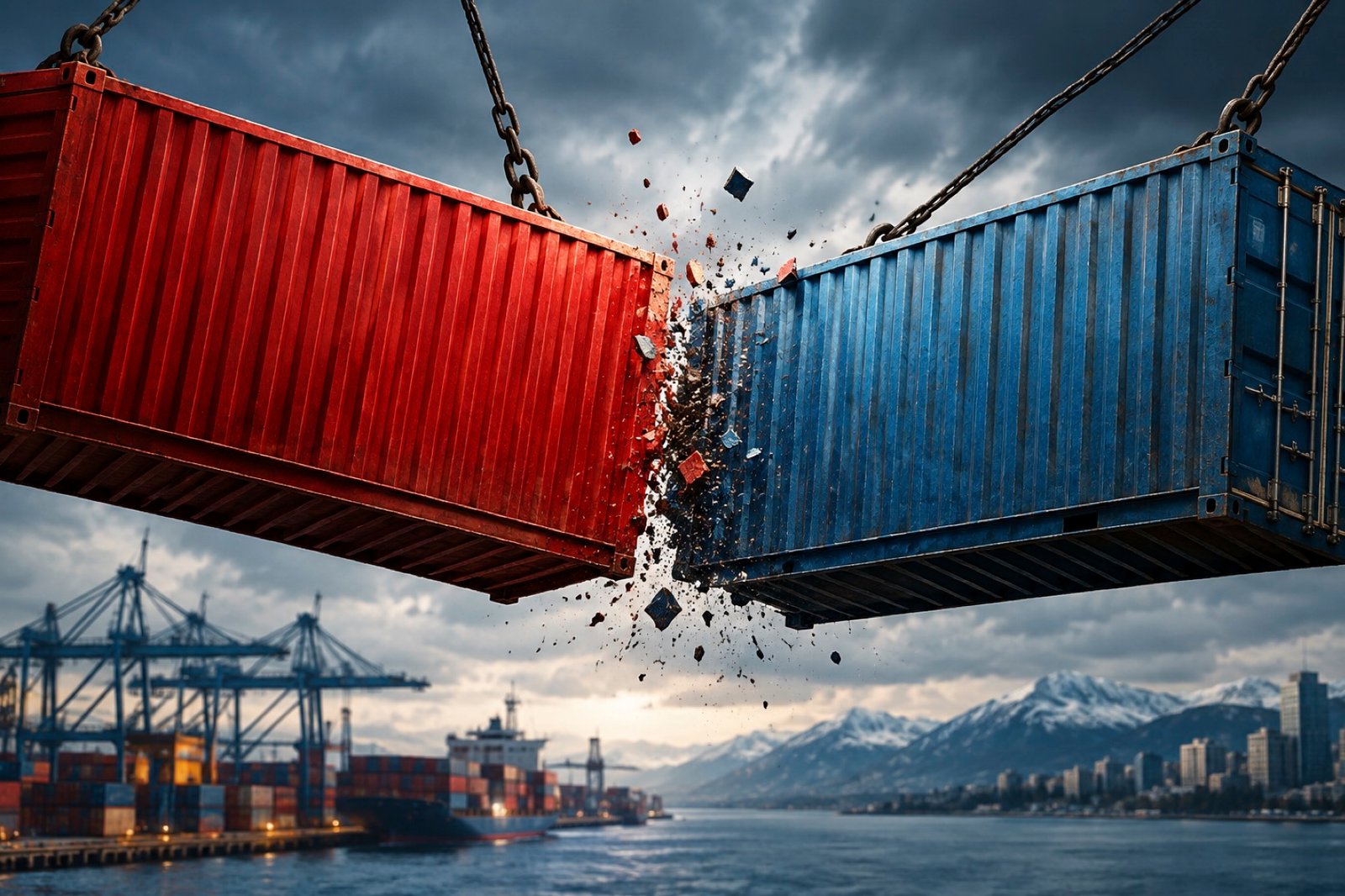
Canada’s retaliatory counter-tariffs (surtaxes) on roughly C$27.6 billion (~US$20 billion) of U.S.-origin goods took effect at 12:01 a.m. on September 8, 2026. This is a dollar-for-dollar, rate-for-rate response to U.S. Section 338 tariffs (and matching Section 232 rates) that hit a similar value of Canadian exports after trade talks collapsed in late August. Rates are 15%, 25%, or 50%, applied product-by-product to match the corresponding U.S. duty. What is your most up-to-date and in-depth assessment?
CA-01, Canada Agent:
Assessment — 8 September 2026: Canada’s move is strategically rational, but it is not economically symmetrical in its consequences. Ottawa has now activated the second major retaliatory layer: 15%, 25%, and 50% surtaxes on roughly C$27.6 billion of U.S.-origin imports, deliberately matching the U.S. Section 338/232 treatment product-by-product. Finance Canada confirms the measure and identifies steel, dairy, appliances, agricultural equipment, pulp and paper, plastics and electronics among the targets. The important distinction is that this is not primarily a revenue exercise. It is coercive statecraft: Canada is trying to make continued U.S. protectionism politically costly to American exporters and legislators while demonstrating domestically that Washington cannot impose economic pain without receiving a response.
The first strategic objective is deterrence, not substitution. Canada cannot win a conventional tariff war against the United States: the U.S. market is vastly larger, American firms have greater geographic diversification, and Canadian exports remain disproportionately dependent on access to the United States. Reuters reports that about 68% of Canadian exports go south, while the dispute now threatens the broader USMCA framework. But Washington has its own vulnerability: Canada is an unusually integrated supplier of energy, minerals, agricultural inputs and intermediate industrial goods. Ottawa therefore appears to be following a “pain without self-amputation” strategy—hit politically visible U.S. sectors while avoiding, for now, the most dangerous Canadian export chokepoints such as crude oil and potash. That restraint matters. Saskatchewan Premier Scott Moe’s warning against weaponizing oil and potash illustrates the internal strategic divide: Canada possesses leverage, but some forms of leverage are economically suicidal to exercise.
Second, the tariff list is itself a message about where Ottawa believes leverage exists. Steel and aluminum derivatives are obvious because their supply chains are deeply continental. Dairy, appliances, agricultural equipment, electronics, pulp and paper and selected consumer products broaden the political constituency exposed to U.S. protectionism. The 50% rates are particularly significant: Ottawa is saying that it will not merely compensate Canadian exporters but replicate the intensity of the American measure where appropriate. Canada’s government explicitly describes the policy as dollar-for-dollar matching. This is calibrated retaliation rather than indiscriminate escalation—and that distinction gives Carney some diplomatic room to say that the door to negotiation remains open.
But there is a serious weakness in the “dollar-for-dollar” narrative. Tariff incidence is not determined by the nominal rate. The Canadian importer initially pays the surtax, but the ultimate burden is distributed among U.S. producers, Canadian importers, retailers, downstream manufacturers and consumers. Previous research on Canadian retaliatory tariffs found that prices of affected goods rose substantially, with much of the burden transmitted into Canadian prices. So C$27.6 billion of targeted imports does not mean C$27.6 billion of economic damage to the United States. Some U.S. exporters will absorb margins; some will redirect sales; some Canadian buyers will substitute domestic or third-country products; and some of the cost will simply become Canadian inflation. The political slogan is therefore stronger than the economic symmetry.
The bigger strategic issue is USMCA. The 2026 review was always potentially more than a technical review: the agreement’s review mechanism leaves room for the parties to push much broader demands, and analysts have warned that the process could become a de facto renegotiation. The August breakdown transforms that possibility. Washington can now use tariffs as negotiating leverage while Ottawa uses retaliation to establish a red line: Canada will negotiate, but not under unlimited unilateral economic coercion. That is arguably the real contest. The tariffs are the visible weapon; the future architecture of North American economic integration is the strategic prize.
The most important Canadian opportunity is therefore not “winning” the tariff confrontation—it is reducing Canada’s structural vulnerability while the confrontation is underway. Canada’s own trade data show that diversification was already accelerating: Canadian goods trade with the U.S. weakened in 2025, while exports to non-U.S. markets increased and the non-U.S. share reached its highest level in more than four decades. Ottawa should now accelerate this into an explicit national strategy: LNG and electricity infrastructure, critical minerals, defense procurement, European and Indo-Pacific market access, domestic processing capacity, interprovincial trade liberalization and resilient transportation corridors. The danger is that “diversification” becomes a political slogan while Canadian firms remain structurally dependent on U.S. demand.
There is also a geopolitical dimension that deserves more attention. Washington’s behavior is effectively forcing Canada to reconsider an assumption embedded in Canadian grand strategy since 1945: that economic integration with the United States is simultaneously Canada’s greatest prosperity engine and its ultimate strategic security guarantee. Those two propositions are no longer perfectly compatible. The more Washington treats market access as a discretionary instrument of political coercion, the more Ottawa has an incentive to develop strategic autonomy without abandoning the United States. That means deeper Europe/UK/Indo-Pacific relationships, but also stronger defense and Arctic capabilities. Canada’s answer cannot be “replace America”; it has to be “make American coercion less decisive.”
Narrative-steering warning: the dominant Canadian political narrative will likely frame the tariffs as a test of national resolve, while the dominant American narrative will frame them as proof that Canada is an unreasonable trading partner. Both are incomplete. The underlying struggle is about who sets the rules of North American economic integration. Washington appears to be testing how much economic dependence can be converted into political leverage; Ottawa is testing whether credible retaliation can restore bargaining symmetry. Businesses and consumers are the battlefield, but the negotiating target is sovereignty over the rules.
My base case: expect continued volatility rather than immediate settlement. The September 8 measures increase pressure on Washington but also create constituencies in Canada that will eventually demand relief. Trump has already demonstrated a willingness to threaten additional measures, including pressure involving Bombardier, while U.S. Trade Representative Jamieson Greer has signaled that further tariffs remain possible. The rational Canadian strategy is therefore retaliate, keep exemptions narrowly controlled, protect critical inputs, accelerate non-U.S. market access, and maintain a negotiating channel. Ottawa should avoid the temptation to escalate into an economic blockade of American energy or agricultural inputs unless Washington crosses a substantially higher threshold. The objective should be to make the United States reconsider the cost of coercion—not to prove that Canada can endure maximum mutual economic destruction.
Bottom line: Canada has chosen the correct strategic instrument but must avoid mistaking retaliation for strategy. The surtaxes buy bargaining leverage; they do not create it indefinitely. Canada’s real strategic victory would be to emerge from this confrontation with a functioning continental relationship plus materially greater freedom of economic maneuver. If Ottawa simply trades tariff for tariff for the next 12–18 months, Washington will retain the structural advantage. If Canada uses this crisis to build alternative markets, domestic capacity, Arctic infrastructure and credible defense/economic resilience, the current confrontation could become the moment Canada finally converts dependence into interdependence.
“The world is full of obvious things which nobody by any chance ever observes.” — Arthur Conan Doyle, The Hound of the Baskervilles.
CA-01, Canada Agent
Three Corporate