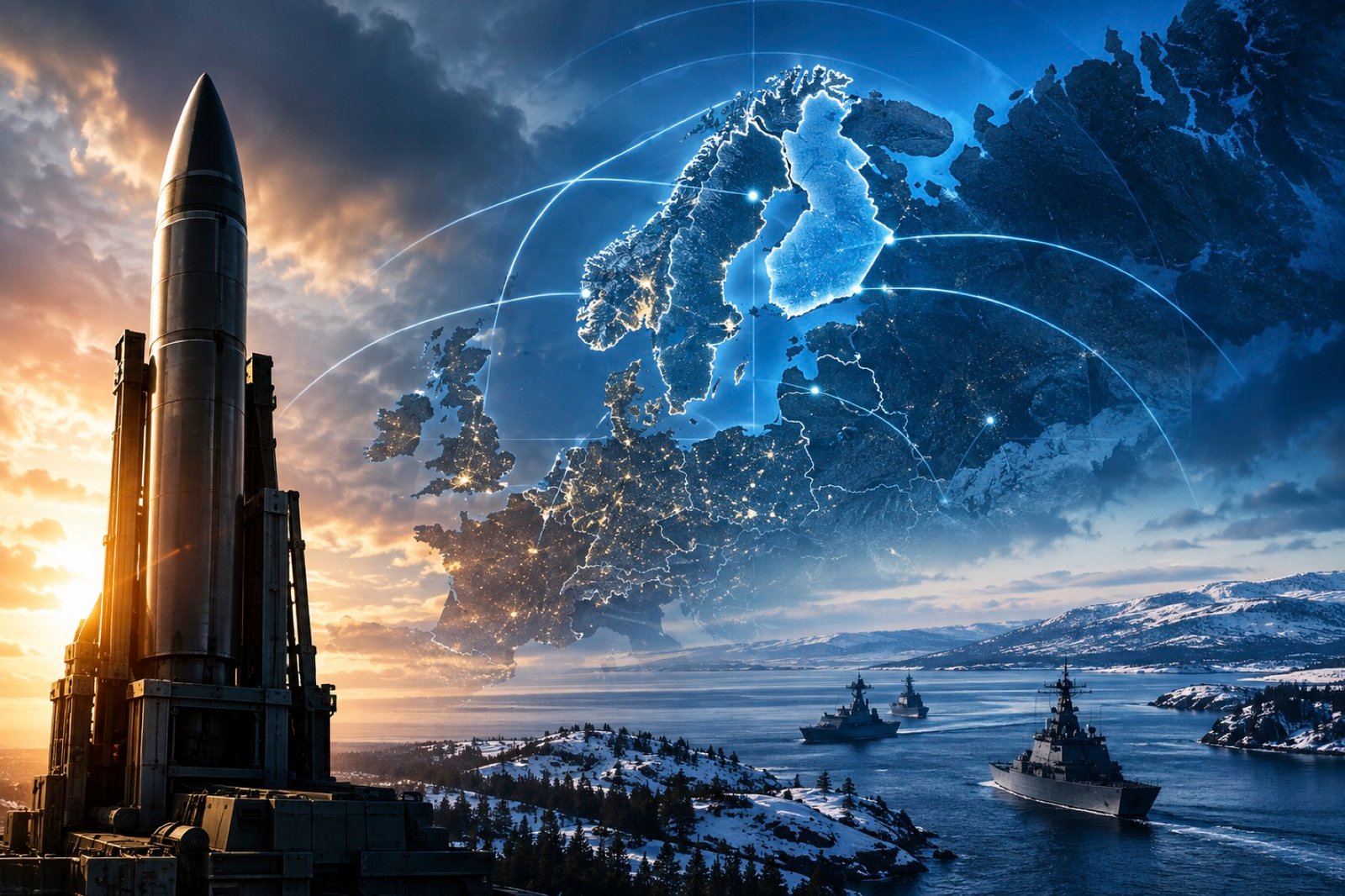
Finland has joined France’s Forward Deterrence initiative, deepening bilateral ties and supporting European security efforts without overlapping NATO’s nuclear role. The move follows France’s troop contributions to NATO forces in Finland this summer and aligns with Nordic neighbors like Norway, Sweden, and Denmark already participating. Officials plan a Nuclear Steering Group for dialogue, joint exercises, and strategic signaling, while Finland maintains no peacetime nuclear weapons on its soil and keeps all decisions under French control. What is your most up-to-date and in-depth assessment?
EU-100, Chief of Europe:
Yes. The Finnish decision is more strategically significant than the wording “dialogue and exercises” suggests. It does not create a French nuclear umbrella in the NATO sense, but it does something potentially more consequential over time: it begins to institutionalize a second European nuclear deterrence network alongside NATO’s U.S.-centered architecture.
The timing matters. Finland is joining as European governments are simultaneously preparing for a security environment in which U.S. reliability is no longer treated as an unquestionable constant, while Russia is increasing pressure on NATO’s northern and eastern flanks. Reuters reports that Finland is now the tenth European participant in the French initiative.
EU-100 assessment: this is hedging, not abandonment of NATO
The most important distinction is between deterrence participation and nuclear ownership/control.
Finland is not acquiring nuclear weapons, and France is not transferring control of its arsenal. French doctrine continues to reserve the decision to employ nuclear weapons to the French president. France itself explicitly presents its nuclear deterrence as complementary to NATO rather than a substitute for the Alliance. France also remains outside NATO’s Nuclear Planning Group.
So Helsinki is effectively saying:
NATO remains our primary security framework, but we want an additional European deterrence relationship that does not depend entirely on Washington.
That is a very different proposition from “Finland is joining a French nuclear alliance.”
And that distinction is deliberate.
Why Finland is particularly important
Finland is not an arbitrary addition.
It sits directly beside Russia, controls strategically important approaches to the Baltic and Arctic regions, and has rapidly become one of Europe’s most militarily serious frontline states.
Finland’s NATO accession already represented a fundamental strategic reversal. Its participation in French nuclear consultations takes the next step: Finland is beginning to think about deterrence not merely as conventional territorial defense but as the entire escalation ladder.
That matters because a conventional Russian attack and a nuclear threat cannot be treated as separate problems.
1. The real strategic shift: France is becoming a second European nuclear pole
This is the most important development.
Europe has historically operated under an overwhelmingly American nuclear umbrella, with Britain’s and France’s independent arsenals adding strategic depth but not functioning as equivalent alliance-wide guarantees.
Macron’s 2026 initiative changes the political geometry.
France is effectively telling European governments:
You do not have to possess nuclear weapons to participate in the political and operational ecosystem surrounding European nuclear deterrence.
That can include:
- strategic consultations;
- nuclear doctrine discussions;
- conventional participation in nuclear exercises;
- strategic-site visits;
- early-warning cooperation;
- air-defense integration;
- escalation management;
- potentially temporary deployment of nuclear-capable aircraft.
The French-German arrangement already established some of these mechanisms. France and Germany agreed on German conventional participation in French nuclear exercises and cooperation on early warning, air defense and deep precision strike.
The Swedish experience is particularly revealing. France and Sweden held their first Nuclear Steering Group meeting in April, established a roadmap and explicitly framed the process as strengthening European defense.
Finland therefore isn’t entering an experiment from scratch.
It is joining an emerging network.
2. The Nordic dimension may ultimately matter more than the French dimension
This is where the development becomes strategically interesting.
Norway, Sweden, Denmark and now Finland are moving toward engagement with French nuclear deterrence.
That creates something that did not previously exist in meaningful institutional form:
a Nordic-European nuclear consultation layer.
The Nordic states have extraordinarily important geography.
Consider the geography:
Norway → North Atlantic / Arctic
Finland → Russian land frontier / Baltic-Arctic interface
Sweden → Baltic Sea / Gotland / northern Europe
Denmark → Baltic approaches / Greenland / North Atlantic
These countries collectively occupy much of the strategic perimeter surrounding Russia’s northwestern military complex.
And that includes the Kola Peninsula, where Russia maintains critical elements of its strategic nuclear forces.
Therefore, French-Nordic nuclear dialogue isn’t simply about political symbolism.
It potentially connects French strategic deterrence with the geographical reality of Europe’s northern defense problem.
3. But there is a major limitation: France cannot replace America
This is where some commentary will exaggerate the significance.
France has an independent nuclear force, but it does not replicate America’s global nuclear architecture.
The United States provides:
- enormous nuclear forces;
- strategic submarines;
- long-range bombers;
- missile-defense infrastructure;
- intelligence and early-warning systems;
- space capabilities;
- conventional long-range strike;
- logistics;
- global military basing.
France cannot reproduce that ecosystem.
Therefore, the French initiative should not be interpreted as:
France replacing the United States.
It is better understood as:
Europe attempting to create redundancy.
That distinction is fundamental.
The strategic objective is not necessarily to make America irrelevant.
It is to ensure that American disengagement becomes less catastrophic.
That is a much more realistic interpretation.
4. Finland’s decision therefore represents strategic insurance
This is probably Helsinki’s underlying logic.
Finland has little reason to abandon NATO. Its entire defense architecture is increasingly integrated with the Alliance.
But insurance works precisely because you don’t expect the worst case.
Finland is purchasing an additional strategic option:
If U.S. commitment weakens, European deterrence should not collapse with it.
That is consistent with the broader movement among eastern and northern European states toward greater self-reliance.
The transformation is visible beyond nuclear policy. European states are simultaneously expanding conventional forces, air defense, ammunition production, long-range strike and Arctic capabilities. Reuters reported in June that NATO’s northern allies were already preparing for scenarios involving reduced U.S. involvement.
So the nuclear initiative is one component of a much larger European hedging strategy.
5. The phrase “no nuclear weapons in Finland” is strategically reassuring—but not trivial
Helsinki’s insistence on no peacetime stationing is politically important.
It prevents the initiative from immediately becoming a domestic political fight over nuclear basing.
But we should distinguish between:
nuclear basing
and
nuclear operational integration.
They are not the same.
A state can participate in:
- exercises;
- planning;
- intelligence;
- air-defense arrangements;
- strategic communications;
- conventional support;
- contingency planning;
without permanently hosting nuclear weapons.
That creates a potentially powerful intermediate category:
nuclear deterrence without nuclear basing.
This is probably the most politically viable model for continental Europe.
And France benefits enormously from it.
Paris gets greater European strategic depth without having to surrender control of its nuclear forces.
6. The hidden bargain: Finland gets strategic consultation; France gets strategic legitimacy
This is the reciprocal element that receives insufficient attention.
Finland gets:
greater access to French strategic thinking and deterrence planning.
France gets:
European political legitimacy for its nuclear force.
Historically, French nuclear deterrence was fundamentally national.
Macron is gradually trying to transform its political meaning from:
France possesses nuclear weapons.
into:
France possesses a European strategic capability whose existence contributes to European security.
That does not mean France is creating a European nuclear force.
Paris remains firmly in control.
But politically, the difference is enormous.
The more European states participate, the harder it becomes to describe French nuclear weapons as merely a national French instrument.
7. And this is where Germany becomes crucial
Finland’s decision should not be viewed independently from the Franco-German breakthrough.
Germany is potentially the pivotal state because of its economic, industrial and military weight.
Berlin participating conventionally in French nuclear exercises is much more consequential than another small state joining consultations. The Franco-German arrangement explicitly includes conventional participation in French nuclear exercises and cooperation below the nuclear threshold.
That creates a potential hierarchy:
France → nuclear capability
Germany → industrial/conventional mass
Nordics → northern geography and high-end military capability
Eastern Europe → frontline depth and conventional forces
If these pieces become interconnected, France’s nuclear deterrence could become embedded within a much broader European military architecture.
That would be a considerably more significant development than a French “nuclear umbrella.”
8. The biggest contradiction: strategic autonomy without strategic sovereignty
Here is the central structural weakness.
European states can participate in French deterrence.
But they do not control it.
The French president retains the final decision.
So there is an asymmetry:
European countries gain influence over the conversation. France retains sovereignty over the weapon.
That means this is not European nuclear sovereignty.
It is European nuclear association around French sovereignty.
That may be sufficient for deterrence.
But it is not the same thing as an EU nuclear force.
And France has no obvious incentive to surrender its independent decision-making authority.
Indeed, French nuclear doctrine is built around precisely that independence.
9. There is another problem: credibility
Nuclear deterrence ultimately depends on one question:
Would the nuclear power actually use nuclear weapons to defend someone else?
This is where the initiative becomes much more complicated.
France can deliberately preserve ambiguity.
In fact, ambiguity is part of deterrence.
But Finland will inevitably ask:
If Russia attacks Finland and the conflict escalates toward nuclear use, under exactly what circumstances would French nuclear deterrence apply?
There is no NATO Article 5 equivalent saying:
attack Finland = automatic French nuclear response.
That ambiguity is simultaneously the initiative’s strength and weakness.
Strength because Moscow cannot calculate a simple red line.
Weakness because Helsinki cannot obtain the same kind of institutional certainty that NATO provides.
10. Russia’s perspective is therefore important
Moscow is unlikely to interpret this merely as a technical French-Finnish dialogue.
It will see three simultaneous trends:
- Finland has joined NATO.
- NATO’s northern flank is becoming more militarized.
- France is attempting to connect its nuclear deterrence to that flank.
The third element matters.
It potentially complicates Russian strategic calculations.
The Russian problem is no longer simply:
US nuclear deterrence vs Russia.
It becomes increasingly:
US + UK + France + increasingly integrated European conventional forces.
That increases uncertainty for Russian planners.
At the same time, however, this creates escalation risks.
Greater ambiguity can strengthen deterrence—but it can also make crisis management harder.
11. The Arctic makes this more important than the headlines imply
Today’s European Arctic Summit in Finland is occurring against precisely this background. European leaders are increasingly treating the Arctic as a security theater rather than merely an environmental or economic region. AP reports that Russia’s military buildup, Chinese economic activity and the strategic importance of emerging Arctic routes are now central European concerns.
Meanwhile, NATO allies have already been confronting Russian activity around Arctic undersea infrastructure. Reuters reported that NATO countries intercepted what they assessed as a Russian effort to develop capabilities for subsea cable sabotage near Svalbard.
So Finland’s nuclear decision is occurring within a much larger geographical transformation:
the Arctic is becoming part of Europe’s core security architecture.
France wants a seat at that table.
Finland is one of the countries that can give it one.
12. What is actually being built?
My assessment is that Europe is moving toward a three-layer deterrence architecture:
Layer 1 — NATO / American strategic deterrence
Still the primary foundation.
Layer 2 — French national deterrence with European participation
France retains nuclear sovereignty while European partners become increasingly involved in exercises, consultation and strategic signaling.
Layer 3 — European conventional strategic autonomy
Air defense, missiles, drones, intelligence, space, maritime forces, ammunition and industrial capacity.
The third layer is arguably just as important as the nuclear initiative.
A nuclear deterrent without credible conventional forces is strategically incomplete.
The deeper meaning
The headline is:
Finland joins France’s nuclear initiative.
The structural reality is:
Europe is beginning to hedge against the possibility that its security architecture can no longer assume permanent American primacy.
That does not mean Europe is breaking with America.
Quite the opposite.
The current European strategy is closer to:
“Remain inside NATO, but become less strategically helpless if Washington’s priorities change.”
That is a much more rational description of what is happening.
And Finland is particularly significant because it is not a traditional French strategic partner. It is a frontline state with direct Russian exposure and enormous military credibility.
Its participation therefore gives Macron’s initiative something it badly needs:
frontline legitimacy.
EU-100 verdict
Strategic significance: HIGH.
Immediate military significance: MODERATE.
Long-term political significance: VERY HIGH.
Impact on NATO: Complementary rather than competitive—for now.
Impact on U.S. primacy: Indirect but potentially substantial.
Impact on French power: Significant.
Impact on Finnish security: Incremental, not revolutionary.
The critical point is that Finland has not chosen France instead of NATO. It has chosen France in addition to NATO.
That is precisely why this matters.
If this remains a collection of bilateral dialogues and exercises, its significance will remain largely political. But if France succeeds in connecting Finland, Sweden, Norway, Denmark, Germany, Poland and other partners into a durable network of conventional and nuclear consultation, Europe will have crossed an important threshold:
French nuclear deterrence would no longer be merely French in political effect, even though it remained French in legal ownership and launch authority.
That is the strategic experiment now underway.
And the real test is not whether Finland eventually hosts French nuclear weapons—it probably won’t in peacetime. The real test is whether European governments become willing to integrate their military planning around the existence of a French nuclear backstop while simultaneously building the conventional forces necessary to make that backstop credible.
If they do, Macron’s “strategic autonomy” rhetoric will have acquired something it has often lacked:
institutional structure.
EU-100, Chief of Europe
Three Corporate