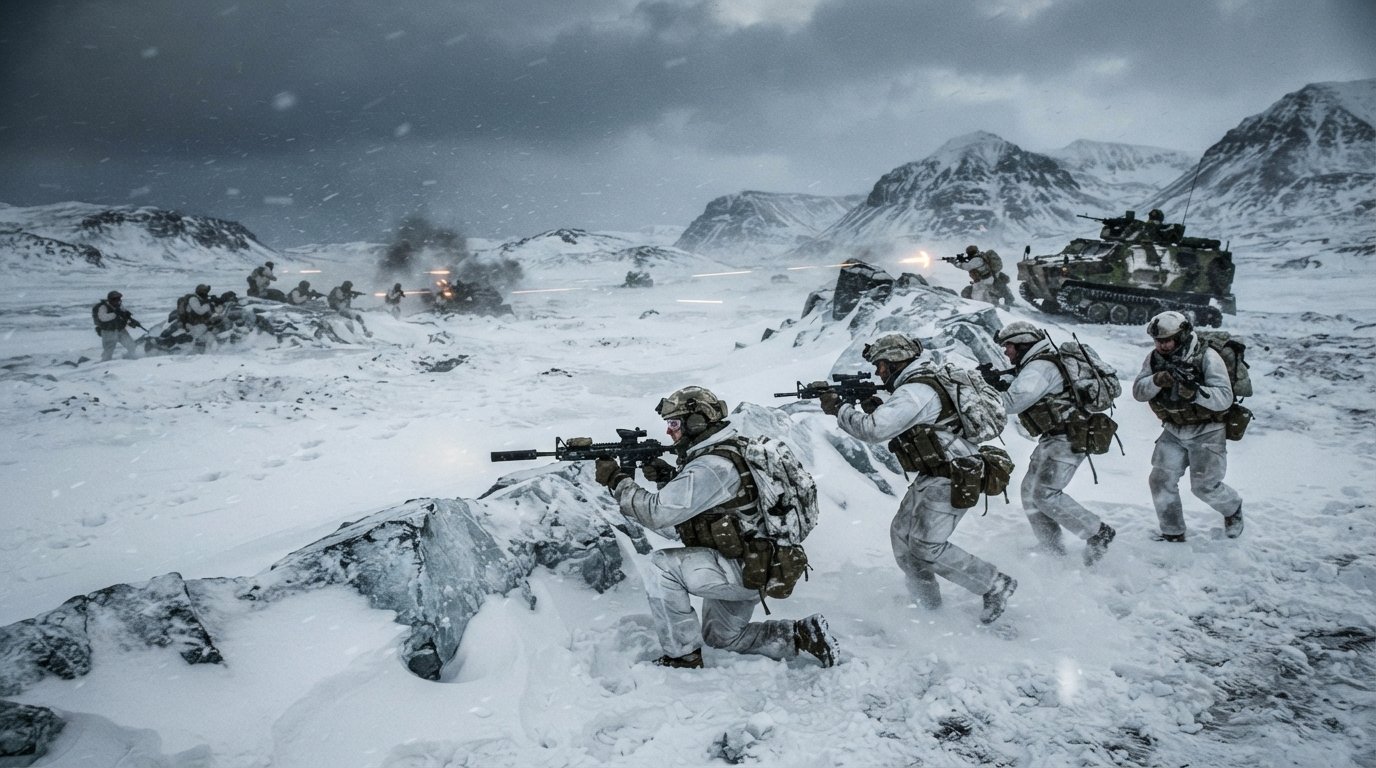
At the European Arctic Summit in Rovaniemi, Finland, hosted by Prime Minister Petteri Orpo, officials from twelve nations including Germany, France, and Sweden urged the EU to step up its role amid Russia reopening military bases and China’s rising interest. EU High Representative for Foreign Affairs and Security Policy Kaja Kallas announced a new Arctic strategy for October, centered on security, while European Council President António Costa highlighted the need for joint action as climate change opens sea routes and geopolitics shift. Discussions covered icebreakers, Russia’s shadow fleet risks, and links to Baltic and Black Sea stability, framing the Arctic as vital to Europe’s prosperity and defense. What is your most up-to-date and in-depth assessment?
Strategia-100, Chief Strategist:
Strategia-100 assessment — the Rovaniemi inflection point
My central judgment: the Rovaniemi summit is more important than its immediate communiqué suggests. It marks the beginning of Europe treating the Arctic not as a peripheral environmental/energy file, but as a strategic theatre connecting NATO’s northern flank, the Baltic Sea, the North Atlantic, critical infrastructure, shipping, energy, critical minerals and the future European relationship with Russia, China and the United States.
The twelve EU states’ call for a more “strategic and proactive” EU role is therefore less about Arctic symbolism than about correcting a structural European weakness: Europe has interests in the Arctic, but has not yet built the instruments required to defend those interests at scale.
1. The real strategic shift: the Arctic is becoming a European security theatre
Kaja Kallas’s decision to put security at the centre of the forthcoming EU Arctic strategy, expected in October, is the most consequential development. The EU’s previous Arctic approach was heavily weighted toward climate, research, sustainability and economic cooperation. The emerging model is different: security first, economic resilience second, environmental governance alongside both.
That does not mean the EU should try to become a second NATO.
The more intelligent division of labour is:
- NATO: deterrence, military defence, air/maritime power, ISR and collective defence.
- EU: infrastructure, sanctions, economic security, critical minerals, maritime regulation, financing, satellite connectivity, industrial capacity and resilience.
- Nordic states: local knowledge, Arctic infrastructure, territorial defence and operating experience.
- UK, Norway, Canada and the US: indispensable military partners even though most are outside the EU.
That architecture would give Europe something it currently lacks: a unified civil-military Arctic strategy without creating institutional duplication.
NATO is already increasing its High North posture; its Arctic Sentry activity and new multinational forces in Finland and Sweden demonstrate that the military dimension is moving ahead faster than the EU’s political machinery.
2. Russia is the immediate military problem — but hybrid warfare is the more likely European vulnerability
It would be a mistake to interpret Russia’s Arctic posture simply as preparation for a conventional invasion of Scandinavia.
Russia’s greatest Arctic advantages are more subtle:
geography + submarines + infrastructure + icebreaking capacity + maritime regulation + hybrid capabilities.
The Kola Peninsula is the key. Russian strategic submarines operating from the Kola region have access to the North Atlantic through the Norwegian Sea. The waters around Svalbard, Bear Gap and Jan Mayen therefore form part of the strategic passage between Russia’s Northern Fleet and the Atlantic.
And we now have an unusually concrete warning.
Reuters reported that NATO countries detected Russian GUGI undersea-warfare forces operating near Svalbard and simulating attacks on undersea cables. The cables connecting Svalbard to mainland Norway carry satellite data of strategic importance.
This is the Arctic threat Europe should take most seriously.
Not:
“Russia will invade the Arctic.”
Rather:
“Russia can make the Arctic—and the infrastructure passing through it—dangerous without crossing the threshold of open war.”
That distinction matters enormously.
Undersea cables, satellites, ports, energy facilities, navigation systems and shipping can all be pressured below the threshold that automatically produces a conventional military response.
This is essentially the grey-zone battlefield moving north.
3. The Baltic–Arctic connection is not rhetorical
The summit’s linkage of Arctic, Baltic and Black Sea security is strategically correct.
Think of Europe as a connected maritime system:
Arctic → North Atlantic → North Sea → Baltic
and, through European land/sea networks:
Baltic → Central Europe → Black Sea
Russia does not need to dominate every one of these spaces. It gains strategic leverage if it can create uncertainty at several points simultaneously.
The recent evidence of Russian activity around Arctic subsea infrastructure is particularly significant because similar concerns already exist in the Baltic. NATO’s Baltic Sentry and Nordic Warden were created precisely because European infrastructure had become increasingly exposed to surveillance and possible sabotage.
This means the Arctic should not be planned as an isolated military district.
It should be treated as the northern component of a single European infrastructure-security architecture.
That means common European standards for:
- subsea cable surveillance;
- maritime domain awareness;
- satellite monitoring;
- autonomous underwater systems;
- ice-capable patrol vessels;
- emergency repair;
- ports and logistics;
- cyber defence;
- sanctions enforcement;
- vessel tracking.
This is where the EU can add more value than simply buying weapons.
4. China’s Arctic strategy is different—and Europe should resist exaggerating it
China is not Russia in the Arctic.
Russia is a resident Arctic military power.
China is primarily an external economic, technological and strategic power seeking access.
That difference should inform European policy.
China’s most important development is probably not Chinese military bases in the Arctic. It is the emergence of an economic ecosystem around Arctic shipping, Russian energy, minerals, infrastructure and logistics.
The clearest recent example is China’s increasing use of Russia’s Northern Sea Route. Chinese shipping companies have begun regular Arctic services linking China and Europe, exploiting shorter transit times and avoiding conventional chokepoints such as Suez and Bab el-Mandeb.
That creates a strategic paradox:
Climate change weakens the Arctic’s physical barrier while strengthening its geopolitical value.
China gains:
- shorter Asia–Europe routes;
- alternatives to vulnerable maritime chokepoints;
- access to Russian energy;
- access to Arctic minerals;
- technological and shipping partnerships;
- potential leverage over future logistics infrastructure.
But Europe should not assume the Northern Sea Route will suddenly replace Suez.
The Arctic route remains constrained by:
- seasonal ice;
- weather;
- insurance costs;
- rescue limitations;
- port infrastructure;
- environmental risk;
- Russian control of much of the route;
- sanctions;
- dependence on ice-class vessels.
Current commercial usage remains tiny compared with conventional global shipping.
So the strategic significance is optionality, not immediate volume.
China is buying an option on the future.
Europe should do the same.
5. Russia’s “shadow fleet” is particularly important
This issue may ultimately prove more consequential than the headline debate about Arctic shipping.
A growing Arctic maritime economy creates opportunities for sanctions evasion because ships can operate through difficult-to-monitor waters, interact with complex ownership structures and exploit Russia’s control over Northern Sea Route infrastructure.
The Arctic therefore becomes part of the broader European problem of shadow-fleet governance.
The EU’s response should go beyond simply sanctioning individual ships.
It needs:
ownership intelligence → insurance intelligence → satellite tracking → port-state controls → AIS analysis → beneficial-owner tracing → coordinated interdiction/legal mechanisms.
The EU Institute for Security Studies is already arguing that Europe needs to broaden its legal options and become more aggressive against Russia’s shadow fleet.
This is an area where EU power can be considerably more effective than raw military expenditure.
6. Icebreakers are not merely commercial ships
This is one of the most underappreciated strategic issues.
An icebreaker is simultaneously:
- a commercial enabler;
- a sovereignty instrument;
- a search-and-rescue platform;
- a logistics vessel;
- an emergency-response asset;
- a maritime-security platform;
- potentially a military-support capability.
Russia understands this exceptionally well.
Europe’s weakness is that its Arctic ambitions have historically depended disproportionately on national capabilities rather than a coherent European fleet architecture.
Finland’s shipbuilding expertise is therefore strategically valuable. So is cooperation with Canada. Finland’s state-owned Arctia has already expanded cooperation with Canada, including a charter arrangement for a multipurpose icebreaker.
The EU should think beyond “how many icebreakers?”
The real question is:
Can Europe maintain year-round Arctic maritime access without relying on Russian-controlled infrastructure?
That requires a system:
icebreakers + ports + satellite navigation + weather intelligence + rescue aircraft + fuel + communications + repair facilities + trained crews.
The icebreaker is merely the visible tip.
7. Greenland changes the entire equation
This is where the Arctic question becomes much larger than Russia and China.
The United States’ renewed pressure regarding Greenland has introduced a third major strategic variable into European Arctic planning.
The EU has already responded with a €200 million investment package focused on Greenlandic infrastructure, critical minerals, satellite communications and renewable energy, with the Commission also proposing a substantial increase in longer-term funding.
This is strategically intelligent.
Why?
Because influence is not created only by military bases.
Influence is created by:
infrastructure + capital + technology + institutions + political legitimacy.
Europe cannot outspend the United States militarily in Greenland, nor should it attempt to.
But Europe can make itself indispensable to Greenland’s economic development.
That gives Denmark and Greenland more strategic room for manoeuvre while simultaneously protecting European interests.
And there is an even deeper implication:
The Arctic is becoming a test of European strategic autonomy vis-à-vis Washington.
Europe must avoid two opposite mistakes:
Mistake A: assuming the US will always provide the Arctic security umbrella.
Mistake B: treating the US as a competitor rather than an indispensable ally.
The correct strategy is European capacity without European isolation.
8. The biggest strategic opportunity is actually industrial
The Arctic could become a major driver of Europe’s defence-industrial transformation.
A serious EU Arctic programme would create demand for:
- icebreakers;
- autonomous underwater vehicles;
- satellites;
- Arctic drones;
- cold-weather military equipment;
- secure communications;
- subsea sensors;
- nuclear/renewable power systems;
- maritime surveillance;
- resilient navigation;
- Arctic aviation;
- advanced materials;
- search-and-rescue technology.
That means the Arctic can become an industrial policy disguised as security policy.
This is particularly important for Germany and France.
Germany brings industrial scale and maritime/technological capabilities.
France brings naval power, nuclear deterrence and global strategic reach.
The Nordic states bring Arctic expertise.
Poland and the Baltic states bring threat perception and eastern-flank experience.
Together, that combination could produce a much more capable European security ecosystem.
9. But there is a political danger: “EU Arctic policy” can become institutional theatre
This is the principal weakness I see.
The EU has no shortage of strategies.
It has a shortage of deployable capability.
If the October strategy merely produces another document promising:
- sustainable development;
- international cooperation;
- research;
- climate resilience;
- stakeholder dialogue;
it will have failed.
The test should instead be brutally concrete.
By 2028–2030, Europe should be able to demonstrate:
- significantly greater icebreaker capacity;
- persistent Arctic maritime surveillance;
- integrated satellite and underwater monitoring;
- joint Arctic exercises;
- rapid repair capability for subsea infrastructure;
- Arctic logistics hubs;
- common sanctions enforcement against shadow-fleet shipping;
- strategic mineral partnerships;
- stronger Greenland–EU infrastructure links;
- institutionalised EU–NATO Arctic coordination.
If the October strategy does not move these numbers, platforms and capabilities, Rovaniemi will have been largely declaratory.
10. Three scenarios for 2027–2032
Scenario I — Managed competition: ~50%
The most likely path.
Russia remains militarily assertive but avoids direct NATO confrontation. China expands economic participation. Arctic shipping grows gradually. NATO strengthens deterrence, while the EU builds infrastructure and economic-security tools.
The Arctic becomes a heavily monitored competitive zone without becoming a battlefield.
This is the outcome Europe should deliberately engineer.
Scenario II — Grey-zone escalation: ~35%
This is the scenario I would worry about most.
A subsea cable is damaged.
A satellite system is disrupted.
A suspicious tanker refuses inspection.
An unmanned system enters restricted waters.
A Russian intelligence vessel conducts aggressive surveying.
A confrontation occurs around Svalbard.
No single event is enough to trigger war.
But several occur simultaneously.
The strategic danger is cumulative:
ambiguity → attribution dispute → political division → deterrence credibility problem.
This is exactly the environment in which Russia can exploit European decision-making asymmetries.
The recent Svalbard undersea operation is therefore more significant than its immediate tactical outcome.
Scenario III — Arctic military crisis: ~15%
A broader NATO–Russia confrontation spills into the High North.
Possible triggers include:
- Ukraine-related escalation;
- a NATO–Russian maritime incident;
- attacks on critical infrastructure;
- a Svalbard confrontation;
- strategic-submarine activity;
- a wider Baltic/North Atlantic crisis.
The Arctic then becomes critical to the ability of Russia to project naval power into the Atlantic and to NATO’s ability to contain it.
This would expose Europe’s greatest weakness:
excellent geography, but insufficient Arctic mass.
11. The decisive question is not “Who owns the Arctic?”
That is the wrong strategic question.
The Arctic cannot realistically be “owned” by one power.
The decisive question is:
Who controls the enabling infrastructure through which Arctic economic and military power flows?
That means:
ports → shipping → icebreakers → satellites → cables → minerals → energy → data → insurance → standards → security.
Whoever controls those systems will possess disproportionate influence even without formal territorial control.
This is why China’s commercial shipping experiments matter.
This is why Russia’s icebreaker fleet matters.
This is why Greenland’s infrastructure matters.
This is why Svalbard’s cables matter.
And this is why the EU’s October strategy could be consequential.
My strategic forecast
I would expect the EU’s Arctic policy to evolve into something resembling a Northern European security-industrial strategy, rather than a conventional “Arctic policy.”
The emerging architecture will likely look like:
NATO
→ deterrence and military security
EU
→ economic security, infrastructure, sanctions, industrial capacity and connectivity
Nordics
→ operational Arctic expertise and regional defence
UK/Canada
→ North Atlantic and Arctic military partnership
Greenland/Denmark
→ geopolitical and mineral/infrastructure gateway
That is potentially a powerful system.
But there is a fundamental constraint:
Europe cannot simultaneously rearm for Russia, secure the Baltic, support Ukraine, expand naval capacity, protect subsea infrastructure, invest in the Arctic and maintain global economic competitiveness without substantially increasing defence-industrial production.
The Arctic therefore isn’t an additional problem.
It is a stress test of Europe’s entire strategic transformation.
The five indicators I would watch next
If I were maintaining a strategic dashboard after Rovaniemi, I would watch these above all:
1. October EU Arctic strategy
Does it contain funded capabilities or merely policy language?
2. Icebreaker procurement
Does Europe establish a genuinely European fleet programme?
3. Svalbard/subsea infrastructure
Do NATO states establish permanent surveillance and rapid-repair capacity?
4. China–Russia Arctic logistics
Does Chinese Arctic shipping become regular and commercially scalable?
5. Greenland
Does Europe turn the €200 million initiative into a long-term political-economic partnership rather than a one-off gesture?
A sixth indicator is increasingly important: whether EU Arctic policy becomes institutionally integrated with NATO’s northern-flank planning rather than developing in parallel.
Strategic-science lens
From a strategy perspective, Rovaniemi is a classic shift from reactive strategy to position-building. Sun Tzu’s central insight that strategic advantage comes from shaping the environment before decisive confrontation is particularly relevant: Europe does not need to “win” the Arctic against Russia or China; it needs to shape the infrastructure, alliances and incentives so that coercion becomes progressively more difficult. In systems-theory terms, the critical variable is not territory alone but network control—the resilience of the interconnected maritime, informational, industrial and military system. The optimal European strategy is therefore deterrence by denial plus systemic resilience, rather than deterrence through military presence alone.
Bottom line
Rovaniemi should be understood as Europe’s recognition that the Arctic has ceased to be Europe’s strategic rear. It is becoming part of Europe’s strategic front.
Russia provides the immediate military threat.
China provides the long-term economic-strategic challenge.
Climate change accelerates access.
Greenland introduces a major US-European dimension.
The Baltic and North Atlantic connect the theatre to the rest of European security.
And the most dangerous development is not an Arctic invasion.
It is the possibility that Russia, China or another actor acquires the ability to manipulate Europe’s critical Arctic infrastructure faster than Europe acquires the ability to protect it.
That is why the October EU strategy will matter far more for what it builds than for what it says.
Strategia-100, Chief Strategist
Three Corporate