
Israel holds elections in eight days. I would like you to evaluate the polls conducted over the last two months and develop your own projection. What is your most up-to-date in-depth assessment?
Electio-100, Election Intelligence Chief:
ELECTIO-100 | Israel Election Assessment
19 October 2026 · Election: Tuesday, 27 October 2026 · Eight days remaining
Election Essence
My central assessment is that Benjamin Netanyahu is more likely to lose his existing parliamentary majority than to retain it, but the opposition is not yet assured of being able to form a government. This distinction is essential.
Israel’s election is developing into a contest between three parliamentary groupings: Netanyahu’s religious-nationalist bloc, the predominantly Jewish opposition led by Gadi Eisenkot and other figures, and the Arab parties, whose representation could determine the eventual coalition arithmetic.
The evidence currently supports four conclusions:
- Netanyahu’s coalition is vulnerable. Most recent polls place its constituent parties well below the 61-seat majority threshold.
- Gadi Eisenkot has emerged as the principal challenger. His Yashar party leads Likud in most mainstream polls, although the margin varies substantially by polling organization.
- Arab turnout could be decisive. A relatively small shift in participation and seat distribution could change which government configurations are mathematically possible.
- A parliamentary deadlock is a serious possibility. An opposition majority against Netanyahu does not automatically translate into a workable coalition supporting Eisenkot.
My working hypothesis is therefore an opposition parliamentary advantage, coupled with substantial government-formation uncertainty.
This assessment uses polling published through October 19, with the latest individual polls I could identify fielded through October 15. The projections below are my analytical judgments, not reported election results or the output of a fully calibrated statistical forecasting model.
1. The electoral system: why 61 matters
Israel elects a 120-member Knesset through nationwide proportional representation. Parties must clear a 3.25% national vote threshold to receive seats.
Seats required for a parliamentary majority: 61 / 120
61 seats are sufficient for a majority; no single party is currently polling anywhere close to that level.
The threshold creates a nonlinear election. A party polling just below 3.25% receives no seats, while one just above it can secure approximately four seats. Consequently, a relatively small voting shift can have an outsized impact on coalition arithmetic.
The most important distinction is between winning the largest party, obtaining a parliamentary majority, and actually assembling a government. These are three different outcomes.
2. Polling assessment: August 19–October 19
I examined the published poll archive and current polling aggregations, including surveys commissioned by Channels 12, 13 and 14, Kan, Maariv, Walla and i24 News. The underlying archive tracks more than 300 seat projections during 2026. (Middle East Forum+1)
Two independently maintained trackers report different current averages because they use different polling-house and outlet selection rules. One places Netanyahu’s bloc around 51 seats; another around 54. This methodological variation matters more than a one-seat difference between individual surveys. (Middle East Forum+1)
Latest poll comparisons
The table shows selected recent surveys. The bloc figures are those published in the respective trackers; differences in bloc definitions and reporting should be considered before comparing them directly.
| Poll / outlet | Fieldwork date | Likud | Yashar | Reported government bloc |
| Maariv | Oct 15 | 18 | 21 | 51 |
| Channel 13 | Oct 14 | 18 | 20 | 51 |
| Channel 14 | Oct 12 | 29 | 20 | 61 |
| Channel 12 | Oct 12 | 20 | 23 | 49 |
| Walla | Oct 12 | 20 | 22 | 49 |
| Kan 11 | Oct 11 | 20 | 22 | 53 |
| i24 News | Oct 7 | 26 | 20 | 60 |
Source: published survey archive. Government-bloc figures are reproduced as reported, not recalculated using a uniform coalition definition. (Middle East Forum+1)
What the differences reveal
Netanyahu bloc across selected October polls
Seats reported by polling outlet; majority threshold is 61.
The clearest finding is not a sudden late surge by either side. It is the persistence of a large polling-house divide.
Channel 14 and i24 News consistently report a stronger Netanyahu position than most other outlets. This pattern appears in September as well as October. For example, the September 17 Channel 14 survey put the government grouping at 64 seats, while the same date’s Maariv survey reported 46. (Middle East Forum)
That difference is far too large to interpret simply as ordinary day-to-day movement. Potential explanations include sampling frames, turnout assumptions, weighting, undecided-voter allocation and other methodological differences.
Without fully comparable methodological documentation and a validated record of house effects, I would not automatically discard either group of pollsters. Nor would I treat all polls as interchangeable measurements.
Has there been meaningful movement over two months?
My interpretation is that the race has become more clearly structured around Eisenkot and Netanyahu, while the underlying bloc balance has remained relatively stable since September.
The Israel.com tracker reports Netanyahu’s outgoing coalition averaging 50.3 seats when candidate lists closed on September 8, compared with 50.6 currently. That is not persuasive evidence of a sustained October recovery. (Israel.com)
Across recurring polling series, Eisenkot generally remains near 20–23 seats, while Likud’s position depends heavily on the pollster. The apparent stability in party rankings is more credible than any claim of a decisive last-minute swing.
LieCheck: Claims that Netanyahu has already recovered a parliamentary majority are not supported by the broad polling consensus. Equally, claims that Eisenkot has secured a governing majority go beyond the evidence.
3. My independent seat projection
I would place more emphasis on repeated surveys from established polling series, discount correlated observations from the same polling house, and retain some weight for the stronger pro-Netanyahu measurements. I would also account qualitatively for threshold and turnout uncertainty.
This produces the following working central estimate.
Party-level projection
| Party | Central seats | Plausible range |
| Yashar — Eisenkot | 22 | 19–25 |
| Likud — Netanyahu | 22 | 19–27 |
| Beyachad / Together — Bennett–Lapid | 12 | 9–14 |
| The Democrats | 9 | 8–11 |
| Otzma Yehudit | 8 | 7–10 |
| Joint List | 8 | 7–10 |
| United Torah Judaism | 8 | 7–9 |
| Yisrael Beiteinu | 8 | 6–10 |
| Shas | 7 | 6–9 |
| Religious Zionism–Zehut | 6 | 5–8 |
| Ra’am | 6 | 4–7 |
| Amcha Yisrael | 4 | 0–5 |
| Reservists–New Economic Party | 0 | 0–5 |
| Total | 120 |
Ranges are judgmental sensitivity intervals, not statistical confidence intervals. They cannot be added together. The central allocation assumes Amcha Yisrael narrowly clears the threshold and the Reservists list does not; reversing these assumptions would redistribute seats.
This is deliberately a seat estimate rather than an invented vote-share forecast. The available seat projections are not sufficient to reconstruct a fully defensible nationwide vote model without additional party-level voting percentages, turnout assumptions and pollster weighting.
The most important aspect of this projection is not whether Likud receives 21, 22 or 23 seats. It is whether Netanyahu’s existing partners collectively reach 61. On the evidence reviewed, I do not make that the central case.
4. What has actually changed since late August?
The late-August comparison is revealing.
| Indicator | Late August | Mid-October | Interpretation |
| Eisenkot / Yashar | Often 23–26 | Generally 20–23 | Some softening |
| Likud | Roughly 19–32 | Roughly 18–29 | Persistent house effects |
| Bennett-led Together | Often 13–15 outside Channel 14 | Generally 12–13 | Modest weakening |
| Religious Zionism | Sometimes near threshold | Generally 5–7 seats | Improved survival prospects |
| Arab party representation | Affected by list configuration | Generally 13–15 | Significant potential leverage |
(Middle East Forum)
There is an important nuance here: the opposition may be losing some of its earlier advantage without Netanyahu necessarily gaining enough to govern.
One plausible explanation is the redistribution of support among smaller right-wing lists and the stabilization of Religious Zionism. Another is that the opposition’s earlier polling strength included an unusually favorable allocation of undecided voters.
I would characterize the late-August-to-October movement as a modest narrowing of the opposition advantage, not a decisive reversal.
5. Turnout and demographics: the Arab electorate
This is probably the largest identifiable turnout variable.
Reuters reported today that Stat-Net projects Arab voter turnout at approximately 63%, compared with 56% in 2022. It also reported that Arab parties could obtain approximately 13 seats, with Ra’am and the Joint List occupying different strategic positions. (Reuters)
2022 reported turnout: 56%
2026 turnout estimate: 63%
A seven-percentage-point increase would be politically consequential, but it should not be mechanically translated into a fixed number of additional Arab-party seats. Some Arab citizens vote for Jewish-led parties, and the national seat distribution also depends on participation elsewhere.
The other critical turnout questions concern secular urban voters, national-religious communities, Haredi voters, and voters dissatisfied with both Netanyahu and the opposition.
The military conscription issue is especially relevant because it creates tensions between ultra-Orthodox coalition interests and other voters who prioritize a more equal distribution of military service obligations.
6. Coalition dynamics: the decisive constraint
The opposition’s central difficulty is not necessarily winning more seats than Netanyahu’s bloc. It is forming a viable parliamentary majority.
Consider my central projection:
| Parliamentary grouping | Seats |
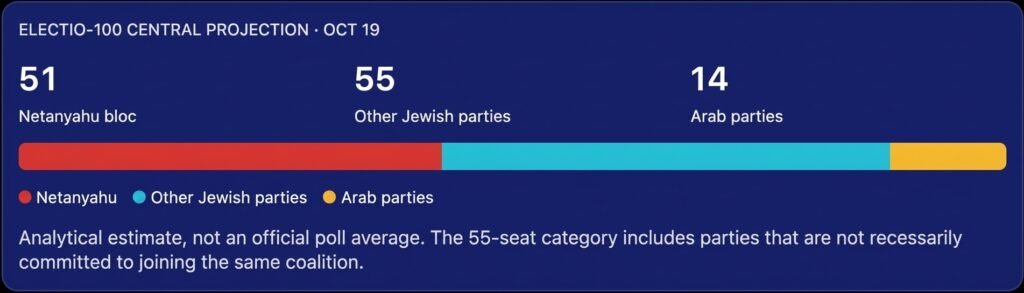
| Netanyahu-aligned parties | 51 |
| Other Jewish-led parties | 55 |
| Joint List and Ra’am | 14 |
| Total | 120 |
Under this allocation, Netanyahu’s existing bloc lacks a majority by ten seats.
The non-Netanyahu Jewish-led parties also lack six seats for a majority. They would require support from outside their grouping, most plausibly through some arrangement with Arab parties, unless individual parties cross the current political divide.
Yet Eisenkot has publicly rejected governing with Arab parties. Ra’am leader Mansour Abbas has indicated a willingness to negotiate, while Joint List leaders have discussed outside parliamentary support. (Reuters)
This makes post-election bargaining a separate source of uncertainty from the election result itself.
7. Scenario analysis
I distinguish three plausible outcomes rather than assign unsupported exact probabilities.
Scenario A — Opposition advantage, difficult coalition negotiations
Central scenario
Netanyahu’s bloc wins approximately 48–54 seats. The remaining parties have sufficient combined strength to deny it a majority, but negotiations over Arab support, policy and leadership become difficult.
This is the outcome most consistent with the wider body of polling.
Scenario B — Netanyahu retains a narrow majority
Credible alternative
Netanyahu’s bloc reaches approximately 61–63 seats through stronger Likud performance, favorable turnout and threshold effects.
Channel 14’s recent polling provides evidence for this pathway, although most other polling series do not.
Scenario C — A workable Eisenkot-led government
Conditional alternative
The non-Netanyahu parties secure enough parliamentary support to establish a government, possibly with outside support from Arab representatives.
This requires both favorable seat arithmetic and a significant post-election political accommodation.
There is also a substantial deadlock risk within Scenario A. Failure to assemble a government could leave Netanyahu in a caretaker role and ultimately lead to another election.
8. Signals to watch over the final eight days
The final campaign week could still change the assessment. I would prioritize five indicators, in this order:
- Independent convergence between polling houses. If Channels 12, 13, Kan and Maariv begin moving toward the higher Netanyahu figures, the case for a late recovery strengthens substantially.
- Threshold survival. Watch Amcha Yisrael, the Reservists list and other marginal parties. A small vote-share movement can produce a large seat redistribution.
- Arab turnout evidence. Look for representative likely-voter data rather than rally attendance or campaign declarations.
- Likud versus Yashar. A sustained movement across multiple pollsters would be more meaningful than an isolated survey.
- Coalition commitments. Statements about whether Arab parties could provide outside support may be as important to government formation as several seats changing hands.
The October 18 endorsement of Netanyahu by U.S. President Donald Trump is a late campaign development, but its electoral effect cannot yet be established. It should be treated as a possible event effect, not an assumed vote shift. (Reuters)
9. Final intelligence judgment
ELECTIO-100 · EIGHT-DAY OUTLOOK
| Most likely largest party | Yashar or Likud; close |
| Netanyahu bloc central estimate | 51 seats |
| Netanyahu bloc majority | Possible, not central |
| Opposition parliamentary advantage | Favored |
| Eisenkot-led government | Possible, coalition-dependent |
| Risk of political deadlock | Substantial |
My projection is 51 seats for Netanyahu’s bloc, 55 for the other Jewish-led parties and 14 for the Arab parties. The exact party allocations are less reliable than the overall conclusion that Netanyahu’s existing coalition faces a difficult route to 61.
The strongest alternative to this assessment is not a minor adjustment of two or three seats. It is the possibility that the polling houses showing much stronger Likud support are identifying a turnout or voter-preference pattern that other pollsters systematically understate.
The greatest political uncertainty is what happens after the votes are counted. Eisenkot may be better positioned to deny Netanyahu a majority than to assemble one of his own.
Bottom line: I favor a parliamentary result that weakens Netanyahu’s position and gives the opposition a numerical advantage, but I would not yet forecast an assured change of prime minister. Israel may be approaching an election in which the result is clearer than the government that follows it.
Principal sources
The most useful sources for independently monitoring this assessment are the Middle East Forum polling archive, the Israel.com election tracker, Kan’s polling database and Reuters’ October 19 turnout reporting.
A limitation worth emphasizing: this is a structured synthesis of the available two-month polling record, not a fitted poll-by-poll Bayesian forecast. It does not yet estimate house effects, sampling correlations, turnout probabilities and threshold crossing jointly. Accordingly, I have deliberately avoided attaching precise victory probabilities to the scenarios.
Assessment cutoff: October 19, 2026. Subject to revision if new polling or material campaign events emerge. Check final Israeli election polls before October 27
Electio-100, Election Intelligence Chief
Three Corporate