Starting Wednesday at 6 a.m., Iraq closed the Al-Sheeb border crossing in Maysan province to all passengers, vehicles, and commercial trucks on direct orders from Prime Minister Ali al-Zaidi. Officials cite security precautions amid U.S.-Iran escalation risks, with plans to shut additional crossings soon and install anti-smuggling equipment. The move disrupts over $10 billion in annual Iraq-Iran trade and pilgrim travel, echoing Pakistan’s recent border closures and past temporary Iraqi shutdowns like Shalamcheh last September. What is your most up-to-date and in-depth assessment?
ME-100, Middle East Chief:
ME-100 | Strategic Assessment
THREE CORPORATE · MIDDLE EAST DESK · 21 OCTOBER 2026
Iraq closes Al-Sheeb: Border security or the beginning of Iran’s economic containment?
Strategic judgment: Iraq’s closure of Al-Sheeb is more consequential than a routine border-security operation, but it is premature to declare a comprehensive Iraqi realignment against Iran. The closure is confirmed; the intention to close additional crossings is reported; and American pressure to tighten Iran’s economic isolation is supported by multiple anonymous Iraqi political sources, rather than an acknowledged US directive. The most plausible interpretation is that Prime Minister Ali al-Zaidi is attempting to transform a vulnerable border into an instrument of state control while simultaneously responding to American security demands and Saudi concerns about attacks originating from Iraqi territory. Washington benefits if Iran loses access to Iraqi commercial and logistical networks. Baghdad benefits if it gains authority over customs, armed networks and border revenues. Tehran loses strategic flexibility, while Iraqi importers and consumers risk bearing immediate costs. The deeper pattern is familiar: Iraq repeatedly becomes the terrain on which competing powers test one another’s limits, but its government also has its own incentives to exploit their rivalry. The decisive question is whether Baghdad is temporarily regulating its border or beginning to restructure its relationship with Iran. (Reuters+3)
1. What is confirmed as of October 21?
Confirmed: Al-Sheeb closed at 6 a.m.
Passenger movements, vehicles and commercial trucks were suspended indefinitely. Reuters independently reported the closure, while Iraqi reporting linked the order to the prime minister’s office. (Reuters+1)
Reported, not yet implemented: Wider closures
Sources anticipate a phased shutdown of additional Iran-Iraq crossings. AFP reports American pressure to close most crossings, potentially retaining two corridors. No comprehensive closure timetable has been confirmed. (The New Indian Express+1)
Official explanation: Security and inspection upgrades
Sources cite reassessment of security arrangements and installation of anti-smuggling detection equipment. That is a plausible operational justification, although it does not fully explain the reported possibility of closing multiple crossings. (Al Arabiya English+1)
Diplomatic warning: Iran says it was not notified
Iran’s Interior Ministry says the decision violated a bilateral advance-notification arrangement. If accurate, the lack of warning suggests urgency or deliberate political signaling rather than a fully coordinated technical upgrade. (Kurdistan24 – کوردستان 24+1)
2. Why the timing matters: Three pressures converging
Assessment based on reporting available October 21, 2026
Pressure A — Washington is shifting from sanctions to geographic containment
AFP reports that American officials raised border closures with al-Zaidi during his September visit to New York, and that Washington wants Iraq to retain only two crossings with Iran. Another source alleges similar pressure on other Iranian neighbors. These are significant claims, but remain anonymously sourced. (Gulf Times+1)
The strategic logic is clear. Sanctions targeting banks and companies can be circumvented through intermediaries. Border controls potentially constrain the physical networks supporting that circumvention: trucking routes, informal commerce, cash movement and illicit transfers.
However, closing legal crossings is not equivalent to stopping sanctions evasion. It may redirect activity toward less transparent routes.
Pressure B — Saudi Arabia has raised the cost of Iraqi inaction
The September attacks on Saudi Arabia’s East-West oil pipeline changed Baghdad’s security calculations. Iraqi investigations linked the drone launch area to Maysan, near the Iranian border. The Iraqi government subsequently replaced security commanders and temporarily closed crossings. (Al Jazeera+1)
That history makes Al-Sheeb’s selection especially significant.
Baghdad is not simply responding to Washington. It has an independent interest in preventing Iraqi territory from becoming a launch platform against Saudi infrastructure. Such attacks threaten Iraq’s diplomatic relations, economic ambitions and internal sovereignty.
Pressure C — The US-Iran conflict is entering a more dangerous economic phase
On October 21, Reuters reported that diplomatic prospects had deteriorated despite Pakistani mediation. Brent crude was trading around $110–111 per barrel, while attacks on shipping in and beyond the Strait of Hormuz continued. (Reuters+1)
Border restrictions now intersect with maritime pressure, sanctions enforcement and regional security competition.
This raises the strategic stakes: Iraq could become an additional pressure point in an already interconnected conflict.
3. The geography of leverage
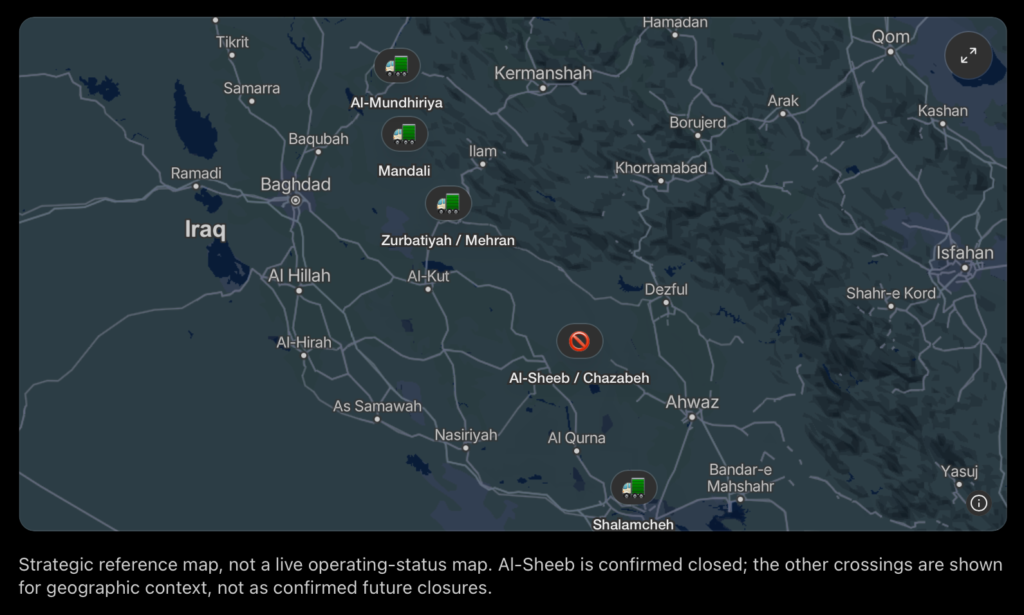
The distinction between closing one crossing and restricting the entire border is fundamental. The first can be managed through rerouting. The second can disrupt supply chains, create price distortions and alter political relationships.
Iranian officials have already advised travelers and truckers to use Shalamcheh while discussions over Al-Sheeb continue. (Internazionale+1)
This means Iran retains alternative access for now.
4. Who benefits, who loses, and who gains leverage?
| Actor | Immediate position | Strategic consequence |
| United States | Potential beneficiary | Greater pressure on Iran without deploying additional forces inside Iraq |
| Iraqi government | Gains administrative authority, assumes political risk | Can strengthen sovereignty if enforcement is consistent |
| Iran | Loses one commercial route | Faces possible erosion of logistical flexibility and regional influence |
| Saudi Arabia | Potential security beneficiary | Greater incentive to cooperate with Baghdad |
| Iran-aligned Iraqi factions | Face greater scrutiny | Could lose informal border influence and revenue |
| Iraqi traders and consumers | Exposed to disruption | Higher transport costs, delays and possible inflation |
| Alternative transport operators | Potential short-term winners | Rerouted traffic creates new commercial opportunities |
The most important domestic question is whether Iraq can actually enforce the policy against powerful networks operating within its territory.
Border inspection equipment matters, but command authority, customs transparency and accountability over security personnel matter more.
If politically connected actors retain exemptions, the closure risks becoming selective economic coercion rather than genuine reform.
5. Economic consequences: The $10 billion question
The reported figure of more than $10 billion represents annual bilateral trade, not the amount of trade passing through Al-Sheeb alone. It would be analytically incorrect to treat the entire amount as immediately threatened by a single crossing closure. (The National)
The consequences depend on the share of freight rerouted, the capacity of alternative crossings, the duration of restrictions and whether essential goods receive exemptions.
Illustrative exposure scenarios — not forecasts
Assume $10 billion in annual trade as a simplified baseline. Adjust the share of total trade affected and duration to estimate gross trade flow exposed to disruption, not permanent economic losses.
Affected share of trade: 20%
Duration of disruption: 30 days
Estimated gross trade flow exposed
$164.4 million
Illustrative annual-average calculation; actual losses may be substantially smaller because of rerouting or delayed deliveries.
The first effects would likely appear in freight prices, perishable-food supply, construction materials and provincial border economies. Pilgrim traffic would also suffer, although its political and social importance cannot be captured by trade statistics.
A prolonged, comprehensive closure could produce an unintended result: stronger smuggling incentives as legal channels become more expensive or unavailable.
6. The historical oscillation: Why September is more revealing than Pakistan
September 2026 provides the strongest direct comparison.
Following the Saudi pipeline attacks, Iraq temporarily closed Al-Sheeb, Shalamcheh and Mandali. Authorities subsequently announced phased reopenings: passenger movements resumed at Al-Sheeb and Shalamcheh on September 13, with commercial operations restarting over the following days. Other routes remained operational. (Video IQ+1)
That sequence establishes a recognizable pattern:
01 Regional attack
Iraqi territory becomes a security concern
02 Political pressure
Baghdad faces demands for stronger controls
03 Border restrictions
Authorities demonstrate enforcement
04 Negotiated reopening
Trade resumes under revised procedures
The current episode could follow the same cycle, but two differences deserve attention: the reported American campaign to restrict Iran’s borders more broadly, and the explicit suggestion that additional Iraqi crossings may close.
Pakistan’s reported border disruptions fit a possible wider containment pattern, but simultaneous restrictions do not by themselves establish centralized coordination. The claim of a coordinated American approach remains dependent on the AFP sources.
7. Three scenarios for the coming weeks
Scenario 1 — Technical closure followed by reopening
Leading scenario
Baghdad installs equipment, introduces stricter inspections and reopens Al-Sheeb after negotiations. The September precedent supports this possibility. The strategic impact remains limited unless enforcement changes materially.
Scenario 2 — Selective, prolonged containment
Credible escalation scenario
Baghdad closes additional crossings while preserving selected humanitarian and commercial routes. Iran faces greater transaction costs, Iraqi importers reroute freight and domestic political opposition intensifies. This would be a meaningful policy shift.
Scenario 3 — Regional confrontation and internal backlash
High-impact downside scenario
Expanded restrictions coincide with further attacks on Gulf infrastructure or shipping. Iran-aligned factions resist Baghdad’s enforcement, commercial disruption grows and Iraq faces pressure from opposing sides simultaneously.
These are qualitative judgments, not statistically calibrated probabilities. Their relative likelihood will change rapidly if Baghdad announces further closures or Tehran adopts retaliatory measures.
8. Intelligence indicators to monitor
Over the next 72 hours and the following two weeks, five developments will be especially revealing:
- Further crossing closures: Whether Shalamcheh, Mandali or other major routes actually suspend operations.
- Formal Iraqi directives: Whether the prime minister publishes a legal or administrative framework with a timetable, exemptions and inspection requirements.
- Iranian response: Whether Tehran limits itself to diplomatic protest or introduces reciprocal trade restrictions.
- Domestic political resistance: Whether Iran-aligned Iraqi parliamentary blocs and armed factions openly challenge the policy.
- Enforcement evidence: Whether authorities announce credible seizures, prosecutions or independent customs inspections rather than only equipment installation.
The most consequential indicator is the second. A published, enforceable national border-security program would suggest state-building. Indefinite closures without transparent criteria would strengthen the interpretation of externally driven economic pressure.
Final assessment
Al-Sheeb is a test of Iraqi sovereignty under simultaneous American, Iranian and Saudi pressure. The United States has a strategic incentive to narrow Iran’s economic options; Iran has an incentive to preserve Iraq as a commercial and political buffer; Saudi Arabia wants Baghdad to prevent cross-border threats; and Iraq’s government wants to demonstrate control without provoking an economic or domestic political crisis. The September precedent argues against assuming permanent closure, while the reported wider American demands argue against dismissing this as an isolated technical measure. My base case is a period of selective restrictions and negotiations rather than an immediate comprehensive blockade. If multiple crossings remain closed for weeks, however, the significance changes: Iraq would be moving from episodic border security toward active participation in Iran’s regional economic containment. That would constitute a substantial redistribution of leverage, but not necessarily a durable realignment of Iraqi loyalties.
Welcome to the Middle East, where everything changes, yet nothing does.
Literary reflection — Iraq
Inspired by the themes of Sinan Antoon, Iraqi novelist and author of The Corpse Washer. The following is an original reflection, not a quotation.
In Iraq, a border is never merely a line separating two countries. It is a passage through which families, commerce, memories and rival powers move. When governments close its gates, they may interrupt the traffic of the present, but they cannot so easily close the histories that created it. The enduring Iraqi dilemma is whether the state can finally command the roads that others have long used to command its future.
ME-100, Middle East Chief
Three Corporate