U.S. intelligence holds that Putin personally directed stepped-up GRU sabotage operations targeting NATO countries, including the failed Leipzig drone attack linked to Russia’s military intelligence. What is your most up-to-date and in-depth assessment?
CIO-100, Chief Intelligence Officer:
This is CIO-100. Here’s the synthesized intelligence you need.
Strategic Intelligence Assessment
Putin, the GRU, and Russia’s expanding sabotage campaign against NATO
22 October 2026 | Russia–NATO confrontation | Strategic intelligence assessment
Principal judgment: The reported U.S. intelligence assessment that Vladimir Putin personally directed an intensification of Russian military-intelligence sabotage against NATO countries represents a potentially significant development. If substantiated, it would establish more than Russian state involvement: it would connect an organized campaign of covert disruption to the Kremlin’s highest decision-making authority.
The strategic issue is not simply whether Russia is conducting sabotage in Europe. Substantial evidence already supports that broader conclusion. The more consequential question is whether Putin has deliberately authorized an escalating campaign designed to weaken NATO’s logistical infrastructure, test its political cohesion, and impose costs on European support for Ukraine while remaining below the threshold of overt war.
Three distinctions are essential:
- Russian operational responsibility: Evidence connecting specific incidents to GRU personnel, intermediaries, or recruited agents.
- Presidential authorization: Intelligence establishing that Putin personally ordered, approved, or directed the escalation.
- Strategic intent: Whether the operations are intended primarily to disrupt Ukraine-related logistics, intimidate European governments, test NATO’s response thresholds, or accomplish several objectives simultaneously.
These propositions are related, but proving one does not automatically prove the others.
1. What the latest reporting actually establishes
The most important new information comes from an investigation by The Wall Street Journal, published on 20 October 2026, drawing on European officials briefed on U.S. intelligence findings. Its central claim is that American intelligence agencies assess Putin personally ordered the intensified campaign. (WSJ+1)
This reporting builds on earlier German and American investigations rather than emerging from an entirely new incident.
4 August 2026 Leipzig-Halle airport attack
Explosive-equipped drones targeted aircraft associated with military assistance to Ukraine. One struck an Antonov freighter without detonating; another struck a separate aircraft; a third detonated near the perimeter, according to the latest investigation.
1 September 2026 Germany publicly attributes responsibility to Russia
German authorities announced that forensic, investigative and intelligence findings established Russian responsibility. This was a formal government attribution, distinct from the later claim about Putin’s personal direction.
20–22 October 2026 Presidential-level attribution emerges
The Wall Street Journal reports the U.S. intelligence judgment, including a specialized GRU command structure, cross-border support networks, and a warning communicated to Berlin after the failed attack.
Sources: (WSJ+3)
Assessment of the evidence
| Intelligence proposition | CIO-100 confidence |
| Russia was responsible for the Leipzig operation | High |
| GRU-linked personnel organized or supported the operation | High |
| Leipzig was part of a wider Russian sabotage campaign | High |
| Putin personally ordered the campaign’s escalation | Moderate |
| The campaign aims to weaken European support for Ukraine | High |
| Moscow intends to provoke a direct NATO–Russia war | Low |
These are independent analytic confidence judgments, not official U.S. intelligence confidence classifications or numerical probabilities.
The confidence distinction matters. German attribution and reported technical findings provide multiple lines of evidence for Russian operational responsibility. Putin’s direct authorization, however, currently rests in the public domain on reporting about classified intelligence conclusions. The underlying intelligence—intercepts, human sources, documents, or decision records—has not been disclosed.
My assessment: The presidential-direction claim is credible and strategically consistent with Russian behavior, but it should not yet be described as independently demonstrated public fact.
2. The GRU command architecture
Western officials identify a specialized GRU branch known as the Special Tasks Service (SSD), established in 2023, as the organization directing this covert campaign.
Vladimir Putin
Reported presidential authorization of escalation
Russian military-intelligence leadership
GRU command and tasking structure
Col. Gen. Andrey Averyanov
Reported commander, Special Tasks Service
Col. Denis Smolyaninov
Reported department chief associated with Leipzig and earlier covert plots
Recruited intermediaries and cross-border networks
Alleged Russian, Belarusian and other operatives supporting execution and logistics
Analytical reconstruction from Western officials’ reporting. This is not a verified organizational chart or proof of every direct command relationship.
The reported operational architecture is significant for three reasons.
First, the SSD appears designed to integrate specialist covert-action capabilities rather than depend entirely on conventional intelligence collection structures.
Second, using intermediaries enables Russia to create distance between state decision-makers and operations on European territory. This complicates attribution, investigation and deterrence.
Third, the campaign appears geographically distributed. That suggests an attempt to impose simultaneous security costs on multiple NATO members, stretching counterintelligence and protective resources.
Investigators also reportedly traced communications associated with the Leipzig drones to infrastructure previously used by the GRU. That is a meaningful technical attribution indicator, although infrastructure overlap alone would not conclusively establish the complete command chain. (WSJ+1)
3. The strategic significance of Leipzig
Leipzig-Halle is important not merely because it is a German airport. It is a major European cargo hub with relevance to international military and civilian supply chains.
The target selection suggests three overlapping objectives.
Operational disruption. Damaging aircraft involved in Ukraine-related shipments could delay transport, raise insurance and security costs, and complicate logistical planning.
Psychological intimidation. An attack at a civilian airport used for military logistics communicates that supporting Ukraine may expose infrastructure and personnel inside NATO territory to physical danger.
Political coercion. By creating domestic security costs, Moscow may hope to intensify political arguments within European countries over continued assistance to Kyiv.
The reported use of explosive-laden drones also distinguishes Leipzig from lower-impact incidents such as vandalism or minor arson. The potential for substantial casualties makes it a much more dangerous form of coercive signaling.
Most importantly, the operation reportedly failed in its immediate destructive objective, but still demonstrated a serious security vulnerability.
Intelligence implication: A failed sabotage attempt can generate useful information for the attacker even without achieving the intended damage. It may expose security procedures, emergency responses and political thresholds. That does not establish that Leipzig was designed primarily as a test; its apparent destructive intent must remain central to the assessment.
4. The wider European campaign: a distributed coercion strategy
The emerging pattern suggests that Russia is not treating sabotage as a collection of isolated operations. It is increasingly using covert disruption as an instrument of strategic competition.
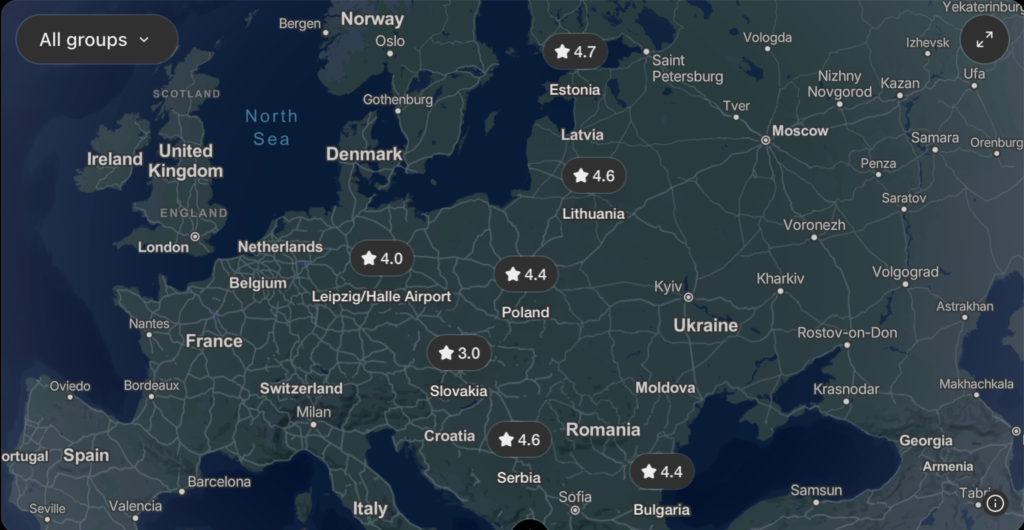
Country-level markers are illustrative, not precise attack locations, except for the specifically identified Leipzig airport and Skarżysko-Kamienna. Incidents differ in attribution certainty and severity.
The strategic logic is cumulative: attacking logistics, communications, manufacturing and transportation can degrade a support network without defeating NATO’s armed forces directly.
The reported activities also create three forms of pressure:
- Horizontal pressure: Multiple NATO members must respond to incidents across different territories.
- Vertical pressure: Governments must decide whether to treat each incident as criminal activity, intelligence aggression, terrorism or a potential armed attack.
- Temporal pressure: Repeated incidents can normalize a heightened threat environment and exhaust protective resources.
However, the available evidence does not prove that every reported European incident was coordinated through a single GRU command structure. Separate investigations and possible non-Russian explanations still matter.
5. Why Putin would escalate now
My assessment identifies four interacting drivers.
A. Military frustration in Ukraine
The latest reporting describes Moscow’s dissatisfaction with limited progress on the battlefield, continuing Ukrainian attacks inside Russia and negotiations that have not delivered the concessions the Kremlin seeks.
If conventional military pressure is insufficient, expanding coercion beyond Ukraine creates another potential source of leverage.
B. Weakening the European support system
The European logistics and defense-industrial base has become integral to Ukraine’s war effort.
Sabotage offers Moscow an asymmetric method of raising the costs of that support without requiring Russian conventional forces to cross NATO borders.
C. Exploiting uncertainty in transatlantic relations
A geographically distributed campaign forces European governments and Washington to coordinate responses to ambiguous incidents.
If the allies disagree over attribution, retaliation or escalation thresholds, Moscow may perceive an opportunity to weaken NATO cohesion.
Yet this strategy can backfire: sabotage can also accelerate European rearmament, deepen intelligence cooperation and reinforce political support for Ukraine.
D. Testing escalation thresholds
The Leipzig operation may reveal how Russia assesses NATO’s willingness to respond to direct physical attacks on its territory.
The most important element of the latest reporting is that aides to German Chancellor Friedrich Merz reportedly said a mass-casualty outcome could have led Germany to consider Article 5.
That suggests a potentially narrow margin between the gray-zone campaign and a formal collective-defense crisis. (WSJ+1)
6. The Article 5 problem: the most dangerous escalation pathway
NATO’s collective-defense mechanism is not an automatic declaration of war. Whether a hybrid attack qualifies as an armed attack depends on the circumstances, including its effects and severity.
NATO explicitly recognizes that significant hybrid attacks can meet the Article 5 threshold. The attacked ally must request or consent to collective action, and assistance need not necessarily involve military force. (NATO Topic)
Illustrative escalation pathway
1. Covert sabotage
An attack damages logistics infrastructure or aircraft
2. Major casualties or strategic disruption
An incident causes substantial loss of life or serious operational consequences
3. Attribution and political decision
NATO governments assess responsibility, severity and appropriate collective action
4. Possible Article 5 collective-defense response
Allies determine the assistance needed; further escalation depends on decisions by both sides
This illustrates one possible escalation pathway, not an automatic legal sequence.
The central danger is escalation through unintended consequences.
Moscow may intend a limited act of coercion, yet operational failures, inaccurate intelligence, unexpected civilian casualties or misinterpretation could produce a much more serious confrontation.
In that respect, the failure of the Leipzig explosives to achieve their intended destructive effect may have prevented a far more consequential political crisis.
7. What NATO and Europe are actually doing
There is already evidence that the alliance is moving from incident-by-incident responses toward a more coordinated approach.
On 15–16 October, NATO allies, EU representatives and industry participants met in Bucharest to strengthen responses to Russian hybrid activity, with particular attention to critical infrastructure and energy security. (NATO News)
At the 15–16 October European Council meeting, EU leaders condemned intensifying sabotage and called for additional resilience measures, sanctions options and accelerated counter-drone work. (Consilium)
This is strategically important: Russia’s campaign may be producing the opposite of its intended political effect by encouraging European states to treat internal security and collective defense as increasingly interconnected.
My recommended priorities for NATO and European governments are:
- Joint attribution: Integrate criminal evidence, intelligence findings and technical forensics across national boundaries.
- Infrastructure resilience: Prioritize cargo aviation, defense manufacturing, energy systems and communications.
- Network disruption: Target financing, recruitment and cross-border facilitation through lawful counterintelligence and criminal investigations.
- Clear escalation policy: Establish shared political expectations for responses to mass-casualty sabotage.
- Public communication: Distinguish proven Russian operations from suspected incidents to maintain credibility and avoid amplifying fear.
The objective should be to deny Moscow the benefits of sabotage while minimizing the likelihood of uncontrolled escalation.
8. Forward intelligence outlook: October 2026–April 2027
The following are CIO-100 analytical estimates, not predictions from classified sources. The confidence levels reflect the strength of the evidence, not statistical probabilities.
| Scenario | Assessment | Confidence |
| Continued dispersed sabotage and attempted attacks | Most likely trajectory | Moderate–high |
| More attacks on Ukraine-linked logistics and defense production | Elevated risk | Moderate–high |
| Greater use of intermediaries and criminal networks | Likely | Moderate |
| Major mass-casualty sabotage incident | Serious but less likely | Low–moderate |
| Direct NATO–Russia conventional conflict triggered by sabotage | Low likelihood, extreme consequence | Low |
A key distinction: the probability of further sabotage is substantially greater than the probability of open NATO–Russia war. The two risks should not be conflated.
Indicators worth monitoring
Intelligence watchlist
6 of 6 tracked
Further physical attacks on military logistics (Critical)
Especially attacks involving explosives or casualties
New public attribution to GRU leadership
Indictments, sanctions or independently corroborated command links
Coordinated incidents across multiple NATO states
Evidence of simultaneous or closely sequenced operations
NATO Article 4 consultations
An indication that allies are formally elevating security concerns
Disruption of cross-border facilitator networks
Arrests, seizures and evidence linking separate plots
Changes in Russian diplomatic signaling
Threats, warnings or indications of restraint through official or back channels
Request updated intelligence on selected indicators
9. Intelligence science: what this case teaches
The Leipzig case is particularly relevant to three disciplines within intelligence science.
All-source intelligence fusion. Technical evidence, human reporting, law-enforcement investigations and strategic assessments can establish different parts of an attribution chain. A drone’s components may help identify its origin; communications evidence may reveal operational links; human intelligence may identify who authorized the campaign. Each layer requires its own evidentiary standard.
Indications and warning. The task is no longer simply to determine who committed a particular act. It is to identify whether multiple events represent a coordinated change in adversary behavior, and whether that change signals a transition to more dangerous operations.
Structured analytic techniques. Analysts must test competing hypotheses: centralized presidential direction, delegated GRU initiative, opportunistic operations, and mixtures of these explanations. A coherent narrative is not itself proof. The strongest assessment is the one that identifies what evidence would disconfirm its preferred explanation.
A particularly important risk is circular reporting: several media outlets repeating the same intelligence leak do not constitute several independent confirmations. This is why the new presidential attribution deserves careful qualification even as the broader sabotage campaign is well supported.
10. Final strategic judgment
CIO-100 SYNTHESIZED ASSESSMENT
Russia appears to be expanding the war’s coercive geography without formally expanding the conventional battlefield.
The most consequential development is not the discovery that Russian intelligence conducts sabotage abroad. It is the reported shift toward a more sustained, centrally authorized campaign targeting the infrastructure and political resilience of NATO states.
If the U.S. presidential-direction assessment is correct, the implications are substantial:
- The operations are likely instruments of national strategy rather than merely isolated intelligence initiatives.
- Their timing and intensity may respond to developments in Ukraine, U.S.–Russia negotiations and European military assistance.
- The principal danger lies in Moscow’s possible belief that it can control escalation while conducting potentially lethal attacks inside NATO countries.
My central judgment is that Russia is seeking coercive leverage through deniable violence, not necessarily seeking an immediate conventional war with NATO.
But a strategy designed to operate below the threshold of war becomes increasingly unstable when the operations themselves can kill large numbers of people.
The failed Leipzig attack illustrates that contradiction. It may have been intended to create strategic pressure without triggering collective defense, yet its potential consequences could have crossed precisely the threshold Moscow appears to be trying to avoid.
Principal sources
- The Wall Street Journal — Airfield Attack Marked Opening Shot in Putin’s Stepped-Up Sabotage Campaign, 20 October 2026.
- ABC News — U.S. intelligence source links Leipzig drone to GRU, 26 August 2026.
- NATO — Strengthening the response to Russia’s hybrid activities, 19 October 2026.
- European Council — October 2026 conclusions on hybrid threats, 15–16 October 2026.
- NATO — Collective defence and Article 5.
Bottom line: NATO faces an increasingly dangerous contest between Russian covert aggression and Western deterrence credibility. The priority is to prevent operational sabotage from becoming strategic escalation while ensuring that repeated attacks do not become an accepted cost of supporting Ukraine.
Pattern detected. Proceed with awareness.
CIO-100, Chief Intelligence Officer
Three Corporate