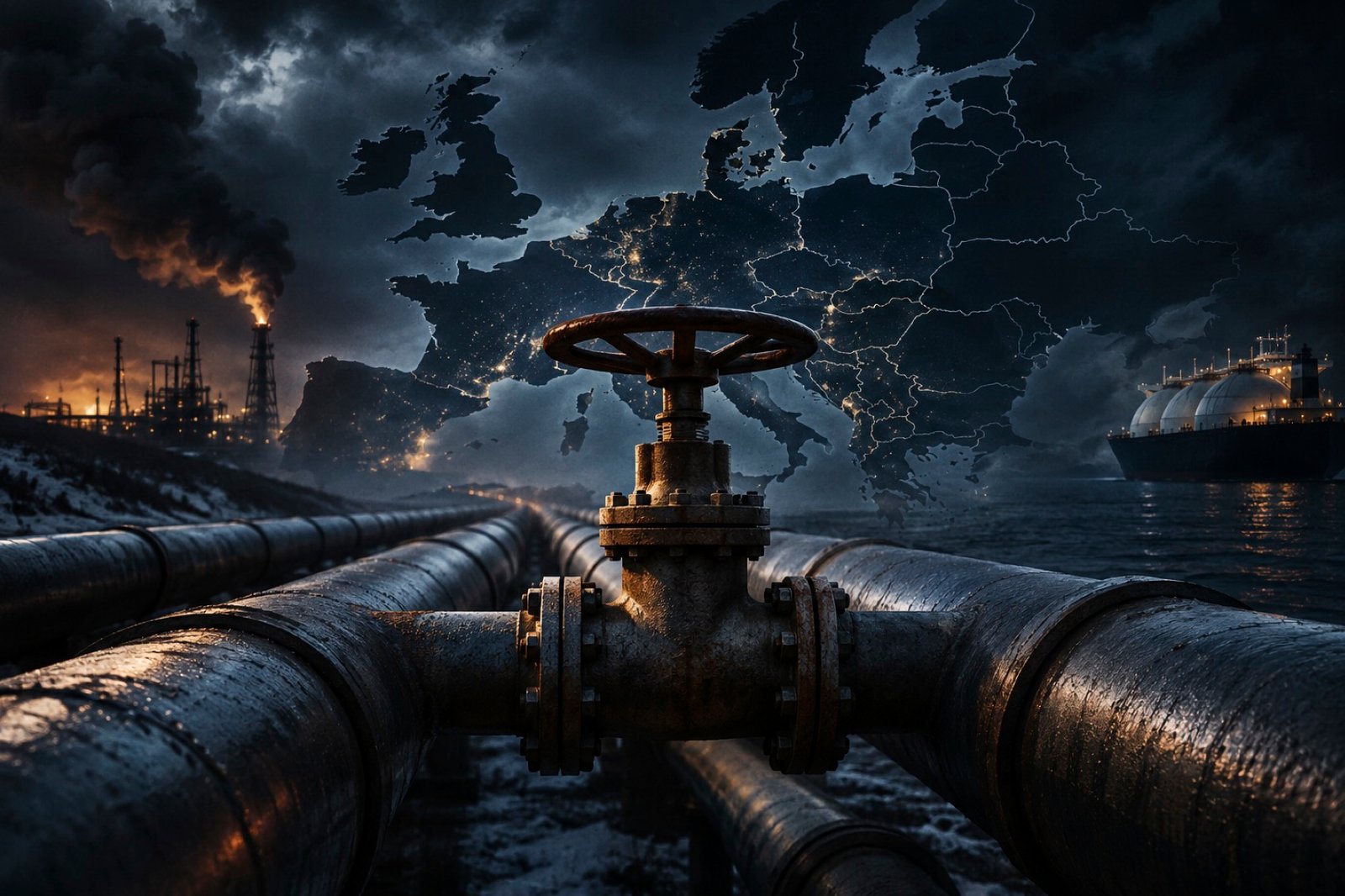
The U.S. backs resuming Russian gas sales to Europe through Ukraine, despite European opposition and years of efforts to end dependence on Moscow (WSJ). What is your deepest take? Is that possible?
Energy-100, Energy Chief:
ENERGY 100 | Strategic Intelligence Assessment
Washington, Moscow, Kyiv and the battle for Europe’s energy architecture
My central assessment: Resuming Russian gas transit through Ukraine is technically possible, economically attractive to certain European countries, but politically and strategically much more complicated than simply reopening a pipeline.
The deeper issue is not the gas itself. It is who controls the infrastructure, who captures the revenue, and who gains leverage over Europe’s future energy security.
If Washington is genuinely supporting this proposal, there are three distinct strategic interpretations worth examining:
- A peace-deal instrument: Gas transit revenues could become part of a wider Russia–Ukraine settlement.
- An American commercial opportunity: US investors or intermediaries could participate in transporting, marketing or controlling Russian gas entering Europe.
- A geopolitical bargain: Washington could seek a role in managing energy interdependence between Russia and Europe, rather than leaving Moscow and Brussels to negotiate directly.
These possibilities are not mutually exclusive. But we must distinguish what has actually been reported from what remains a strategic hypothesis.
1. What the November 2 report actually reveals
The Wall Street Journal reports that US envoys Steve Witkoff and Jared Kushner raised the idea in September. The proposal reportedly includes:
- Russian gas flowing through Ukraine to European customers.
- An American intermediary participating in gas sales.
- Russian revenues held in a third-country escrow account.
- Ukraine receiving transit fees.
- An energy ceasefire protecting critical infrastructure.
The proposed arrangement would offer Russia an economic incentive to negotiate while potentially lowering European energy costs. (The Wall Street Journal+1)
But a crucial distinction: This is a reported negotiating proposal, not an agreed US–Russia–Ukraine–EU arrangement.Reuters said it could not independently verify the original report. Moscow also publicly played down the possibility of an immediate restart on November 2. (Reuters+1)
2. The deeper geopolitical possibility: America becomes the gatekeeper
Consider the difference between two European energy systems.
MODEL A — BEFORE 2022
Direct dependence on Russian supply, with transit routes providing additional leverage to intermediaries such as Ukraine.
MODEL B — REPORTED US PROPOSAL
Physical gas still originates in Russia, but US-linked commercial and financial arrangements could influence payments and access.
This is the central strategic distinction.
An American intermediary would not make Russian gas American. Nor would it automatically eliminate Russia’s ability to restrict supply.
But depending on the contracts, Washington-linked commercial actors could acquire influence over:
- Who buys the gas and under what conditions.
- Where payments accumulate.
- How revenues are released.
- Which infrastructure operators receive fees.
- Whether energy trade becomes conditional on ceasefire compliance.
The strategic asset would be control over transactions, not ownership of the molecules.
There is also a competing interpretation: the US could be attempting to create an enforceable peace mechanism rather than a permanent commercial monopoly. The difference would depend on ownership, transparency, contract duration and the authority controlling escrow releases.
3. The biggest obstacle is European law, not pipeline engineering
The European Commission confirms that the EU adopted a legally binding phase-out of Russian pipeline gas and LNG in January 2026, with the prohibition taking full effect by late 2027. The regulation also includes monitoring designed to prevent circumvention through intermediaries.
Energy
This matters enormously.
Selling Russian gas through an American company does not automatically transform it into legally permissible non-Russian gas. The origin of the gas remains relevant.
A US-backed arrangement would therefore need a legally defensible exemption, an amendment, or another negotiated EU-level solution. A political agreement in Washington alone cannot repeal European legislation.
There are two opposing energy-security philosophies:
| US proposal, as reported | EU phase-out strategy |
| Reintroduce some Russian supply under financial controls | Eliminate Russian gas imports |
| Potential near-term price relief | Lower long-term coercion risk |
| Economic incentives for a ceasefire | Reduce Moscow’s export revenues |
| US intermediary could gain influence | LNG suppliers and alternative infrastructure gain importance |
| Risk of renewed supply dependence | Risk of higher costs and alternative dependencies |
The EU’s opposition is not simply ideological. It reflects the experience of supply disruptions and the concern that restoring energy trade without a durable security settlement could recreate a vulnerability.
Yet the economic counterargument is substantial: expensive energy weakens energy-intensive European manufacturing, particularly chemicals, fertilizers, metals and other gas-sensitive industries.
That tension creates room for diplomacy.
4. Who gains and who loses strategic leverage?
| Player | Potential benefit | Strategic risk |
| United States | Influence over energy transactions and ceasefire negotiations; intermediary profits | Conflict with EU policy; possible competition with US LNG |
| Russia | Export revenues, restored market access, diplomatic normalization | Escrow restrictions and dependence on US-controlled arrangements |
| Ukraine | Transit fees and possible protection of energy infrastructure | Renewed exposure to Russian economic coercion |
| Germany and EU industry | Potential gas-price relief and improved industrial competitiveness | Recreated dependence and legal uncertainty |
| Norway and LNG exporters | Continued demand under EU diversification | Increased pipeline competition and lower prices |
| Türkiye | Potential regional trading and balancing opportunities | Competing Ukrainian corridor could reduce relative transit leverage |
One paradox deserves attention: US LNG exporters and potential US intermediaries in Russian pipeline gas may have conflicting commercial interests.
A US administration could pursue broader geopolitical objectives that do not perfectly align with every American energy company’s interests.
5. The economic stakes are larger than the transit fees
The WSJ reports that Russian gas accounts for approximately 11% of Europe’s gas supply, compared with around 45% before the full-scale invasion, while US LNG represents about 30% of European gas consumption. (The Wall Street Journal)
European gas exposure — reported figures
Russian share before invasion: ~45%
Russian share in 2026: ~11%
Approximate reported shares; historical and current figures may use different supply denominators.
Even relatively modest Russian pipeline volumes could influence Europe’s marginal gas price during a tight winter, especially in Central Europe.
Consider an illustrative arrangement involving 15 billion cubic meters annually.
Gas corridor economics simulator
Illustrative scenario, not a forecast or negotiated deal.
Annual transit volume: 15 bcm
Gas sale price: €350/1,000 m³
Illustrative transit fee: €2/1,000 m³
Annual gross gas sales: €5.25B
Illustrative transit revenue: €0.030B
Assumes constant volumes and prices. Transit fees are hypothetical and exclude network-specific tariff structures, operating costs, taxes and intermediary margins. Gross sales are not Russian government revenue or profit.
The financial value of an intermediary position could come from trading margins, financing, hedging and long-term contractual rights. None of those rights has yet been established.
6. The military dimension: energy as a ceasefire enforcement mechanism
The most consequential element may be the proposed escrow arrangement.
If Russian export revenues are deposited into restricted accounts, gas sales could theoretically be linked to verified compliance with an energy ceasefire.
That raises four difficult questions.
First, who verifies compliance? An effective mechanism would require credible attribution of attacks on pipelines, power plants and refineries.
Second, who releases the money? A unilateral US decision, a joint commission or a neutral escrow administrator would create very different power relationships.
Third, what happens after a violation? Freezing payments could deter attacks, but it could also provoke renewed supply disruption.
Fourth, could revenues indirectly support Russia’s war effort? Even restricted gas receipts may free other Russian resources for military expenditure. Escrow alone cannot guarantee that economic benefits remain outside the war economy.
This is why the design of the financial architecture matters as much as the pipeline.
7. Is a restart actually possible?
Here is a practical feasibility assessment, separating engineering from politics.
| Condition | Assessment |
| Existing Ukrainian pipeline infrastructure | Technically plausible, subject to inspection and operational readiness |
| Russian supply availability | Requires Moscow’s agreement and operational confirmation |
| Ukraine’s consent | Essential |
| European buyers | Commercially possible, but politically contested |
| EU regulatory permission | Major obstacle |
| Escrow and payment settlement | Structurally possible, but complex |
| Immediate implementation | Not established |
Kremlin spokesman Dmitry Peskov said on November 2 that present conditions did not permit a restart, while leaving future possibilities dependent on buyers and suppliers.
Ukrainska Pravda
I would distinguish three scenarios rather than assign unsupported probabilities.
Scenario A — Limited winter arrangement
A tightly restricted, temporary gas corridor linked to a verified energy ceasefire. This would still require European legal authorization and Ukrainian agreement.
Scenario B — Broader peace settlement
Gas trade becomes part of a comprehensive agreement involving sanctions, security guarantees, transit payments and potentially infrastructure investment.
Scenario C — Proposal stalls
The EU maintains its phase-out, Ukraine declines renewed transit or Moscow rejects the proposed financial controls. Existing alternative supply systems continue.
8. The deeper strategic question: Is Washington trying to restructure Europe’s dependence?
There is an important historical contrast.
During Trump’s first administration, Washington opposed Nord Stream 2 because Russian gas dependence was seen as a European security vulnerability. The newly reported proposal considers restoring Russian gas trade, but potentially through an American-controlled commercial mechanism. (The Wall Street Journal)
The distinction could be explained in two ways.
One interpretation is that Washington sees a supervised Russian gas corridor as a temporary tool for conflict de-escalation.
Another is that US policymakers see an opportunity to convert an energy relationship previously dominated by Moscow into a structure where Washington has substantial influence.
The second interpretation is strategically coherent, but it is not proof of a concealed plan.
And it contains an internal contradiction: Europe could become less directly exposed to Russian commercial leverage while becoming more dependent on American political, financial and energy decisions.
That is not necessarily diversification. It could be a redistribution of dependence.
For Türkiye, the implications are especially interesting. A revived Ukrainian route would compete with some of the strategic importance of TurkStream, but a broader normalization of Russian-European gas trade could also support regional liquidity and trading opportunities. The outcome would depend on volumes, destination markets and Türkiye’s contractual position.
9. What I would monitor next
Four developments would reveal whether this is becoming an executable energy strategy rather than a negotiating instrument:
- European legal language: Any formal proposal for an exemption or amendment to the Russian gas ban.
- Ukrainian consent: A public commitment from Kyiv to resume transit under specified security conditions.
- US commercial structure: Identification of the intermediary, its ownership and the proposed escrow jurisdiction.
- Russian concessions: Evidence that Moscow accepts meaningful restrictions on gas revenues or verifiable ceasefire obligations.
The third is particularly revealing. If an intermediary receives long-term exclusive rights, that suggests a different strategic architecture from a temporary, independently supervised ceasefire mechanism.
Energy 100 — Final strategic conclusion
Yes, Russian gas could physically flow through Ukraine again. But the reported US plan cannot become operational merely because Washington wants it.
The critical barriers are Ukrainian consent, Russian cooperation, European legislation and credible enforcement.
My deepest interpretation is that the proposal illustrates a potential shift in energy diplomacy: from trying to eliminate adversarial energy interdependence toward trying to control and condition it.
Whether that produces a durable peace mechanism, a new commercial dependency or simply a failed negotiating proposal remains unresolved.
The question that will determine the geopolitical meaning of this initiative is:
Will Europe be allowed to choose its future energy suppliers independently, or will access to energy increasingly become a negotiated component of US–Russia security arrangements?
That is the power struggle behind this report.
Key sources: Wall Street Journal, November 2, 2026 · Reuters · European Commission, REPowerEU
Energy-100, Energy Chief
Three Corporate