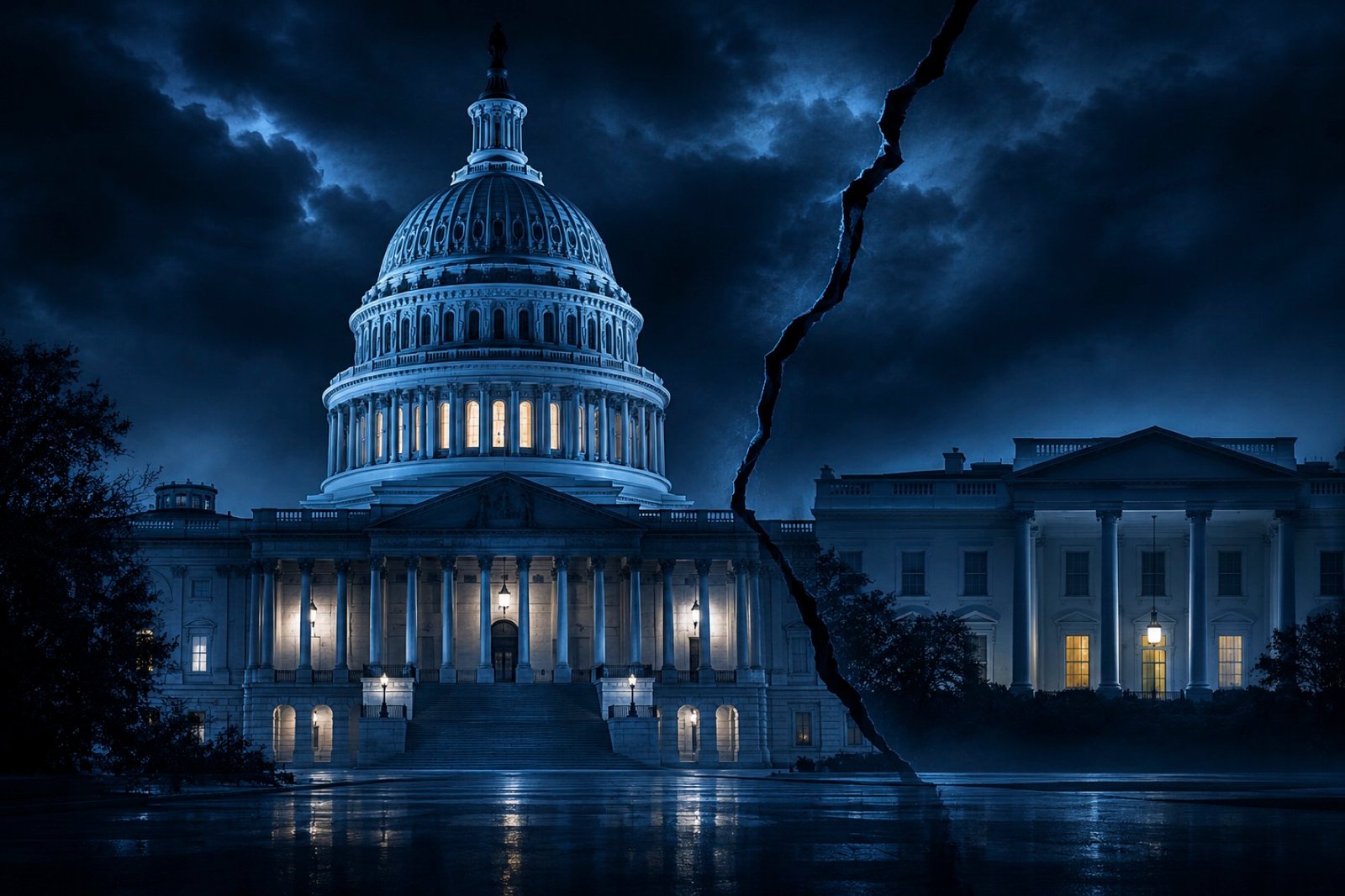
Democrats have flipped the House and Senate in the midterm elections, securing at least 228 House seats and a 54–44 Senate majority. Vance attributed voter defections to the war, living costs, and U.S.–Israel ties. With Trump facing two years of divided government, what is your most up-to-date and in-depth assessment?
US-01 | US Agent, Strategic Assessment
THREE CORPORATE · NOVEMBER 4, 2026 · POST-MIDTERM ASSESSMENT
Strategic judgment: The 2026 midterms represent a major redistribution of American political power, not merely a routine electoral correction. Donald Trump retains the presidency, executive authority, military command, and veto power, but he has lost the congressional dominance needed to advance his domestic agenda without substantial resistance. The Democrats’ victory in both chambers, particularly their breakthroughs in historically Republican states, suggests a broader rejection of the administration’s governing priorities. The Iran war, household affordability, tariffs, and perceived corruption converged into a crisis of political legitimacy. Yet the result should not be mistaken for a comprehensive public endorsement of progressive policies. The electorate has principally demanded accountability, economic relief, and constraints on presidential power. (Reuters+2)
1. The new balance of power
House balance of power
U.S. general election · 435 seats
Democrats: 233 seats secured / 218 seats needed for majority
Republicans: 139 seats secured
Source: Associated Press (Updated: Nov 4, 2026 at 9:16 PM)
Senate balance of power
U.S. general election · 100 seats
Democrats: 54 seats secured / 51 seats needed for majority
Republicans: 44 seats secured
Source: Associated Press (Updated: Nov 4, 2026 at 9:15 PM)
The reported Democratic floor of 228 House seats and 54 Senate seats, including independents caucusing with Democrats, establishes control of both chambers. Several races remain unresolved, so the final margins could increase. (Al Jazeera+1)
The critical distinction is between controlling Congress and controlling the government. Democrats will gain committee chairmanships, subpoena authority, appropriations leverage, and the ability to block much of Trump’s legislative agenda when the new Congress convenes on January 3, 2027. But Trump can veto legislation, and Democrats will not have the two-thirds majorities necessary to override him independently. In the Senate, most ordinary legislation also remains subject to the 60-vote cloture threshold.
This creates an unusually consequential division of power: a president capable of acting unilaterally in important areas, facing a Congress capable of investigating, obstructing, and restricting those actions.
2. Why Republicans lost: The collapse of the governing bargain
The strongest explanation is cumulative rather than single-cause.
The Iran war transformed a foreign-policy decision into a domestic economic liability. Vice President JD Vance explicitly identified the war as a central cause of Republican losses. Trump subsequently acknowledged that assessment as substantially accurate, while defending the underlying military decision. (The Guardian+1)
The strategic damage is especially significant because Trump’s political identity depended partly on rejecting prolonged American military entanglements. When voters see military commitments coinciding with higher energy prices and persistent household pressures, the administration’s promise of national renewal becomes harder to sustain.
Affordability undermined the administration’s economic credibility. The public does not experience economic policy primarily through GDP, stock indices, or claims of industrial investment. It experiences policy through groceries, rent, fuel, insurance, and wages relative to expenses. Tariffs, energy disruption, and uncertainty created an environment in which the administration struggled to demonstrate material improvement. The election therefore became a referendum on the gap between political promises and household outcomes.
Institutional concerns amplified economic dissatisfaction. AP reporting identifies government corruption concerns and presidential conduct alongside prices and war as major drivers. (AP News+1)
This matters because dissatisfaction was not confined to voters seeking a different economic program. It also included voters seeking restraints on how presidential power is exercised.
The Republican electoral coalition proved less transferable than anticipated. Trump’s personal appeal did not reliably protect Republican candidates. Democratic Senate victories in Texas, Kansas, and South Carolina demonstrate that this was not simply a turnout problem in traditionally Democratic territory. The geographic scale suggests meaningful voter defections, although district-level and demographic analysis will be needed to distinguish lasting realignment from temporary protest voting.
3. Vance, Trump, and the struggle over Republican direction
Vance’s explanation is politically consequential beyond its factual content.
By placing the war at the center of the defeat, he is identifying a policy failure that can be separated from the entire Republican ideological project. That framing potentially preserves the party’s positions on immigration, cultural issues, and economic nationalism while acknowledging a disastrous strategic choice.
It also creates a distinction between Vance and Trump.
Trump’s initial response emphasized the failure of Republican candidates to reproduce his personal electoral appeal. His subsequent defense of the war signals that he is not yet prepared to reverse its underlying rationale. (The Guardian+1)
There are three plausible developments:
- Trump doubles down: He treats congressional resistance as obstruction and intensifies executive action, political confrontation, and appeals to his core supporters.
- Vance becomes the vehicle for strategic correction: He preserves much of the MAGA coalition while advocating reduced foreign military commitments and renewed attention to domestic affordability.
- Republicans fragment: Competing factions blame the war, tariffs, leadership failures, or political extremism, weakening party coherence before 2028.
The third outcome would be particularly damaging to Republicans because the party would be debating its identity while Democrats control congressional investigations and legislative priorities.
Vance’s comments should therefore be interpreted as both a diagnosis of electoral failure and a potential opening in the 2028 succession struggle. There is not yet sufficient evidence to conclude that he is deliberately breaking with Trump.
4. The Iran war and the future of American deterrence
This is the most strategically sensitive consequence of the election.
Congressional Democrats can investigate the administration’s legal justification for military action, the intelligence behind operational decisions, military expenditures, civilian consequences, and the diplomatic alternatives that were considered.
They can also pursue war-powers legislation and restrictions on future appropriations. However, ending an ongoing conflict is more complicated than simply controlling congressional majorities. Presidential vetoes, existing military appropriations, statutory authorities, and the operational realities of deployed forces all constrain Congress.
The result is a potentially dangerous strategic contradiction: the executive branch retains military command while the legislature has an electoral mandate to challenge the war’s continuation.
Three effects deserve attention.
First, Iran may interpret the election as evidence that Washington’s political tolerance for prolonged confrontation is weakening. That could strengthen Tehran’s negotiating position, but it could also encourage miscalculation.
Second, Israel faces greater uncertainty about the durability of American support for continued military operations. Congressional control of future assistance, weapons transfers, and oversight could become more contested. Yet a Democratic majority does not automatically translate into a unified anti-Israel policy; the party contains substantial differences on Israeli security and Palestinian rights.
Third, U.S. allies may increasingly distinguish between commitments made by the Trump administration and commitments likely to survive the next presidential transition.
The strategic danger is not necessarily immediate American withdrawal. It is the erosion of confidence in the political sustainability of American commitments.
5. U.S.–Israel relations: A changing domestic constraint
The election potentially marks an important shift in the political environment surrounding the U.S.–Israel relationship.
For decades, American support for Israel benefited from strong institutional bipartisan backing. That foundation has not disappeared, but the combination of the Iran war, rising domestic costs, and public scrutiny of military assistance creates greater political friction.
Vance’s reference to the relationship should not be interpreted as proof that voters have broadly rejected Israel. The stronger inference is that foreign commitments have become electorally vulnerable when voters believe they are being prioritized over domestic needs.
A Democratic Congress could pursue stricter reporting requirements, additional oversight of military transfers, and more aggressive examination of how American support affects regional escalation. Whether it can translate those priorities into binding policy will depend on internal Democratic unity, Senate procedure, and Trump’s veto.
For Israel, the rational response would be to preserve relationships across both parties rather than assume that executive support alone guarantees uninterrupted American backing.
For Washington, the challenge is maintaining deterrence without allowing regional commitments to become an open-ended drain on domestic political consent.
6. Economic policy: Gridlock, correction, and selective cooperation
The next two years are likely to produce a more restrictive legislative environment but not necessarily complete economic paralysis.
| Policy area | Expected direction |
| Federal spending | Greater bargaining, stronger oversight, higher shutdown risk |
| Tariffs and trade | Increased scrutiny; executive authorities remain important |
| Tax policy | Major partisan revisions become harder |
| Energy | Conflict over costs, production, infrastructure, and regulation |
| AI and semiconductors | Continued national-security cooperation, disputes over regulation |
| Healthcare and housing | Democratic pressure for affordability measures |
| Financial markets | Greater policy uncertainty, with potential benefits from reduced legislative volatility |
The immediate market response has been relatively constructive, with Wall Street opening higher following the Democratic takeover.
The Guardian
That should not be read as an endorsement of every Democratic policy. Investors may simply expect fewer sweeping legislative changes and stronger checks on executive policy.
The greatest economic risk is a combination of persistent energy inflation, fiscal confrontation, and unpredictable trade policy. The greatest opportunity is a negotiated shift toward household affordability, infrastructure, and industrial competitiveness.
For American industry, China-related security concerns will continue to support some bipartisan cooperation on semiconductor capacity, supply-chain resilience, and advanced technologies. But Democrats may place greater emphasis on regulatory accountability, labor conditions, and the local environmental and energy costs of AI infrastructure.
The key economic question is whether the administration and Congress can separate areas of genuine national strategic consensus from issues that have become instruments of partisan conflict.
7. The institutional confrontation: Oversight versus executive power
Democratic control of both chambers creates a credible threat of sustained investigations into the Trump administration. Potential targets include war planning, procurement, tariffs, conflicts of interest, immigration enforcement, and the use of federal agencies.
This will change the administration’s operating environment even without new legislation. Cabinet officials may face repeated testimony, agencies may confront document demands, and politically sensitive decisions may receive greater public scrutiny.
The Senate majority also changes the confirmation landscape. Trump will face much greater difficulty securing approval for controversial nominees, including federal judges and senior executive officials.
Impeachment is another possibility, but it should not be confused with removal. The House can impeach by simple majority; conviction in the Senate requires two-thirds of senators present. Even a substantially expanded Democratic majority would remain far short of that threshold without significant Republican defections.
The larger institutional risk is escalation between competing claims of democratic legitimacy. Trump can argue that he retains the presidential mandate granted in 2024. Democrats can argue that voters have now explicitly rejected his governing direction. Both claims have constitutional significance, but neither eliminates the powers of the other branch.
The healthiest outcome would be stronger institutional accountability. The destabilizing outcome would be an extended confrontation over executive compliance with congressional oversight and judicial rulings.
8. Global implications: Competitors will test American coherence
The international consequences extend beyond Iran.
China: Beijing may see a distracted Washington and greater uncertainty in American trade and defense policy. But it would be a mistake to assume that divided government weakens American strategic competition with China. Congressional Democrats and Republicans share substantial concerns about Chinese technological and military power. Indeed, stronger congressional oversight could make certain China-related restrictions more durable.
Europe and NATO: European governments may welcome additional congressional constraints on unilateral American decisions. Nevertheless, they should not assume that Democratic congressional victories restore earlier U.S. foreign-policy traditions. NATO burden-sharing, European defense spending, and industrial competition will remain contentious.
Russia and Ukraine: Congress gains leverage over future assistance, sanctions legislation, and scrutiny of administration diplomacy. Yet substantial differences within both parties mean that a coherent alternative strategy cannot be presumed.
The Gulf states: Regional governments must now account for greater uncertainty over the Iran conflict and American security commitments. They may intensify hedging strategies, diversify diplomatic channels, and pursue de-escalation arrangements where feasible.
Global finance: The dollar’s structural advantages are not fundamentally changed by one election. However, recurring fiscal standoffs, policy unpredictability, and questions about American institutional stability can gradually increase incentives for diversification.
The central distinction is between American power and American political coherence. The United States retains extraordinary economic, military, and technological capabilities. The election raises questions about how consistently those capabilities can be directed.
9. Strategic scenarios, 2027–2028
Analytical estimates, not statistical forecasts. Conditional on the November 4 information available.
Scenario A — Confrontational divided government
Most likely, Working probability: 50%
Trump relies increasingly on executive authority while Democrats intensify investigations and use funding and confirmations as leverage. Limited bipartisan legislation passes, and the 2028 campaign becomes a referendum on institutional conflict.
Scenario B — Selective accommodation
Working probability: 30%
Economic and electoral pressures produce negotiated agreements on spending, affordability, and industrial policy, potentially accompanied by a reduction in military escalation.
Scenario C — Major constitutional or geopolitical confrontation
Working probability: 20%
An intensified regional war, serious budget confrontation, or executive-legislative dispute creates a prolonged governance crisis, potentially involving the courts.
These scenarios are illustrative judgments, not model-derived probabilities. Their purpose is to identify the conditions that could change America’s trajectory.
10. Five indicators to monitor
- Iran war trajectory: Whether the administration seeks a negotiated exit, prolongs operations, or escalates despite congressional opposition.
- Republican leadership: Whether Vance consolidates influence as the party’s principal post-Trump figure or faces organized resistance.
- Democratic cohesion: Whether moderates and progressives can agree on legislative priorities, investigations, and foreign policy.
- Household affordability: Whether energy, housing, and consumer costs improve enough to change political sentiment.
- Executive compliance: Whether the administration cooperates with lawful congressional oversight and judicial decisions or pursues sustained confrontation.
Final strategic assessment
The United States has entered a new phase of the Trump presidency: executive power without legislative dominance, military strength without assured domestic consent, and economic capacity constrained by political fragmentation.
The midterms do not establish that MAGA is finished, that Democrats have secured 2028, or that American global leadership is irreversibly declining. They establish something more immediate: the political coalition that sustained Trump’s governing agenda has suffered a severe electoral defeat.
For Democrats, the central danger is mistaking a rejection of Republican governance for unlimited permission to pursue their entire ideological program. Their strongest opportunity is to deliver visible accountability while demonstrating credible economic alternatives.
For Republicans, the danger is refusing to distinguish loyalty to Trump from the long-term interests of the party and its electorate. Vance’s acknowledgment of the war’s electoral consequences suggests that at least part of the Republican leadership understands the need for correction.
For Trump, the fundamental choice is between adaptation and confrontation. His institutional powers remain substantial, but the political costs of exercising them have increased.
US-01 conclusion: The decisive contest of 2027–2028 will not simply be Democrats versus Republicans. It will be whether the American political system can translate a clear electoral demand for restraint, affordability, and accountability into effective governance while managing an ongoing geopolitical conflict. The outcome will determine whether this election becomes a temporary backlash, a durable political realignment, or the beginning of a deeper institutional crisis.
The election is a warning to the presidency, an opportunity for Congress, and a test of the American constitutional system.
AMERICAN LITERARY PERSPECTIVE
In The Great Gatsby, American novelist F. Scott Fitzgerald wrote: “So we beat on, boats against the current, borne back ceaselessly into the past.” The passage offers a useful reflection on America’s present political moment. Political movements promise renewal, yet often find themselves constrained by unresolved conflicts, inherited commitments, and institutional history. Trump’s second presidency and the Democratic congressional resurgence now confront the same enduring question: whether American power can be redirected toward the future without repeating the failures that produced the present crisis.
US-01, US Agent
Three Corporate