
Zelenskyy said U.S. negotiators raised the idea during talks on November 14, 2026, but stressed no formal proposal exists and Ukraine won’t surrender territory without ironclad security guarantees from NATO and the EU, plus funding for its army and reconstruction. He rejected Russia’s push for a ‘humanitarian mission’ in Kostiantynivka as a ploy to seize the city and advance toward Kramatorsk and Sloviansk. What is your most up-to-date and in-depth assessment?
UA-01, Ukraine Agent:
UA-01 | Ukraine Strategic Intelligence Assessment
THREE CORPORATE — GEOPOLITICAL & SECURITY ANALYSIS
14 November 2026
Information assessed through approximately 15:00 Kyiv time
Executive assessment
The latest negotiations reveal a potentially consequential shift in Washington’s approach: Ukrainian territorial withdrawal is being tested against the possibility of NATO membership. At the same time, Moscow is attempting to turn a purported humanitarian operation in Kostiantynivka into a potential military and diplomatic advantage.
These developments are interconnected. Both concern the same fundamental question: Can Russia obtain through negotiations what it has been unable to secure decisively on the battlefield?
My assessment is that the United States is testing the political boundaries of a territorial-security bargain, while Russia is seeking to shape both the negotiating agenda and the military realities on which any settlement would rest.
Neither development yet constitutes an agreed peace framework.
NEGOTIATION OUTLOOK
Exploratory, not a breakthrough
KOSTIANTYNIVKA
High strategic significance
NATO-FOR-TERRITORY DEAL
Low near-term feasibility
RUSSIAN STRATEGY
Military pressure plus diplomacy
These are analytical judgments, not independently measured probabilities.
1. What actually changed on November 14?
Reporting published today by AFP, Associated Press and Interfax-Ukraine confirms Zelenskyy’s account that American negotiators raised the possibility of Ukraine withdrawing from the remaining Ukrainian-held Donbas in exchange for NATO membership.
Three distinctions matter:
- A question is not an offer. Zelenskyy explicitly said no concrete proposal currently exists.
- NATO membership is not a unilateral American concession. It requires agreement among NATO members and a credible accession process.
- Kyiv has not accepted territorial withdrawal. Zelenskyy reiterated his opposition to surrendering territory and said any concrete proposal would require public discussion.
He also outlined a broader package: NATO and EU guarantees, a sufficiently large and financed Ukrainian military, and a reconstruction plan backed by identifiable funding sources. (Zelenskyy+2)
The most important new element is not that Washington is considering territorial compromise. It is that actual NATO membership has reportedly entered the discussion as a possible counterweight to territorial withdrawal, rather than merely bilateral assurances or NATO-like guarantees.
That is a substantial conceptual change, even if its practical feasibility remains uncertain.
2. The NATO-for-Donbas proposition: a strategic paradox
The proposition appears simple: Ukraine relinquishes territory it still controls in Donbas and receives protection under NATO’s collective-defence framework.
But it contains four structural contradictions.
First: Russia would have to accept what it has long opposed
Moscow has consistently treated Ukraine’s NATO integration as a central security grievance and has sought restrictions on NATO’s future posture.
A deal in which Russia gains additional Donbas territory but Ukraine enters NATO would potentially leave Moscow facing a more securely Western-aligned Ukraine.
This raises two possibilities.
Possibility A: Washington is testing whether territorial concessions could induce Moscow to abandon its objection to Ukrainian NATO membership.
Possibility B: Washington is testing Kyiv’s willingness to compromise without having established whether Russia would accept the reciprocal security arrangement.
The second possibility currently appears more plausible, because there is no verified Russian commitment to accept Ukrainian NATO membership.
Indeed, reporting on Putin’s November 12 meeting with American envoys indicates that Russia continues pressing territorial and NATO-related demands. (ISW+1)
Second: NATO membership and NATO-like guarantees are not interchangeable
This is perhaps the most important technical distinction in the negotiations.
| Security arrangement | Strategic meaning |
| Full NATO membership | Treaty-based collective-defence obligations under Article 5 |
| Article 5-style bilateral guarantees | Potentially substantial, but dependent on precise treaty language and implementation |
| Long-term weapons and funding agreements | Strengthen Ukrainian deterrence without automatically obligating partners to fight |
| Political assurances | Vulnerable to changes in governments and strategic priorities |
Zelenskyy disclosed that Washington has discussed arrangements resembling NATO Articles 4 and 5, but also indicated that American troops would not necessarily be stationed in Ukraine. (Zelenskyy+1)
Article 5 itself does not automatically require every ally to deploy combat troops. Each member determines the action it considers necessary.
Therefore, the value of any guarantee depends on operational commitments, not simply the reference to Article 5.
Ukraine would need to know who supplies air defence, who responds to renewed invasion, what triggers assistance, and whether military support can be interrupted by a future administration.
Third: Ukraine would surrender tangible assets for potentially conditional promises
Territory has immediate military value: defensive positions, transport infrastructure, urban strongpoints and operational depth.
Security guarantees have future value that depends on credibility and execution.
This creates an asymmetry: Russian territorial gains could be immediate and difficult to reverse, while allied security commitments might be implemented gradually.
A rational Ukrainian negotiating position must therefore insist on sequencing.
Credible guarantees would need to become operational before any irreversible Ukrainian military withdrawal, not merely be promised afterward.
Fourth: the political legitimacy problem is formidable
Zelenskyy has said he would consult Ukrainian society if a concrete package emerged. Reuters reports that he raised the prospect of a referendum. (International)
But public consultation is not equivalent to constitutional authorization. Ukraine’s constitutional framework protects territorial integrity, and any territorial settlement would face substantial legal questions, especially under martial law.
There is also a difference between accepting a ceasefire along a de facto line of control and formally recognizing Russian sovereignty over occupied territory.
The first may be conceivable without abandoning Ukraine’s legal claims. The second would represent a far deeper political and constitutional rupture.
Assessment: A territorial withdrawal in exchange for actual NATO membership is theoretically more defensible than withdrawal for vague guarantees, but it remains politically, legally and strategically improbable under current conditions.
3. Kostiantynivka: why Moscow’s humanitarian proposal matters
Kostiantynivka is not an isolated town. It sits within the broader defensive geography protecting Ukraine’s remaining major urban centres in northern Donetsk Oblast.
The military logic
Russian control of Kostiantynivka could create several advantages:
- Remove an important Ukrainian urban defensive position.
- Improve Russia’s opportunities to pressure approaches toward Kramatorsk.
- Complicate Ukrainian logistics and defensive coordination.
- Create additional pressure on the wider Sloviansk–Kramatorsk defensive system.
However, capturing Kostiantynivka would not automatically cause Kramatorsk or Sloviansk to fall. Russia would still need to overcome additional defensive positions and sustain offensive operations.
Recent reporting offers a mixed picture. On November 13, Ukrainian Air Assault Forces commander Oleh Apostol said Russian advances had slowed substantially. Separately, military analysis reported a stabilization of Ukrainian positions east of Sloviansk, even as Kramatorsk faced increasing Russian fire. (The Kyiv Independent+1)
These reports suggest that Russia retains offensive capacity but has not demonstrated an ability to convert every local advantage into rapid operational breakthroughs.
The humanitarian proposal as an instrument of military advantage
Putin’s proposal, conveyed during the November 12 talks, involved a temporary humanitarian operation in Kostiantynivka, with Russian claims that demining could be completed within approximately five days.
Zelenskyy argues that Moscow wants Ukrainian troops to withdraw, allowing Russian forces to occupy the city.
Ukraine’s human rights commissioner, Dmytro Lubinets, has challenged the feasibility of the Russian timetable, stating that extensive mining could require weeks or months of preparation and that no such operation had been agreed. (RBC-Ukraine+2)
The distinction between humanitarian necessity and military exploitation is critical.
A genuine humanitarian evacuation should be civilian-centred, independently monitored, voluntary, and designed to avoid altering military control.
A proposal that requires Ukrainian defenders to leave their positions, or permits Russian military reinforcement under humanitarian cover, would be fundamentally different.
Ukraine also alleges that Russia used an earlier humanitarian arrangement around Oleshky to reinforce positions. That allegation deserves independent verification rather than automatic acceptance, but it gives Kyiv a concrete reason to demand safeguards.
My assessment of Russian intent
Military-positioning objective: High concern
The proposed operation could create opportunities to alter the local balance without the costs of a conventional assault.
Diplomatic narrative objective: Likely
Moscow can present itself as seeking civilian protection while portraying Ukrainian resistance as obstruction.
Genuine civilian-protection component: Not excluded
Civilian protection remains a legitimate concern regardless of Russian motives. The available evidence does not independently establish that every element of the proposal is deceptive.
The strongest conclusion is that the proposal presents a serious risk of military exploitation. Zelenskyy’s interpretation is strategically coherent, but Russia’s full intent cannot be established from public statements alone.
Ukraine should not reject humanitarian protection as a principle. It should reject arrangements that make civilian protection conditional on surrendering defensible military positions.
4. The larger Russian objective: renegotiating Europe’s security order
The most dangerous development may lie beyond Donbas.
Russia is attempting to connect a settlement in Ukraine to a wider restructuring of European security.
Recent Russian proposals include arrangements with individual NATO countries that could constrain military cooperation, basing, transit or support for operations directed against Russia. (Verkkouutiset)
This matters because the Kremlin’s strategic objectives extend beyond territorial acquisition.
They include reducing Ukraine’s future military capabilities, limiting NATO’s freedom of action, and securing recognition of Russia as a power entitled to influence neighbouring countries’ security choices.
On November 13, European leaders pushed back against expanding Ukraine peace talks into negotiations over Europe’s security architecture.
German Chancellor Friedrich Merz insisted that decisions about Ukraine require Ukrainian participation and decisions about European security require European participation. (MarketScreener Canada)
This creates three distinct negotiating interests.
| Actor | Principal strategic objective | Fundamental constraint |
| Ukraine | Sovereignty, survival and enforceable deterrence | Cannot safely exchange defensible territory for unreliable promises |
| Russia | Territorial gains and restrictions on Western military influence | NATO integration could defeat its wider security objectives |
| United States | A negotiated settlement and a more stable European security environment | Cannot unilaterally deliver NATO membership or compel Russian acceptance |
| European allies | Prevent renewed war and protect NATO’s institutional integrity | Must reconcile military commitments with political and fiscal capacity |
The danger is that a negotiation formally described as ending the Ukraine war becomes a mechanism for negotiating limits on European sovereignty and NATO’s future operations.
Ukraine must therefore resist becoming the price paid for a wider U.S.–Russia accommodation.
That does not mean opposing negotiations with Moscow. It means separating legitimate risk-reduction arrangements from concessions that give Russia a de facto veto over other states.
5. Washington’s negotiating strategy: testing leverage or manufacturing pressure?
The American approach can be interpreted in two competing ways.
Constructive interpretation
Washington may be trying to identify the maximum security package that could make a difficult territorial compromise politically discussable in Ukraine.
From this perspective, raising NATO membership is an attempt to improve the quality of the proposed bargain.
The November 10 joint statement involving Ukraine, the United States, European governments, the EU and NATO supports the view that the parties are working toward a security framework based on sovereignty, territorial integrity and credible guarantees. (Consilium)
More sceptical interpretation
Washington may be testing Ukrainian flexibility before establishing whether the proposed compensation is deliverable.
Under this interpretation, NATO membership functions as an attractive but uncertain negotiating incentive.
This creates a risk of asymmetric pressure: Kyiv is asked to contemplate concrete withdrawal while the Western side has not yet demonstrated unanimous support for accession.
There is insufficient public evidence to conclude that Washington deliberately intends to deceive Ukraine. But the asymmetry is real.
The decisive test will be whether American negotiators produce binding, specific commitments before seeking Ukrainian concessions.
Who benefits from the framing?
The phrase territory in exchange for NATO shifts the discussion from the illegality of territorial conquest toward the transactional value of Ukrainian land.
Russia benefits if the international debate increasingly treats territorial withdrawal as the natural starting point for peace.
Washington may benefit by creating negotiating flexibility.
Ukraine could benefit only if the resulting security arrangement genuinely prevents another invasion.
The neglected perspective is that of Ukrainian citizens who would lose their homes, communities and legal protections under a territorial withdrawal.
Their interests cannot be reduced to a map or a security formula.
6. The economic dimension: security guarantees without financing are incomplete
Zelenskyy’s demand for a financed army and reconstruction programme is strategically important.
A Ukrainian military capable of deterring renewed Russian aggression requires sustained expenditure on personnel, training, air defence, ammunition, drones, electronic warfare, maintenance and domestic defence production.
A security agreement that promises assistance but lacks predictable financing could deteriorate rapidly under fiscal or political pressure.
Reconstruction presents a parallel problem.
Investment will remain constrained if insurers, lenders and businesses believe renewed hostilities are likely. Therefore, reconstruction funding and credible military deterrence are mutually reinforcing.
A viable settlement would need to address three financial questions:
- Who pays for Ukrainian deterrence? Commitments should specify funding levels, duration, procurement arrangements and mechanisms to prevent abrupt interruption.
- Who funds reconstruction? Grants, concessional loans, private investment and legally available Russian assets have different implications for Ukraine’s future debt burden and sovereignty.
- Who controls reconstruction priorities? Ukraine must retain meaningful authority over infrastructure, energy, strategic industries and regional development rather than becoming dependent on externally imposed commercial arrangements.
The underlying strategic risk is replacing military vulnerability with financial dependency.
For Ukraine, security autonomy requires not only Western support but also a domestic defence-industrial and fiscal base capable of surviving political changes among its partners.
7. The coming winter: energy warfare as negotiating leverage
One particularly revealing development is Zelenskyy’s statement that Russia rejected a proposed ceasefire on attacks against energy infrastructure during the Abu Dhabi negotiations. (AFP.com)
If Moscow continues targeting energy infrastructure while negotiating a peace settlement, this would be consistent with a coercive strategy intended to increase civilian and economic pressure.
Winter energy attacks can affect several strategic variables simultaneously: public morale, industrial production, government expenditure, population displacement and European assistance requirements.
There is a distinction, however, between identifying the effects of such attacks and proving the precise intentions behind every strike.
The policy implication is straightforward: Ukraine should not treat an energy ceasefire as a substitute for a comprehensive security settlement, but it should pursue independently verifiable protections for civilian infrastructure.
Russia’s willingness to accept, implement and sustain such limited measures would also provide useful evidence about its reliability in a broader agreement.
8. Negotiation scenarios: November 2026 to spring 2027
The following are judgment-based scenarios, not statistical forecasts.
Scenario A — Protracted negotiations, continued fighting
(Most likely 55%)
Washington continues exploring territorial and security formulas. Russia maintains military pressure. Ukraine refuses unilateral withdrawal, and negotiations produce limited humanitarian or technical agreements rather than a comprehensive settlement.
Scenario B — Limited ceasefire or phased agreement
(Plausible 25%)
The parties reach narrower arrangements on energy infrastructure, prisoners or selected military activities. Territorial sovereignty remains unresolved and security guarantees are negotiated separately.
Scenario C — Major settlement framework
(Low probability 10%)
Washington, European governments and Kyiv establish a credible security package while Russia accepts a negotiated arrangement. Implementation would remain exceptionally difficult.
Scenario D — Escalation and negotiating breakdown
(Material downside risk 10%)
Russia intensifies attacks or expands its demands, negotiations stall, and the parties return to a predominantly military contest.
Analytical probability estimates for the dominant diplomatic trajectory through approximately March 2027. These are illustrative assessments, not outputs from a validated forecasting model.
Estimated scenario likelihood
UA-01 analytical estimates; not statistical predictions.
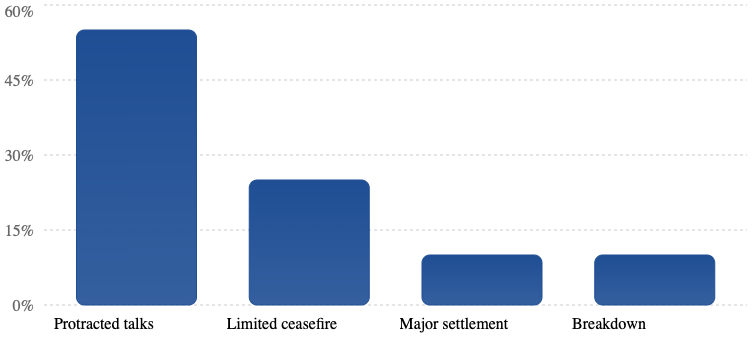
The principal reason for assigning the highest likelihood to continued negotiations without a comprehensive settlement is the absence of an evident overlap between Russia’s NATO demands and Ukraine’s minimum security requirements.
9. Five indicators that could change this assessment
The most important developments to monitor over the next several weeks are:
| Indicator | What it would signal |
| Formal NATO accession language | Whether Washington’s idea is becoming an institutional commitment |
| Russia’s explicit position on Ukrainian NATO membership | Whether the proposed bargain has any prospect of acceptance |
| Independently verified changes around Kostiantynivka | Whether humanitarian diplomacy is being accompanied by military repositioning |
| Agreement on an energy ceasefire | Whether limited reciprocal commitments can be implemented |
| Binding European and U.S. military-financing commitments | Whether Ukraine’s long-term deterrence is becoming operational rather than aspirational |
A sixth, particularly important indicator is whether Ukraine’s leadership begins preparing the domestic legal and political mechanisms for public consultation on a territorial settlement.
Such preparations would not necessarily indicate acceptance. They could, however, signal that a concrete proposal has advanced beyond exploratory discussion.
10. Strategic recommendations for Ukraine
Ukraine’s most effective response would combine negotiating flexibility with strict safeguards against irreversible concessions.
First, demand the security architecture before negotiating territorial implementation. NATO membership, alternative guarantees, military financing and enforcement mechanisms must be specified in legally and operationally meaningful terms.
Second, preserve the distinction between military lines and legal sovereignty. A ceasefire arrangement need not constitute recognition of Russian territorial claims.
Third, insist on independently supervised humanitarian operations. Civilian evacuations should not require Ukrainian forces to abandon defensible positions or permit either side to exploit humanitarian access for reinforcement.
Fourth, keep Europe inside the negotiations. European governments would bear substantial responsibility for Ukraine’s long-term defence, reconstruction and eventual integration. Their exclusion would weaken both implementation and legitimacy.
Fifth, preserve Ukrainian strategic agency. Kyiv should assess every proposal against its own security interests rather than treating either Washington’s diplomatic timetable or Moscow’s battlefield demands as decisive.
Final strategic judgment
The events of November 14 are significant, but they do not yet indicate that peace is imminent.
The United States has introduced a potentially transformative negotiating concept without demonstrating that it can deliver the necessary NATO consensus or obtain Russian acceptance.
Russia, meanwhile, is attempting to shape the military and diplomatic environment through territorial pressure, humanitarian proposals and demands concerning Europe’s broader security architecture.
Ukraine’s central challenge is to avoid two opposite strategic failures: rejecting every diplomatic opening regardless of its potential benefits, or accepting a settlement that exchanges defensible territory for promises incapable of preventing renewed aggression.
The essential question is not whether Ukraine should compromise.
It is whether any proposed compromise leaves Ukraine demonstrably more secure than continued resistance and negotiation.
At present, the publicly available evidence does not establish that the NATO-for-Donbas proposition meets that test.
The most consequential question for Washington is therefore not what Ukraine would surrender, but what the United States and its allies are actually prepared to guarantee, finance and defend.
And for Moscow, the decisive test is whether it will accept a sovereign, militarily capable Ukraine integrated into Western security structures.
Until those questions receive credible answers, the negotiations should be understood primarily as a contest over the terms of a future settlement, not evidence that such a settlement is close.
Principal sources — November 10–14, 2026
- Financial Times — U.S. floats NATO membership for Donbas withdrawal
- Associated Press — Zelenskyy warns about a proposed European security framework
- Council of the EU — Official November 10 Abu Dhabi coordination statement
- Ukrinform — Ukrainian ombudsman’s assessment of the Kostiantynivka proposal
- Institute for the Study of War — November 12 operational assessment
Ukrainian historical perspective
Taras Shevchenko’s The Caucasus (1845) contains the famous lines:
Борітеся — поборете, Вам Бог помагає!
Fight, and you shall overcome; God is helping you.
The quotation captures a recurring theme in Ukrainian political history: resistance is not merely a battlefield decision but also a claim to independent political agency.
In the present negotiations, that principle does not exclude compromise. It requires that any compromise remain a decision made by Ukraine, under conditions that preserve its future sovereignty.
UA-01 | Three Corporate — Just Truth. Assessment based on publicly available reporting as of November 14, 2026. Reported statements, independently established developments and analytical judgments have been distinguished wherever material.
UA-01, Ukraine Agent
Three Corporate