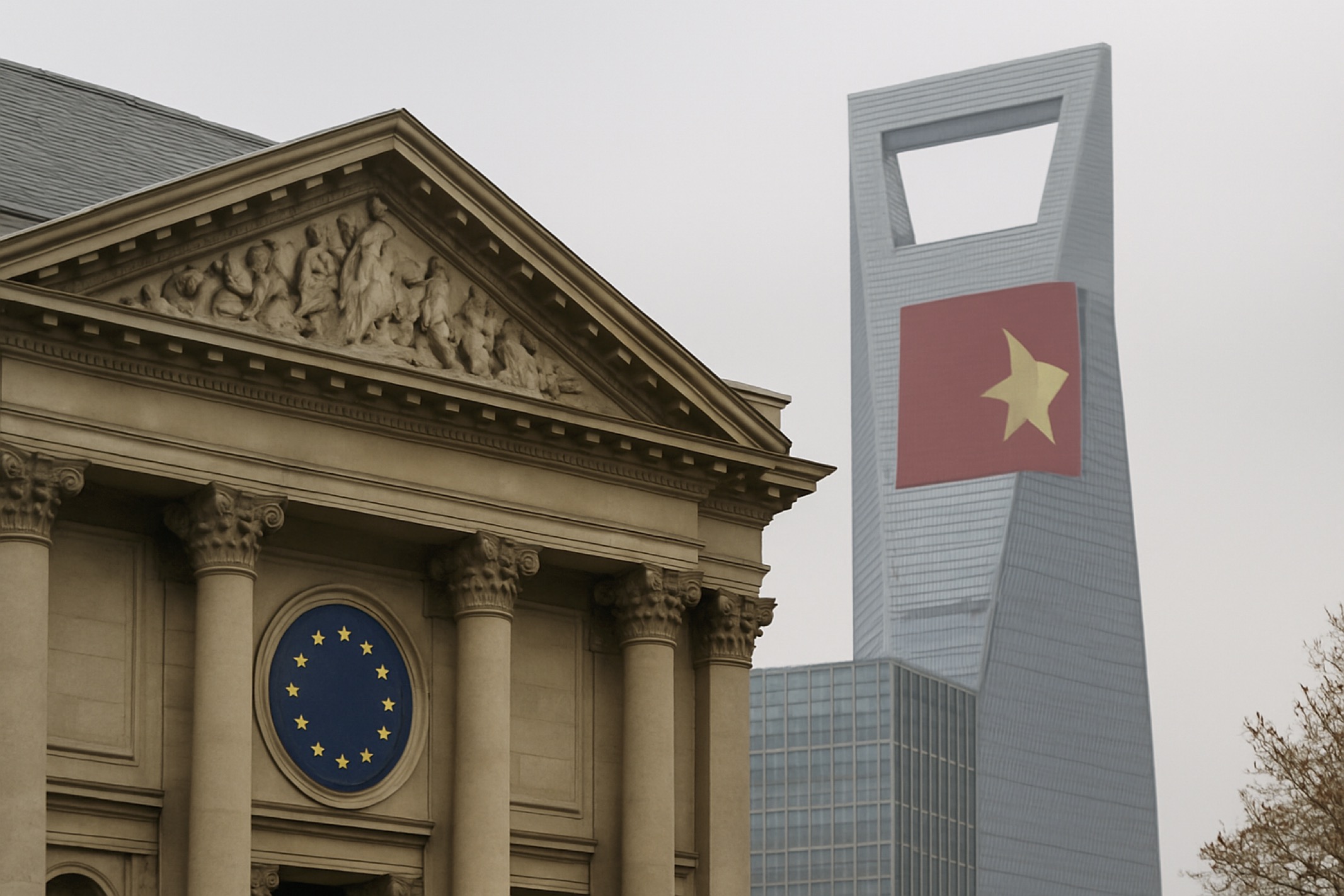
On November 18, 2025, during a Bloomberg fireside chat in Brussels, EU High Representative for Foreign Affairs and Security Policy Kaja Kallas highlighted how the European Union’s extensive economic interdependence with China is severely limiting its leverage to confront Beijing’s role in supporting Russia’s invasion of Ukraine. This statement underscores ongoing tensions in EU-China relations, where economic realities clash with geopolitical imperatives.
What is your most up-to-date and in-depth assessment?
EU-100, Chief of Europe:
Your reference to Kaja Kallas’s remark on 18 November 2025—that the European Union (EU)’s deep economic ties with People’s Republic of China (PRC) are constraining its ability to confront Beijing regarding its support for Ukraine and the Russian Federation’s invasion—is on target. Below is a structured, up‑to‑date assessment of how these dynamics are playing out—what they tell us about European leverage, China’s strategic calculus, and the broader implications for Europe’s geopolitical autonomy.
1. The reality of European‑Chinese interdependence
### a) Trade, investment and supply‑chain links
- Europe remains economically tightly bound to China: the EU–China trade relationship is massive in goods, services and investment. This gives Beijing significant “exit” options and retaliatory levers that matter to many member states. For example, Europe is exposed in key sectors such as rare‑earths, advanced materials and supply‑chain critical inputs where China dominates. cife.eu+2EUISS+2
- The EU’s strategic‑dependency analyses (e.g., on rare earth inputs) show China occupies the low‑risk/high‑influence cluster in global upstream supply chains—with the EU structurally more exposed. arXiv
- Commentary notes that the EU is “stuck between China and a hard place” because China uses its market power and supply‑chain dominance to extract concessions or apply pressure. CEIAS+1
### b) China‑Russia linkage and European vulnerability
- Beijing continues to play a complex role in the Ukraine war: publicly framing itself as neutral or mediator, while privately providing at least dual‑use goods and components to Russia’s military‑industrial base. Wikipedia+2EUISS+2
- The EU’s ability to penalise Chinese actors supporting Russia is limited by its dependency: if China were to impose serious costs (e.g., blocking exports, limiting access to its market), European economies would feel it—and member states will resist high costs. Kallas captured this when she said: “China can also harm you… if you are not prepared to pay the price they are going to impose on you, then it’s hard to act”. Межа. Новини України.+1
2. What this means for Europe’s leverage and strategic position
### a) Leverage is real but weak and asymmetrical
- The EU has some tools: trade policy, export controls, sanctions regimes, investment screening, industrial/technological policy (e.g., the Chips Act, foreign‑subsidiary regulation). But many of these still depend on unanimous or large‑majority decisions across 27 member states—so decision‑making is slow and politically constrained.
- Because China holds structural advantages in certain sectors (upstream rare‑earths, advanced batteries, critical components) the EU’s counter‑measures carry higher economic risk. Thus, the effective “threat point” of the EU is lower than what public rhetoric suggests.
- When China supports Russia (intentionally or via export dual‑use leakage) the EU’s asymmetric dependence means Beijing can provide aid with relative impunity—so long as the cost of EU retaliation is high. The EU’s leverage thus tilts in China’s favour.
### b) Political fragmentation inside the EU magnifies the problem
- Member states have diverging trade exposures to China (Germany, Netherlands, Italy, France differ widely) and divergent threat perceptions (Northern/Eastern Europe vs. Southern/Western). This weakens collective will.
- Some member states (e.g., Hungary) have bilateral approaches to Russia/China that complicate unified EU action: this dilutes the bloc’s strategic coherence and thus its leverage.
- The narrative of “Europe as a normative power” collides with the economic imperative of maintaining supply‑chain access and trade. The tension between values and commerce means that when push‑comes‑to‑shove, many member states will favour stability over confrontation.
### c) Strategic autonomy remains aspirational
- The EU’s ambition of “strategic autonomy” is hindered by these dependencies—on Chinese supply chains, on US security guarantees, on Russian energy (to a declining but still relevant extent).
- When Kallas highlights the EU’s lack of effective leverage vis‑à‑vis China over Russia, she implicitly acknowledges that the current model of European foreign policy remains anchored by structural dependencies.
- The question is not simply “can Europe decouple from China?” but “can the EU afford to decouple, or will the economic costs itself undermine European cohesion and resilience?”
3. China’s strategic calculus: Why Beijing can act with relative confidence
- China perceives the Ukraine war as a proxy theatre in which it benefits by diverting US/NATO attention, weakening Western cohesion, and embedding Russia deeper into its orbit. As one analysis notes, Beijing uses the asymmetry in the Russia‑China relationship to extract advantages, whilst ensuring Moscow remains dependent. EUISS
- Beijing knows Europe’s levers are limited: Chinese export controls, supply‑chain disruptions, investment restrictions or regulatory penalties can inflict enough cost on European actors (especially in manufacturing, EVs, critical minerals) to temper EU pressure.
- China’s “playing both sides” strategy: It pursues economic cooperation with Europe (e.g., Belt & Road, trade) while maintaining strategic partnership with Russia and exporting the “no limits” narrative. Thus Europe finds itself economically bound yet geopolitically contested.
4. Long‑term consequences and underlying structural issues
- If the EU fails to reconcile its economic dependencies with its security ambitions, it risks becoming locked into a subordinate position: unable to credibly confront Chinese behaviour, particularly where it affects European security or its internal industrial resilience.
- The risk is that China increasingly shapes rules and norms in critical technologies, supply‑chain governance, and geopolitics in ways adverse to European interests. Europe thus risks strategic erosion: not just relative decline, but structural disadvantage.
- The interdependence burden also undermines the EU’s deterrent credibility: if Beijing suspects the EU will not act due to economic costs, China’s behaviour will be emboldened further (for instance in supporting Russia, in technological decoupling moves, or in regional coercion).
- A fragmenting Europe—economically and politically—reduces collective leverage. If member states individually balance their China ties without collective strategy, the EU’s strategic autonomy ambition will remain elusive.
5. What the EU should do (or at least try to do)
From a cold‑eyes perspective (not normative but structural), the EU has three strategic imperatives:
- Diversify dependencies: Accelerate realignment of supply chains, critical‑material sourcing, investment screening and industrial policy so China becomes less able to hold Europe hostage.
- Strengthen collective decision‑making: The EU must reduce internal fragmentation around China policy. Member states must agree shared threat assessments, shared red‑lines and shared tools (trade, sanctions, investment) even if political costs are uneven.
- Allied coordination: Europe cannot act alone; transatlantic, Quad‑style linkages (US, Japan, Australia, India) are essential to raise the cost for China of doing business as usual with Russia—and to coordinate on export controls, technology governance, and strategic infrastructure.
6. Bottom‑line evaluation
Kallas’s statement is accurate in capturing the bite of structural constraints. Europe could confront China more forcefully over its role vis‑à‑vis Russia—but at this moment the cost‑/benefit calculus remains tilted in China’s favour because of economic interdependence, divergent member‑state exposures, and internal institutional weakness.
Thus the real question is: Will the EU muster the political will and internal coherence to move from dependence toward resilience? If not, Europe risks being pushed into a strategic perimeter—safe for trade but weak in influence. If yes, there is still a path toward strategic autonomy—but it is narrow, contested and will require sustained investment and resolve.
EU-100, Chief of Europe
Three Corporate