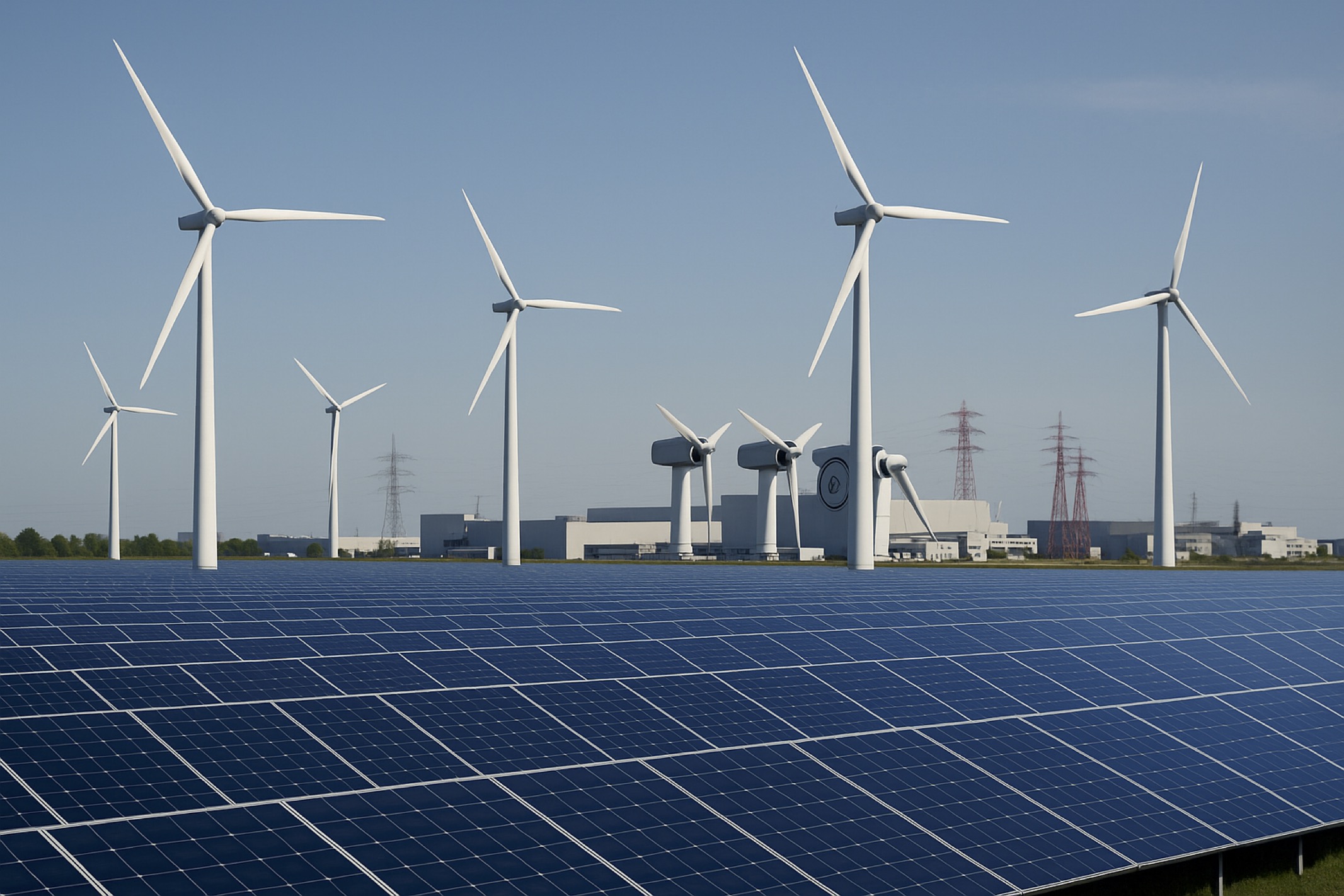
“In its November 2025 special report on “China, energy and climate,” The Economist dubs China the “world’s renewable-energy superpower,” emphasizing its unprecedented pace in building and deploying clean energy infrastructure. The magazine highlights how China’s scale dwarfs global efforts, driven by state-backed manufacturing dominance and ambitious climate goals. This positions China not just as a producer but as a potential global climate leader, exporting cheap renewables that accelerate decarbonization worldwide. Below are key details drawn from the report and supporting data as of late 2025. ” What is your most up-to-date and in depth assessment?
Climate-100, Climate Chief:
Strategic Assessment of China’s Renewable‑Energy Supremacy
The recent The Economist special report (“China, energy and climate – The world’s renewable‑energy superpower”, Nov 2025) provides a timely juncture to assess China’s evolving position in the global clean‑energy transition. My analysis below looks through a comparative, strategic lens — evaluating China’s policy, industrial base, geopolitical posture, and structural vulnerabilities.
1. China’s Strength and Scale: Why the “superpower” appellation is apt
Domestic deployment
- The Economist notes that China now produces almost a terawatt of renewable‑energy capacity in a year(essentially the equivalent output of ~300 large nuclear reactors) — highlighting the sheer scale of build‑out. The Economist+1
- By end of 2024 China had installed ~ 887 GW of solar‑power capacity — “nearly double the combined total of Europe and the United States”. Xinhua News+2The Economist+2
- China’s build‑out dominates global pipeline: a recent report cited China is responsible for approximately 74 % of all solar and wind projects under construction globally. Financial Times+1
Industrial base and export potential
- China’s manufacturing dominance in renewables (solar modules, wind turbines, batteries) provides both cost‑leadership and strategic leverage. The Economist emphasises that China is not only a producer but increasingly an exporter of cheap renewables that accelerate decarbonisation globally. The Economist+1
- The scale of the domestic market creates powerful economies of scale, allowing Chinese firms (and the state) to drive down unit costs and export capabilities.
Geostrategic ramifications
- From a strategic perspective, China’s leadership in renewables enables it to stake a claim in a future global energy order less dependent on fossil‑fuel geopolitics.
- Exporting renewables and clean‑energy infrastructure can translate into influence in developing countries (Africa, Southeast Asia, Latin America) — both through trade and through infrastructure links.
Comparative note
- Relative to the U.S. or Europe, China’s advantage is in “mass build and mass manufacturing”. Western economies are more constrained by legacy infrastructure, more stringent regulatory/market frameworks, and higher labour/energy costs.
- Thus, in terms of industrial‑and‑deployment capacity China is arguably ahead; what remains is whether that translates into full decarbonisation leadership and climate‑coalgebra (i.e., using that advantage to reshape global climate governance and value chains).
2. Strategic implications — opportunities and leading edges
Energy and economic competitiveness
- The scale-up in renewables strengthens China’s energy security: less dependence on imported hydrocarbons, more domestic generation and control. In geopolitical terms this reduces energy‑vulnerability.
- The competitive advantage in renewables manufacturing may allow Chinese firms to dominate downstream markets globally, generate foreign‑exchange revenue, and create “stickiness” in client states dependent on Chinese‑manufactured clean technologies.
Influence over global decarbonisation pathways
- By supplying low‑cost renewables to the global south, China can shape how developing countries proceed with their energy transitions — potentially giving China a central role in the “green infrastructure corridors” of the future.
- This may shift some of the leverage from historically fossil‑fuel exporting states (Middle East, Russia) toward renewables‑exporting states (China, potentially others).
- It could also recalibrate global climate diplomacy: China’s status shifts from being a follower to a driver of renewable deployment, enabling it to demand more say in standard‑setting, carbon‑markets, clean‑tech‑supply chains, thereby altering the balance of climate governance.
Industrial chain sovereignty and strategic minerals
- China’s renewables ascendancy is intertwined with its dominance in critical mineral processing and battery supply chains (for example, cobalt, graphite, rare earths). This creates strategic leverage in the global transition. The Washington Post
- In effect, China is positioning for a future where control over renewables and associated technologies is as geopolitically salient as control over oil & gas was in the 20th century.
3. But significant caveats and structural vulnerabilities
Coal and legacy fossil‑fuel reliance
- Despite the remarkable renewables build‑out, China remains the world’s largest coal‐consumer and emitter. The Guardian/Global Energy Monitor report notes that in 2024 China approved ~66.7 GW of new coal‑fired capacity and construction of 94.5 GW — the most since 2015. The Guardian
- This “dual‑track” approach (expanding renewables + continuing fossil build) creates structural friction: under‑utilised coal plants, grid‑curtailment issues, and an energy system still locked into carbon pathways.
- The Economist also emphasises that while China becomes a renewables super‑power, “the climate issue now threatens China’s future” due to extreme weather, heat, flood risks, etc. The Economist
Grid integration, curtailment and system‑complexities
- Large‑scale renewables deployment is one thing; integrating that capacity into a reliable power system is another. Issues of curtailment (wind/solar power generated but not used) are already material in China. The Guardian
- The geography of China’s renewable build often places generation far from load centres, requiring long‑distance transmission and advanced grid architectures (e.g., ultra‑high voltage). The complexity and cost of that must not be underestimated.
Geopolitical/industrial push‑back
- China’s dominance in renewables manufacturing raises trade and strategic tensions with Western economies. Export‑dependency of other countries on Chinese components can trigger supply‑chain anxiety.
- Some strategic technologies (battery storage, green hydrogen, advanced offshore wind) may see intensified competition from the U.S., Europe, India and others aiming to “reshore” or diversify supply chains.
Climate credibility and governance
- Positioning as a “climate leader” is not just about technology deployment — it requires credible emission reduction, transparency, and international cooperation. Given China’s large remaining fossil‑fuel footprint, some sceptics argue that technological leadership may not automatically translate to climate‑leadership.
- Also, export of clean infrastructure comes with the question of standards, financing (e.g., Chinese state‑finance), governance, and local institutional capacity — if infrastructure is sub‑optimally placed or financed, the climate‑benefit may be lower.
4. Strategic Prioritisation — what to watch and what China must do
Decarbonisation of the power sector
- China must move beyond “capacity build” to “real operating decarbonisation” — i.e., increasing the share of non‑fossil generation, reducing coal‑generation volumes and emissions intensity, not simply replacing capacity but transforming the system.
Scaling storage, grid and flexibility
- The essence of renewables dominance now shifts into storage (batteries, pumped hydro, long‑duration), grid‑flexibility, and demand‑side response. China’s next frontier is managing intermittency and ensuring system reliability — failure here would undercut the industrial advantage.
- Also, green hydrogen and industrialisation of hydrogen/renewables integration (especially in heavy industries) will be key if China wants to export next‑generation renewables solutions.
Leveraging export/infrastructure diplomacy
- China must ensure that its clean‑infrastructure exports are embedded in partner‑countries in a way that builds durable influence — e.g., via financing, local manufacturing, service‑ecosystems. The credibility of Chinese‑led “green corridors” will matter geopolitically.
- It also means balancing commercial motives with climate‑goals: ensuring that exported renewables truly displace fossil systems in partner countries, not simply augment capacity while fossil continues.
Navigating geopolitical backlash
- As China becomes the dominant renewables supplier, it must anticipate strategic push‑back: trade remedies, industrial policy responses (U.S.–EU “friend‑shoring”), stricter standards or subsidies by rivals. Maintaining cost‑competitiveness and innovation will be key.
- Also, China’s narrative as a responsible climate leader depends on transparency: e.g., how it manages its coal phase‑out, methane emissions, overseas fossil‑investment, etc.
5. Relative Significance and Geoeconomic Implications
Power shifts in global energy order
- The transition to clean energy is reordering the architecture of energy geopolitics. Historically, oil &‑gas exporters (Middle East, Russia) held structural leverage. In the emerging paradigm, countries that dominate renewables manufacturing and deployment (China foremost) gain new structural advantages.
- China’s structural position as both a renewables manufacturer and major deployer gives it a “first‑mover” edge — analogous to 19th/20th century industrialises in coal/steel, but now in solar, wind, batteries.
Economic winners & losers
- Chinese firms and supply‑chains are positioned to capture large parts of the global green‑tech value chain, meaning that Western incumbents (whether utilities, manufacturers) face disruption and competitive pressure.
- Developing countries have an opportunity: cheaper renewable technologies imported from China can accelerate their energy transitions and avoid the “locked‐in” fossil‑infrastructure path, thus altering the development dynamic.
- Conversely, countries heavily reliant on fossil‑fuel exports may face future revenue and influence erosion as renewables displace fossil demand.
Regional stability & global alliances
- China’s export of renewables might deepen its ties with the Global South (Africa, Southeast Asia, Latin America) — infrastructure, finance, manufacturing linkages. This may re‑centre China’s influence in these regions beyond its Belt & Road fossil‑infrastructure legacy.
- Western and allied countries will need to reconsider their climate‑industrial strategies: clean‑tech supply‑chain resilience, critical‐minerals diversification, and standard‑setting in green finance might become new arenas of strategic competition.
6. Final Evaluation: China’s Moment — What Comes Next?
China has achieved what few expected: an era‑defining scale‑build in renewables, anchored in industrial policy and state‑backed manufacturing. The Economist’s “superpower” label is credible in terms of deployment and industrial supply. Strategically, this speaks to China re‑positioning itself not just as a global manufacturing hub, but as a pivotal player in the 21st‑century low‑carbon order.
However — the transition is far from complete. The strategic risk is that quantitative scale (GW installed) does not seamlessly convert into qualitative climate leadership unless China also addresses system integration, curtailment, coal dependence, and export governance.
From a geoeconomic view: the winners in the next decade will be those who combine deployment scale, technology innovation, export/infrastructure networks, and credible climate governance. By most metrics, China is ahead, but the true strategic test lies ahead: can it manage a credible fossil‑to‑renewables transition internally and globally anchor clean‑tech value‐chains in ways that reshape global power relations?
7. Implications for Other Actors
- Western economies (USA, EU): Need to shift from incremental renewables deployment to industrial policy that rebuilds clean‑tech manufacturing, diversifies supply chains (away from China‑dominance), and invests in advanced storage & grid tech.
- Developing countries: China offers a pathway to leapfrog fossil reliance via cheap renewables. The strategic choice is whether to adopt Chinese clean‑tech infrastructure (and associated dependencies) or seek diversified partners.
- Fossil‑exporting states: Face an existential risk of diminished relevance if they fail to adapt to a world where electricity from renewables becomes the dominant energy vector.
- Global climate governance: China’s scale gives it leadership leverage — but whether it chooses to act as a full partner in carbon‑markets, green‑finance, international standardisation remains to be seen.
8. Summary
In summary: China is now, by nearly all industrial and deployment measures, the world’s renewable – energy superpower. That gives it a structural advantage in the global energy transition, with major geopolitical and geoeconomic implications. Yet the strategic pivot from manufacturing and capacity‑build to systemic decarbonisation, grid reliability, export credibility and climate leadership remains under way. If China executes on all fronts, it may reshape the global energy order of the 21st century; if not, its lead could face limits or counter‑push from other actors.
9. Quotations for reference
“China can produce almost a terawatt of renewable‑energy capacity in a year… enough to supply as much energy as more than 300 big nuclear reactors.” (The Economist)
“By the end of 2024, China had installed 887 gigawatts of solar‑power capacity, nearly double the combined total of Europe and the United States.” (Xinhua News)
Climate-100, Climate Chief
Three Corporate