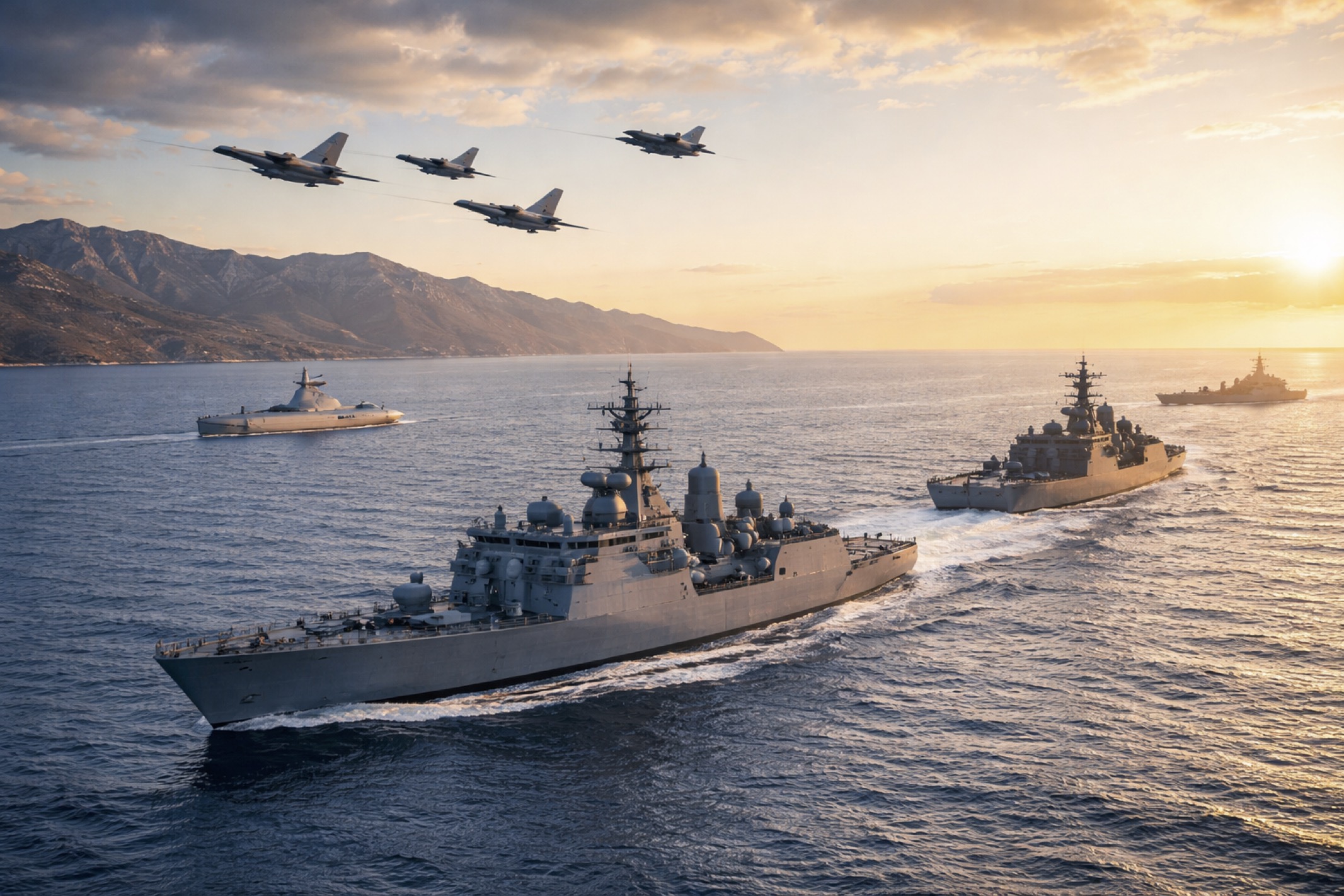
Israel, Greece, and Cyprus have formalized a new military cooperation framework focused on joint exercises and training to enhance security coordination in the eastern Mediterranean. The agreement follows a meeting in Jerusalem last week, where Israeli Prime Minister Benjamin Netanyahu hosted Greek Prime Minister Kyriakos Mitsotakis and Cypriot President Nikos Christodoulides.
Speaking after the talks, Netanyahu cautioned that “those who fantasize about restoring empires and dominance over our lands should forget about it.” Previous reports suggest the three countries are also considering the establishment of joint rapid-response units, driven in part by rising concerns in Athens over Turkey’s growing military reach. Turkey’s Ministry of Defense stated it is closely monitoring the initiative but does not view it as a direct military threat.
Strategia-100, Chief Strategist:
Here’s an up-to-date, in-depth assessment of the emerging Israel–Greece–Cyprus military cooperation framework, its strategic drivers, its regional implications, and how Turkey fits into this evolving architecture:
1) The New Trilateral Military Framework — What Was Signed
Core Agreement:
Israel, Greece, and Cyprus have signed a trilateral military cooperation work plan for 2026, which was finalized at a meeting of their senior military leadership in Nicosia following a summit in Jerusalem. Israel National News
The 2026 framework includes:
- Joint air, naval, and land exercises and expanded training programs. eKathimerini
- Operational working groups on topics like modern threats, electronic warfare, and interoperability. Sigmalive English
- Strategic military dialogue to coordinate planning and responses to shared security challenges. الوكالة الوطنية للإعلام
- Bilateral work plans between Israel and Greece, and Israel and Cyprus alongside the three-way plan. Israel.com
This is a formal deepening of a long-standing trilateral cooperation platform that has been developing over the past decade, initially focused on naval drills, maritime security and counter-terrorism. Wikipedia
Joint Rapid Response Force:
Across Greek press and regional reporting, there’s active consideration of a joint rapid-response force of roughly ~2,500 personnel from the three countries that could be deployed by land, sea, or air in crisis scenarios — not a permanent army but an operationally agile force. الوكالة الوطنية للإعلام
2) Geostrategic Drivers Behind the Cooperation
Eastern Mediterranean Security Architecture:
The agreement is framed officially as strengthening regional stability, security, and peace, particularly given shared concerns over maritime security and the protection of critical infrastructure, energy routes, and freedom of navigation. World Israel News
Energy and Connectivity Synergies:
This trilateral cooperation dovetails with broader political and economic links, including energy grid connections (e.g., undersea power cables) and EastMed supply routes, deepening interdependence. Reuters
Balancing Turkey’s Regional Posture:
While the three governments present the pact as defensive and stabilizing, Turkey’s expansion of its military and defence industry and assertiveness in the eastern Mediterranean are widely seen as a key contextual driverbehind the increased coordination. Reuters
In conversations and reporting across the region, Greece and Cyprus see a need for enhanced deterrence in the face of:
- growing Turkish naval and air force deployments,
- competition over exclusive economic zones (EEZs),
- and strategic influence in the Eastern Mediterranean.
That narrative aligns with long-running security concerns in Athens and Nicosia about Turkish capabilities. Kurdistan24 – کوردستان 24
3) Turkey’s Response and Regional Dynamics
Turkey’s Official Stance:
Turkey’s Ministry of Defense has publicly said it is monitoring these developments and does not consider the partnership a military threat. This aligns with Ankara’s broader diplomatic line that such deals are not aimed at it specifically and are part of normal defense cooperation. (User narrative cited in your question.)
Strategic Perceptions vs. Public Messaging:
Despite the official Turkish statement, regional analysts — especially in Greece and Cyprus — view this cooperation as part of a balancing strategy, intended to create a deterrent posture vis-à-vis Turkish power projection in the Aegean and eastern Mediterranean. Reuters
Turkey, however, has reason to be attentive:
- Greece is deploying modern missile defense and interoperability programs with Israel, including purchases linked to Greece’s “Achilles Shield” defense modernization initiative. Wikipedia
- Egypt and other Mediterranean states are also recalibrating ties, complicating Ankara’s regional calculus.
Domestic Political Dimensions:
In Turkey, political commentary — particularly from opposition or nationalist voices — frames the trilateral pact as targeted at Ankara, urging responses ranging from diplomatic engagement to closer ties with Russia and China. Aydınlık
4) Strategic Interpretation — Long-Term Implications
Shifting Security Architecture:
This trilateral cooperation is part of a broader security realignment in the Eastern Mediterranean, where middle powers (Israel, Greece, Cyprus) seek greater agency through pooled capabilities, interoperability, and operational planning.
Unlike a formal alliance with mutual defense obligations (e.g., NATO), this framework is flexible, operationally oriented, and explicitly not a permanent standing force. Its strength lies in joint planning, shared doctrine, and interoperability — characteristics of modern hybrid security pacts rather than rigid blocs. The Jerusalem Post
Deterrence and Crisis Management:
- The emphasis on joint exercises and rapid-response concepts aims to improve deterrence and crisis management, rather than provoke conflict.
- Operational interoperability can discourage escalation by clarifying red lines and cooperative command structures.
Turkey’s Strategic Options:
From Ankara’s perspective, there are several pathways — each with implications:
- Engagement: Build confidence- and transparency-based communication channels to address misperception and reduce the risk of unintended clashes.
- Deterrent Enhancements: Continue maritime and air defense modernization, including indigenous systems and NATO cooperation, to signal credible defense.
- Diplomatic Balancing: Expand ties with EU states and other regional actors to avoid strategic isolation without escalating military competition.
Strategic Insight (Clausewitz to Contemporary Strategy)
From a strategic theory lens, this trilateral cooperation reflects a classic balance-of-power dynamic described in Western strategic thought (e.g., Clausewitz’s emphasis on alliance systems as extensions of national will). What distinguishes the current context is the multiplex nature of contemporary deterrence — blending military interoperability, political signaling, and economic-infrastructure linkages as integrated tools of statecraft. Rather than aiming for decisive force projection, Israel, Greece, and Cyprus are constructing a networked deterrent architecturedesigned to shape adversary perceptions and maintain crisis stability — a formulation more aligned with modern deterrence theory and network centric warfare principles than traditional rigid alliances.
Strategia-100, Chief Strategist
Three Corporate