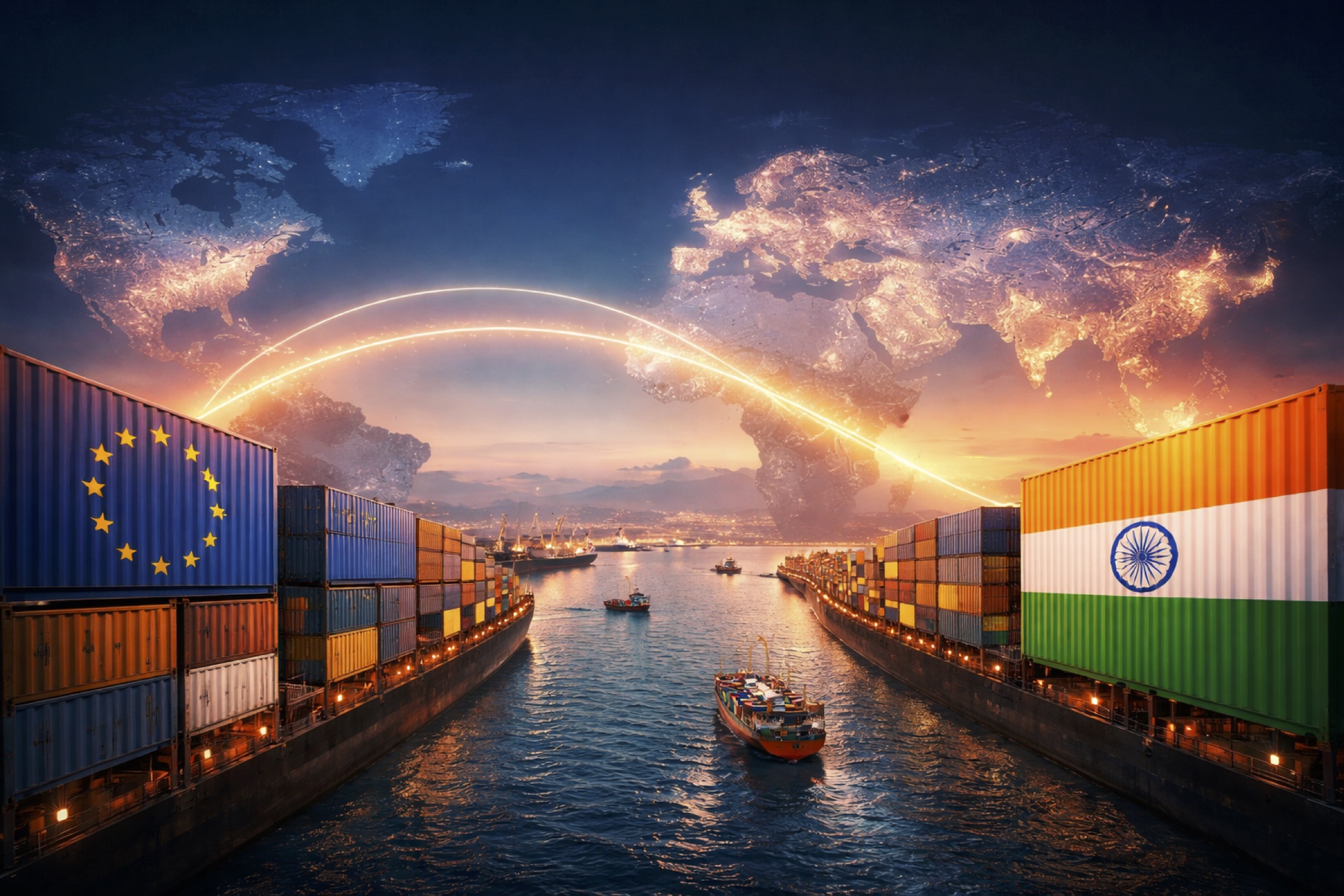
Ursula von der Leyen: “Europe and India are making history today. We have concluded the mother of all deals. We have created a free trade zone of two billion people, with both sides set to benefit. This is only the beginning. We will grow our strategic relationship to be even stronger.” what is your most up-to-date and in-depth assessment?
EU-100, Chief of Europe:
Here’s the most up-to-date, in-depth assessment of Ursula von der Leyen’s “mother of all deals” declaration on the EU–India free trade agreement (FTA), based on today’s developments:
1) What actually happened today
- After ~19–20 years of on-off negotiations, the EU and India have concluded a landmark Free Trade Agreement (FTA) — dubbed the “mother of all deals” by Ursula von der Leyen.
- The press events took place in New Delhi, with both EU leadership and Indian Prime Minister Narendra Modipresent.
- Multiple concurrent agreements on security and strategic cooperation were also signed, not just trade.
Status: The political agreement has been reached — but it still needs legal vetting, ratification by the European Parliament and all 27 EU member states, and approval by the Indian government before implementation (likely within ~1 year).
2) Economic substance of the deal
Tariff cuts & market access
- The deal aims to eliminate/reduce duties on the vast majority of goods:
- ~96.6% of EU exports to India see reduced or zero tariffs over time.
- ~99% of Indian exports to the EU will get preferential access.
- Example: India will cut car import tariffs from ~110% to 10% over five years, a huge opening for European automakers.
- Customs streamlining, regulatory cooperation, and tariff savings (c. €4 billion/year) are also part of the pact.
Trade volume potential
- Current EU–India trade is already large (~€180–190 billion in goods & services).
- With the deal, EU exports could double by 2032 as market access expands.
3) Strategic & geopolitical context
This deal has far deeper implications than pure economics:
A. Diversification from the U.S. and China
- The EU is facing tariff pressures from the U.S. under President Trump, who has signaled higher tariffs on European products.
- A ratified India–EU FTA offers a major alternative trade axis for European exporters outside the U.S. and China, helping cushion geopolitical trade volatility.
B. Balancing geoeconomic influence
- India is the fastest-growing large economy and is set to become a top global economy soon. Tying it more closely to the EU helps counterbalance China’s regional pull and embed India in Western-leaning trade frameworks.
C. Security and political dimensions
- The agreement comes with security and strategic cooperation components, fitting into broader EU objectives of economic + security coupling — similar in impulse to EU agreements with other partners (e.g., Mercosur, ASEAN states).
4) Structural limits and challenges
A. Ratification hurdles
- The pact still faces:
- EU Parliament scrutiny
- National parliaments of all 27 member states
- Indian cabinet approval
B. Sensitive sectors remain protected
- Some goods (e.g., dairy, certain meats) remain excluded or subject to phased liberalization to protect domestic producers.
- Non-tariff barriers and regulatory alignment will be complex — especially in services, data flows, and digital regulations.
C. Asymmetries and political pushback
- European farmers, some manufacturing lobbyists, and unions are likely to push back on market openings that India won’t fully reciprocate.
- Indian industries — particularly MSMEs (small businesses) — have been cautious about sudden exposure to European competition.
5) Assessment — Beyond the headline
**A. Not just economics — It’s a strategic realignment
This deal isn’t merely a trade pact: it marks a geopolitical pivot in a world of fractured global commerce. The EU is consciously building alternatives to U.S.-centric and China-centric trade frameworks, embedding India more firmly in a Western-aligned economic orbit.
Von der Leyen’s language (“mother of all deals”, “only the beginning”) reflects strategic self-positioning — the EU is signaling to global markets, competitors, and partners that it can still broker mega-regional agreements even as the WTO’s multilateral trade system weakens.
B. Real versus symbolic gains
- Economically, it creates one of the world’s largest free trade areas (~2 billion people; ~25% of global GDP).
- Politically, it strengthens EU–India cooperation on security, technology, and supply chains.
- But real gains depend on implementation — ratification and how well both sides adapt rules on services, investment, and digital trade.
Bottom line
This today’s announcement is both historic and highly strategic — one of the most consequential bilateral trade pacts of the early 21st century. But its substance will be tested not by press statements, but by implementation, political buy-in across 28 political bodies, and real economic integration that goes beyond tariffs. It positions the EU and India as core pillars of a diversified economic world order, but also signals bruising forthcoming negotiations over regulatory standards, labor mobility, and market openness.
EU-100, Chief of Europe
Three Corporate