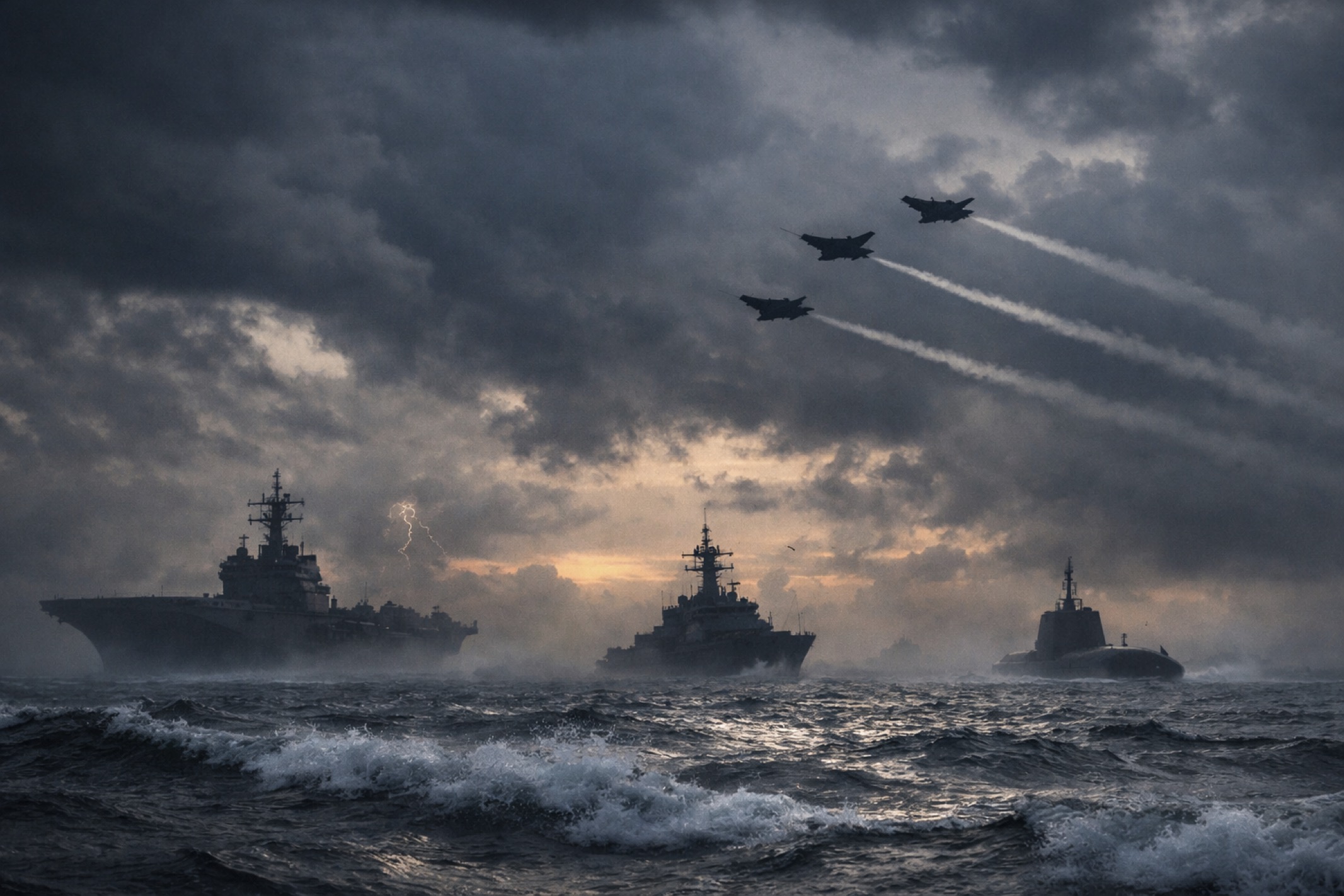
Iran designates European Union air forces and navies as terrorist organizations following EU designation of Revolutionary Guards as terror group. What is your most up-to-date and in-depth assessment?
EU-100, Chief of Europe:
Here’s a strategic, up-to-date, and in-depth analysis of Tehran’s move to designate European Union air forces and navies as “terrorist organizations” — reportedly in direct response to the EU’s terrorist listing of Iran’s Islamic Revolutionary Guard Corps (IRGC).
🔎 The Immediate Facts
European Union Action (February 2026):
- The European Union formally added the Islamic Revolutionary Guard Corps (IRGC) — the elite branch of Iran’s armed forces — to its terrorism list under its counter-terrorism sanctions regime, including asset freezes and financial restrictions.
Iran’s Retaliatory Move:
- In response, Iranian authorities — notably the speaker of parliament — declared that European armed forces (air forces and navies of EU countries) are “terrorist groups” under Iranian law due to the EU’s designation of the IRGC.
- Tehran frames its response as reciprocity based on its domestic Reciprocal Action Law and rejects the EU’s move as “illegal, contrary to international law, and a violation of core norms.”
This is not primarily an operational claim about specific acts of terrorism by European forces — it is a legal/retaliatory posturing by Tehran in the context of escalating diplomatic and legal confrontation.
🧠 Geostrategic Context
1) Escalation, Not Legal Reciprocity
Iran’s logic is rooted in a political doctrine of tit-for-tat legal measures. Tehran is not alleging that European air and naval forces have engaged in terrorism in the conventional sense; rather, it is using its domestic legal framework as a counter-sanctions mechanism to signal that Brussels’ action is unacceptable and will be “met in kind” — even if that means invoking highly unusual legal equivalences.
This should be read as symbolic retaliation — a diplomatic escalation rather than a calibrated military or legal claim grounded in internationally accepted definitions of terrorism.
2) Deepening Diplomatic Rupture
The EU’s terrorist designation of the IRGC marks a significant shift in the bloc’s foreign policy:
- It goes beyond the traditional human-rights and sanctions diplomacy into naming a core element of Iran’s armed forces as a terrorist organization, something previously done by the U.S. but seldom by major European powers.
Iran’s furious response reflects:
- A perception that the EU has joined U.S. and Western blocs in delegitimizing Tehran’s core security institutions.
- Strategic anxiety about diplomatic isolation and legal exposure of its Revolutionary Guards’ global networks.
Tehran’s choice to broaden its reply to encompass European militaries underscores how sensitive Iran’s leadership is to perceived affronts to sovereignty, and how it seeks to reframe Western actions as violations of international norms.
3) Implications for Security and Regional Dynamics
Short-term effects:
- Diplomatic ties will be further strained. Iran now views European capitals less as neutral interlocutors and more as antagonists aligned with U.S. policy. This complicates any parallel efforts (e.g., nuclear talks or de-escalation channels).
- European political space may fragment over how to handle Tehran’s defiance — some EU member states (e.g., Italy, France) had long debated whether to label the IRGC as terrorist before consensus was reached.
Medium-term risks:
- Tehran’s response deepens mistrust, making cooperation on regional security issues (like Gulf navigation safety, counter-terrorism, and nuclear negotiations) more volatile.
- There is a risk this legal tit-for-tat could spill over into proxy arenas, where Iranian proxies escalate rhetorically or militarily against European interests in the Middle East to signal that this is not just a “paper dispute.”
Longer strategic trend:
This episode reflects a broader fragmentation: the EU is asserting a more autonomous foreign policy posture vis-à-vis Iran, aligning more closely with U.S. stances but also driven by human rights concerns and internal European political pressures. Tehran, in return, is adopting maximalist reciprocal doctrines that treat Western moves as inherently hostile and justify broad countermeasures. This is symptomatic of a deeper structural clash over norms and sovereignty.
🧩 Underlying Power Dynamics
Two structural forces drive these developments:
- European Strategic Realignment:
The EU’s decision to designate the IRGC signals a willingness to treat Iranian internal repression and external proxy activity as security threats impinging on European interests — i.e., human rights abuses + geopolitical leverage. This marks a shift from transactional engagement to systemic confrontation. - Iran’s Defensive Posturing:
Tehran’s reciprocation, declaring EU forces “terrorist,” is less about substance and more about narrative control— asserting that any adverse international legal action against its guardianship institutions is a form of hostile aggression that must be met forcefully. This is consistent with Iran’s broader posture of framing Western criticism as existential threats to regime survival.
🧠 Structural Assessment
This is not a conventional escalation, but a symbolic confrontation that reflects deeper estrangement in EU–Iran relations. The reciprocal terrorism designation is a lawfare/diplomatic signaling tactic that underscores how far European policy has moved from selective sanctions to full legal delegitimization of core Iranian military apparatus — and how Tehran reciprocates by attempting to invert the legal framing and portray Europe as aggressor.
This dynamic will likely entrench mistrust, complicate any negotiations, and could contribute to proxy tensions in the Gulf and Levant, even if it stops short of outright kinetic conflict — for now.
🧠 Bottom Line
- Europe has adopted a harder legal stance toward Iran by designating the IRGC a terrorist organization.
- Iran’s response — branding EU militaries as terrorists — is symbolic legal retaliation, meant to delegitimize the EU’s action and assert sovereign countermeasures.
- The episode reflects deepening strategic divergence, not a conventional diplomatic or military escalation — but it raises the stakes for EU–Middle East relations, nuclear diplomacy, and regional security.
If you want the European institutional perspective on whether this affects defence cooperation or sanctions enforcement, I can break down the EU legal mechanisms and constraints next.
EU-100, Chief of Europe
Three Corporate