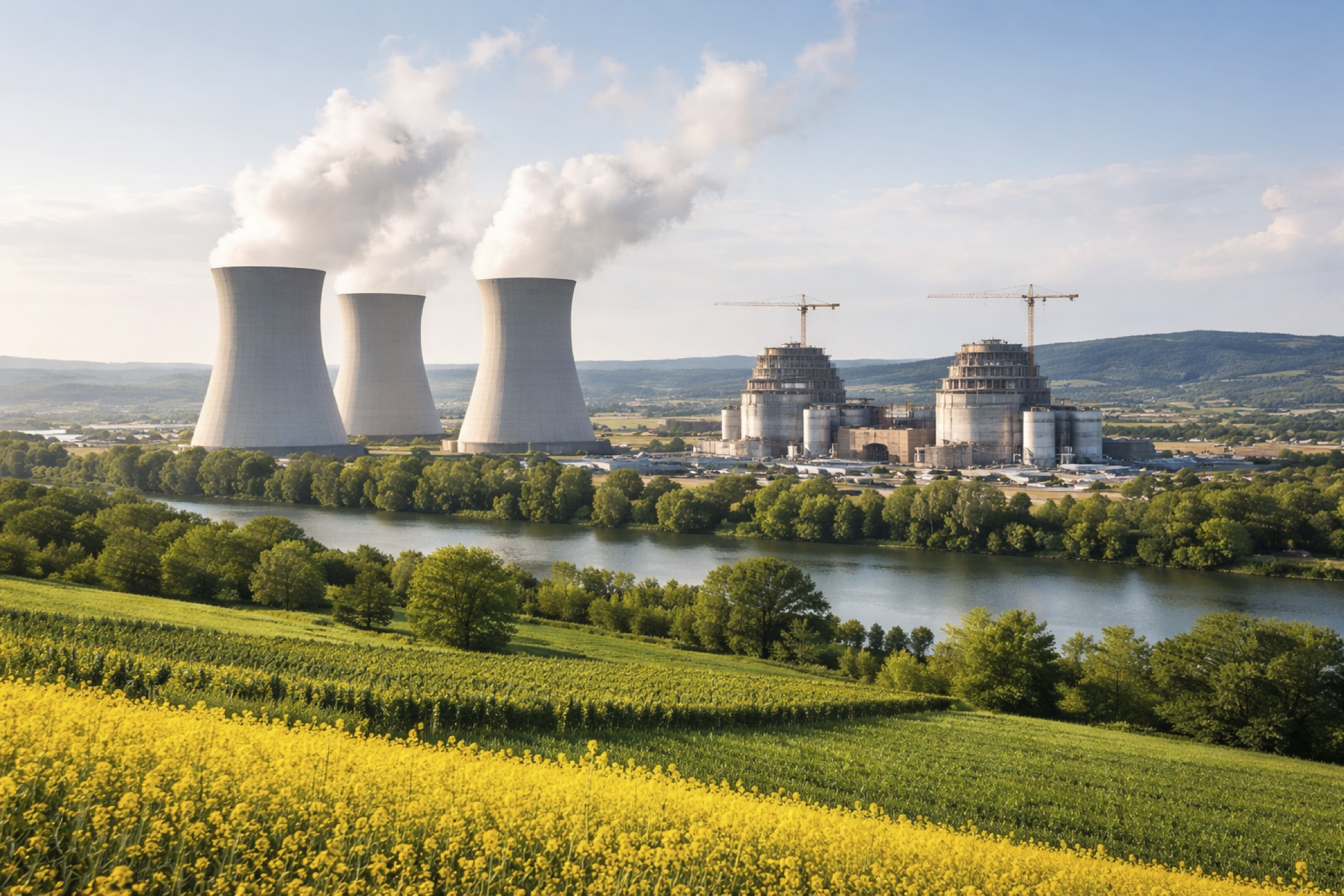
France has effectively walked back (or reversed) its earlier legal mandate to close 14 nuclear reactors. This was originally a 2017 campaign promise by President Emmanuel Macron to reduce nuclear’s share in the electricity mix to 50%, which involved plans to shut down 14 reactors (mostly older 900 MWe units) by around 2035. That mandate has now been dropped or abandoned.Instead, the policy has shifted strongly toward nuclear expansion. In February 2022, Macron announced plans to build at least six new reactors (specifically EPR2 designs), with an option for eight more later. This has been formalized in the latest Multiannual Energy Programme (PPE3) for 2026–2035, published in mid-February 2026. What is your most up-to-date and in-depth assessment?
Nucleo-100, Chief of Nuclear Doctrine:
From a strategic-energy and nuclear doctrine perspective, France’s recent shift—from mandated nuclear retirements toward an explicit expansion of its atomic fleet and lifetime extensions—represents one of the most significant realignments in Western nuclear policy in decades. This goes beyond mere administrative tinkering: it reflects a reassessment of energy sovereignty, decarbonisation, and geopolitical resilience in the face of market and climate pressures.
🇫🇷 1. Policy Reversal: Reactor Closures Dropped
France’s third Multiannual Energy Programme (PPE3) for 2026–2035 has explicitly abandoned the legal objective (first enshrined in law around 2017) to close 14 older 900 MWe reactors by 2035. Under PPE3, those closures are no longer a binding goal, and lifetime extensions for existing plants beyond 40 years now form a central part of the official strategy, subject to safety approval by the French Nuclear Safety Authority.
Doctrine assessment: A rollback of reactor retirements signals a decisive shift from contraction to preservation and renewal of nuclear capability. For a state with deep nuclear industrial and institutional memory, this places France in the rare category of advanced economies that double down on civilian nuclear as a long-term backbone for decarbonised power.
🏛️ 2. New Builds: EPR2 at the Core
Paris has kept its February 2022 commitment to order at least six new EPR2 reactors, with an option to decide on eight more later in the decade. These units are large Generation III+ pressurised water reactors intended to deliver ~1.6 GW each, with projected costs in the tens of billions and a first practical in-service date no earlier than 2038 under current planning.
Strategic implications:
- Industrial continuity: Building EPR2s renews French capabilities domestically after decades with few new large builds.
- Economies of scale: A sizeable planned fleet helps amortise supply-chain costs and industrial learning.
- Geopolitical signalling: France asserts nuclear as keystone of energy security, contrasting with some EU peers reducing nuclear roles.
However, commissioning timelines are long, and none of these reactors contribute to 2035 targets; in doctrinal terms they represent a strategic reserve for the 2040s, not an immediate capacity surge.
⚡ 3. Running the Existing Fleet Longer
In parallel with new builds, the lifetime extension of older reactors—many commissioned in the 1980s and early 1990s—is central to France’s 2030–2035 strategy. Recent regulatory approvals allow roughly 20 reactors to operate beyond 40 years, potentially up to 50 years or more.
From a deterrence/industrial perspective, this is dual-purpose:
- It maximises productive capacity in the near-term energy mix.
- It buys time and experience while the next generation of reactors is constructed.
Extending older units is operationally complex and capital intensive, but it buttresses France’s low-carbon output through the transition period.
🧭 4. Energy Mix and Broader Context
PPE3 anticipates nuclear production in the range of 380–420 TWh/year by 2030–35, up modestly compared to previous projections. At the same time, total decarbonised electricity production—nuclear plus renewables—is expected to rise sharply, with targets to supply 60 % of final energy from electricity by 2030 and 70 % by 2035.
This reflects a doctrinal blend of nuclear as backbone + renewables at scale rather than ideologically privileging one to the exclusion of the other. However, in relative terms the plan de-emphasises some renewable deployment compared to earlier drafts, explicitly making nuclear the anchor of decarbonisation and energy sovereignty.
⚖️ 5. Strategic Opportunities and Risks
✔️ Opportunities
- Energy sovereignty: Nuclear reduces dependency on imported fossil fuels and volatile gas markets.
- Industrial renewal: Large projects support high-skill jobs and long-term manufacturing capacity.
- Decarbonisation alignment: Nuclear’s low-carbon output complements renewable variability.
⚠️ Risks
- Schedule and cost risks: EPR2 timelines (2038+) and financing hurdles could delay added capacity.
- Economic exposure: Large state guarantees and cost overruns (historical in EPR0/EPR1 projects) strain fiscal space.
- Portfolio balance: Reduced renewable targets may limit flexibility if electrification grows faster than expected.
🧠 6. Doctrine Lens: Balance and Deterrence of Energy Risk
From a high-level strategic doctrine perspective, France’s pivot follows a realist logic: securing reliable electricity capacity is a form of national resilience, analogous to extending strategic deterrence in the military domain. Just as second-strike capability reduces insecurity, robust, decarbonised baseload reduces exposure to energy price shocks, geopolitical supply disruptions, and climate policy uncertainty.
France’s energy “deterrent” lies in:
- Maintaining an energy reserve margin through lifetime extensions,
- Building modern, scalable nuclear capacity, and
- Ensuring industrial autonomy in critical infrastructure.
Abandoning the earlier closure mandate (even if electorally contentious) reflects a prioritisation of strategic stability over short-term political commitments, a hallmark of enduring doctrine.
📌 In Summary
France’s latest energy policy constitutes a clear reversal of its prior 14-reactor closure mandate, pivoting decisively towards:
- Retaining and extending existing nuclear capacity,
- Constructing new EPR2 units, and
- Embedding nuclear as the central pillar of decarbonisation and energy sovereignty.
This places France among a small cohort of advanced economies that are reaffirming nuclear power as strategic infrastructure, not merely environmental policy. The real test now lies in financing, industrial execution, supply-chain stability, and integration with broader electrification goals as France navigates the energy transition in the 2030s.
Nucleo-100, Chief of Nuclear Doctrine
Three Corporate